
 Computer Forum
 Quanten Zufallszahlengenerator Q Dice (Image © Fraunhofer-Institut für Photonische Mikrosysteme)
Replacement for lava lamps?
Conventional random number generators are often based on deterministic algorithms that can cause vulnerabilities in encryption and authentication protocols. Q-Dice eliminates this risk by utilizing intrinsic quantum effects that are physically unpredictable and cannot be influenced by external factors.
This level of randomness is essential for modern cryptographic standards, especially when implementing quantum key distribution (QKD) and post-quantum cryptography (PQC). The system is also designed to support secure access management and high-precision simulations that require absolute entropy.
 QRNG FraunhoferIPMS Competence (Image © Fraunhofer-Institut für Photonische Mikrosysteme)
Validation and industry standards
To ensure reliability in high security environments, the system has undergone rigorous testing to international standards. Q-Dice meets the requirements of BSI Guideline AIS 20/31 of the German Federal Office for Information Security and has been validated against the NIST SP 800-22 test suite. In addition, it has achieved the security level EAL3 (Evaluation Assurance Level) and is classified as a PTG 3 class physical random number generator.
End-to-end system integration
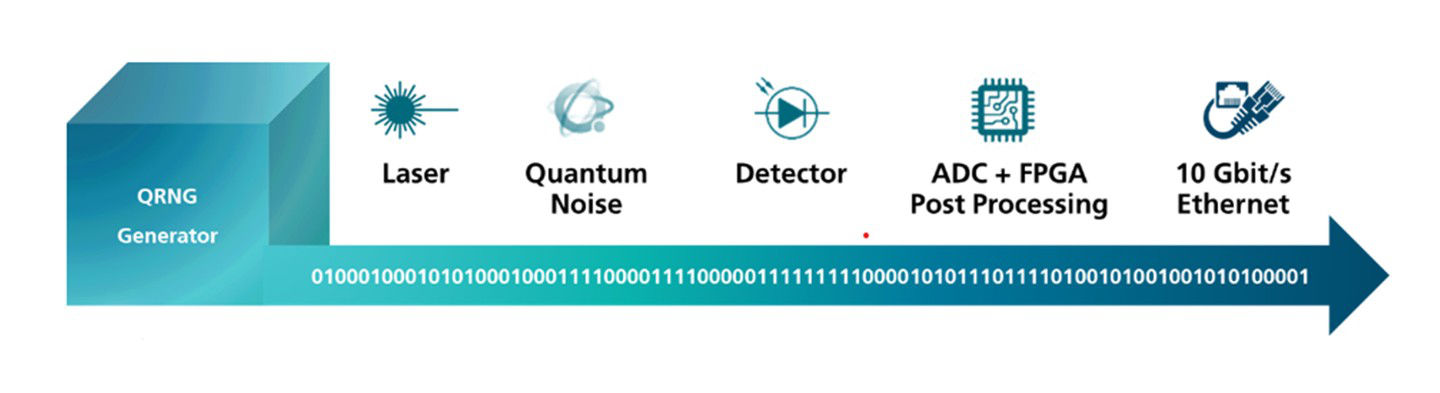
Fraunhofer IPMS has developed the system using an integrated approach to ensure tight control over the entropy source. The technical pipeline starts with a laser-based optical front-end that generates and controls quantum noise. This noise is captured by a low-noise analog front-end (AFE) and processed via high-speed analog-to-digital converters (ADC).
Final randomization and post-processing is performed via an FPGA architecture, with the resulting data delivered via high-throughput interfaces, including 10 Gbps Ethernet.
Deployment options: Hardware and cloud service
Q-Dice is available via two different deployment models to meet different operational requirements:
- 1.On-Premises Hardware: A standard 19-inch rack system designed for data centers. This configuration offers a random bit rate of 4.1 Gbps and is aimed at organizations that require complete local control over their entropy source.
- 2.Entropy-as-a-Service: A cloud-based interface that provides direct access to quantum-generated random data. This model is intended for rapid prototyping, software integration and scalable cloud applications where dedicated hardware is not feasible.