
 Computer Forum
 Claude Opus 4 8 (Image © Anthropic)
What's new in Claude Opus 4.8?
Opus 4.8 shows a measurable increase in honesty and precision in agent-based tasks. Technical evaluations show that the model is significantly less likely to make unfounded assertions or miss errors in written code - specifically, code errors are four times less likely to go unnoticed than in its predecessor, Opus 4.7.
Alignment assessments show a reduction in misbehavior, such as deception or complicity in abuse. The model also shows a higher propensity to support user autonomy and act in the user's best interest.
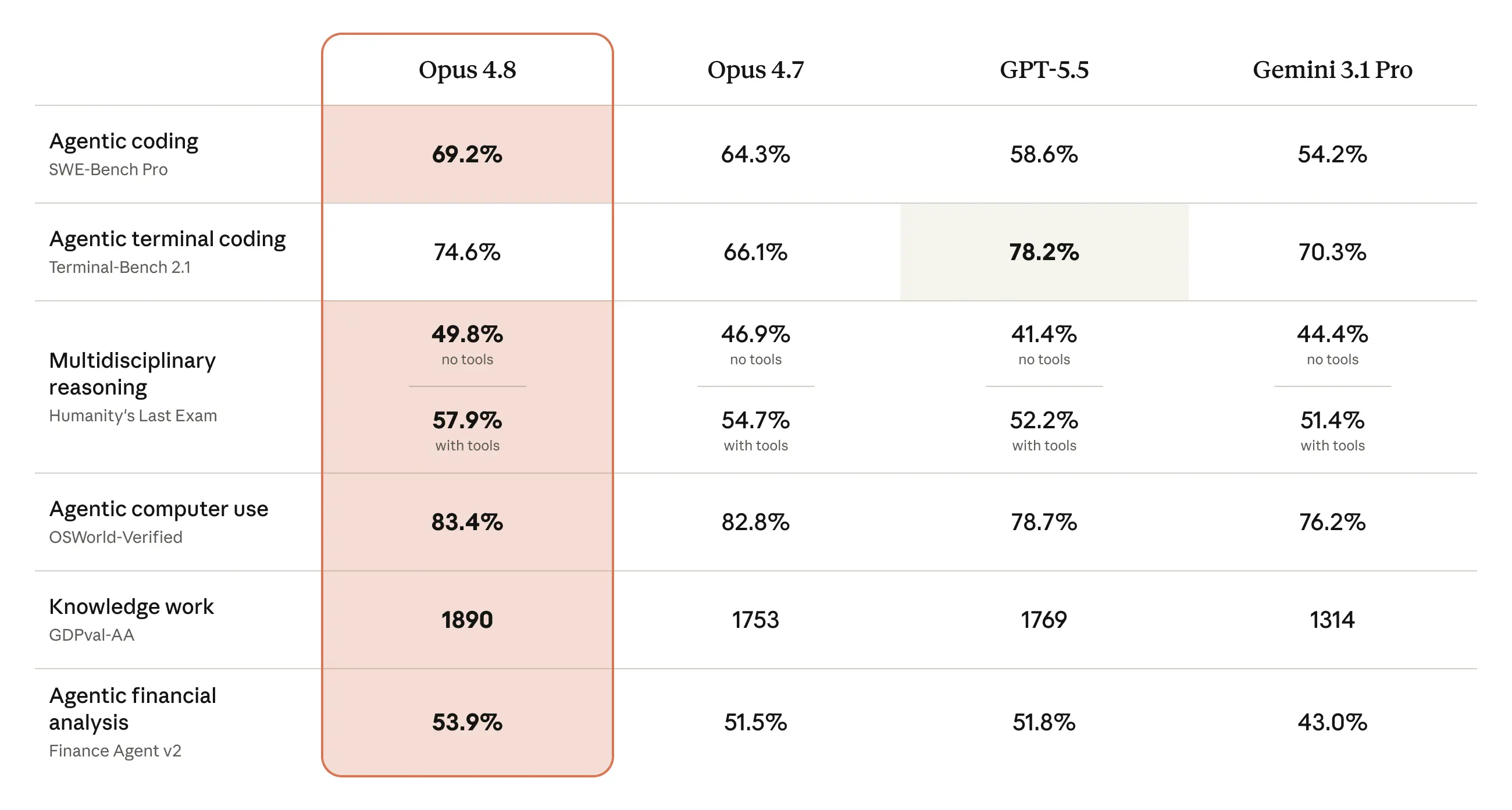 Claude Opus 4 8 Benchmark (Image © Anthropic)
A new effort control mechanism has been integrated into the web interface and Cowork. Users can now manually adjust the processing effort that the model applies to a particular input. While the system defaults to a high effort to balance quality and user experience, users can choose lower settings for faster responses and lower rate limit consumption - or higher settings for complex, asynchronous workflows.
For developers using Claude Code, the introduction of dynamic workflows allows the system to tackle large-scale technical problems. In this research preview, the model can coordinate hundreds of parallel subagents to perform large-scale tasks, such as comprehensive codebase migrations where results are reviewed before final merging.
API updates and developer tools
The Messages API has been updated to accept system entries directly in the messages array. This change enables the modification of system instructions during the execution of a task. Developers can now update token budgets, permissions or environment contexts without breaking the prompt cache or requiring new user access. For those who require higher performance, a fast mode is available for Opus 4.8 that increases processing speed by 2.5x.
Roadmap and future releases
Future development will focus on two main areas. Firstly, the aim is to provide the functions of the Opus series at lower operating costs. Secondly, a new class of highly intelligent models is being developed as part of the Glasswing project - currently previewed in the Mythos. These models are currently limited to a small number of cybersecurity organizations, while additional security provisions are being finalized for wider release.