 Computer Forum
 AMD ROCm 10 0 Release (Image © AMD)
The ROCm 10.0 Core SDK is based entirely on TheRock, an automated open-source build and release system. This pipeline ensures that primitives, libraries, and framework wheels are validated across the entire stack before distribution. The platform offers a unified source code tree that supports Instinct accelerators, Radeon graphics cards, and integrated Ryzen graphics on both Linux and Windows operating systems.
To simplify software procurement, AMD has consolidated the distribution of its GPU software into a single repository at repo.amd.com. This redesign integrates ROCm packages, the amdgpu driver, and public GPU tools into a single location with a unified structure, allowing teams to manage multiple versions and architectures in parallel.
 AMD ROCm 10 0 Release Skills (Image © AMD)
ROCm.AI Developer Experience
A key feature of this release is ROCm.AI, an AI-native development environment designed to reduce manual configuration. This ecosystem consists of three main components:
-
ROCm CLI: A unified command-line interface for installing, updating, and troubleshooting AI workloads. It includes features such as
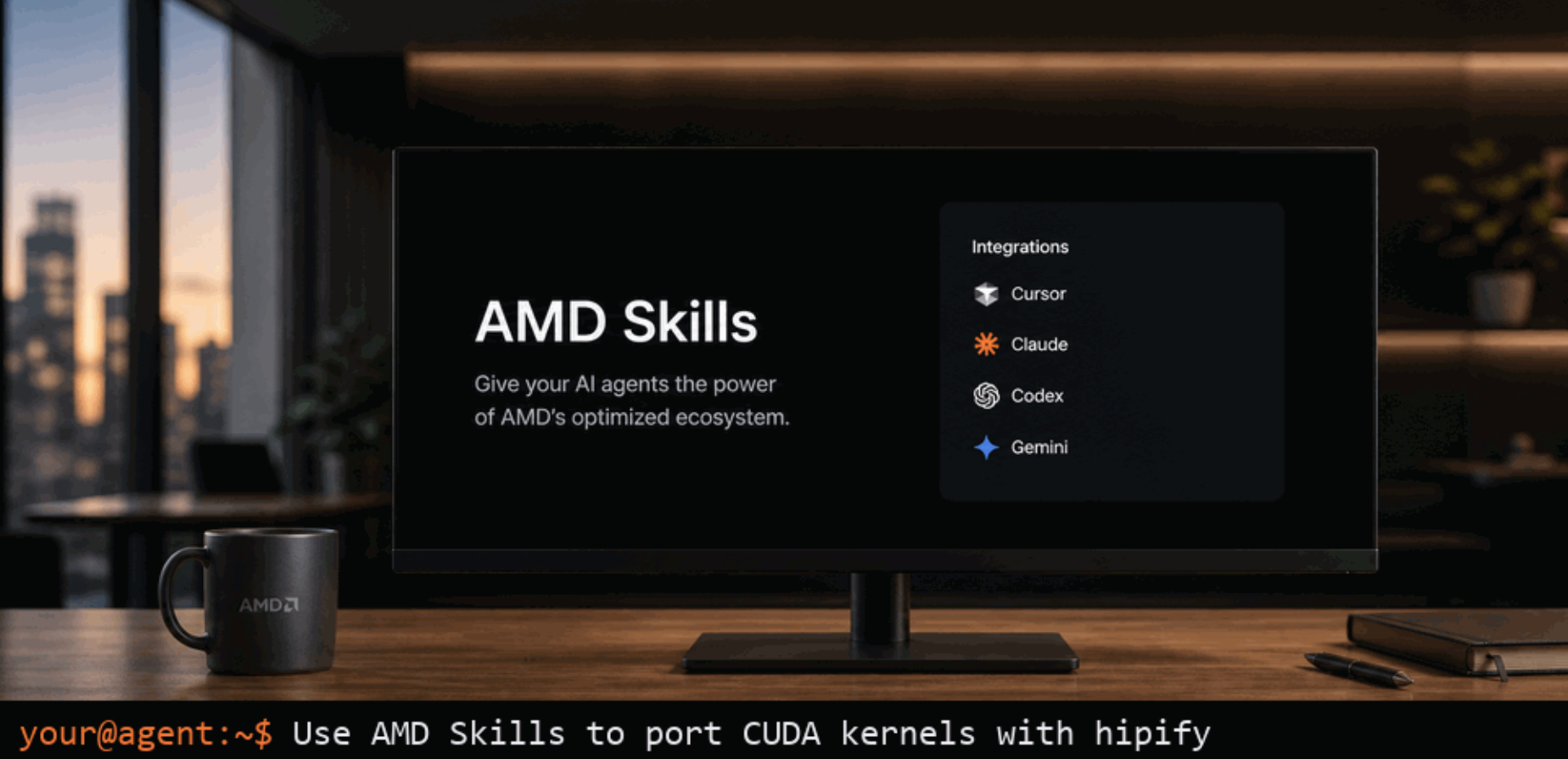
rocm servefor model inference via PyTorch androcm examinefor environment diagnostics. - AMD Skills: A collection of validated knowledge modules compatible with AI programming assistants such as Claude and Cursor. These skills provide automated guidance for tasks such as running LLMs on Instinct GPUs or quantizing models for EPYC CPUs.
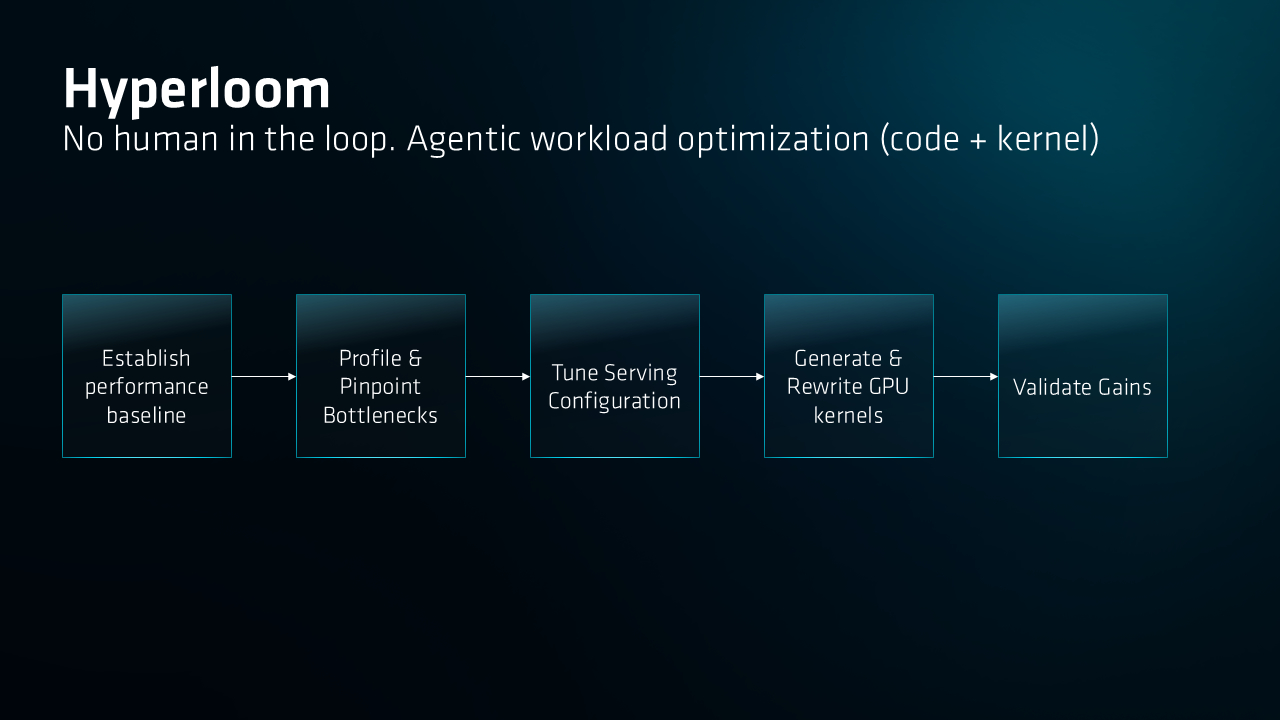
- Hyperloom: An open-source agent system that automates the optimization of inference workloads. Hyperloom uses a cycle of profiling, analysis, and validation to optimize kernels without manual intervention by engineers.
 AMD Hyperloom in ROCm 10 (Image © AMD)
Framework Support and Model Optimization
ROCm 10.0 provides production-ready support for vLLM and SGLang, enabling users to run LLM inference on Instinct, Radeon, and Ryzen hardware via validated containers.
For local development, the update adds support for Unsloth on Ryzen AI Max platforms, enabling memory-efficient fine-tuning using LoRA and QLoRA. Additionally, the release includes performance optimizations for ComfyUI, particularly for models such as Wan2.2, FLUX.2 KLEIN, and Stable Diffusion 3.5 Medium.
Communication and Math Libraries
Significant updates have been made to the communication libraries to improve scalability. RCCL now includes support for symmetric memory in peer-to-peer communication with multiple GPUs, as well as a GPU-initiated network API. rocSHMEM has also been updated to better align with NVSHMEM 3.6.5, with the addition of host AMO and context APIs.
In the area of math libraries, hipBLASLt introduces a GEMM kernel optimizer for local workload optimization. rocSPARSE adds an intelligent SPMM selector to automatically determine the most efficient algorithm based on the matrix structure.
Developer Tools and Windows Integration
This release includes several improvements to diagnostics and profiling:
- Roofline analysis: Now extended to GFX11xx architectures for Radeon hardware.
- ROCm Optiq 1.0: A unified visualization environment that combines system-level traces and kernel-level performance analysis.
- Memory Safety: ASAN-instrumented packages are now available as part of the default installation to help developers identify memory safety errors.
On Windows, the HIP SDK has been discontinued and integrated into the ROCm Core SDK. This transition unifies Windows and Linux under a single SDK definition and release cadence, ensuring feature parity between the two operating systems.