
 Computer Forum
 Mistral Large 4 (Image © Mistral)
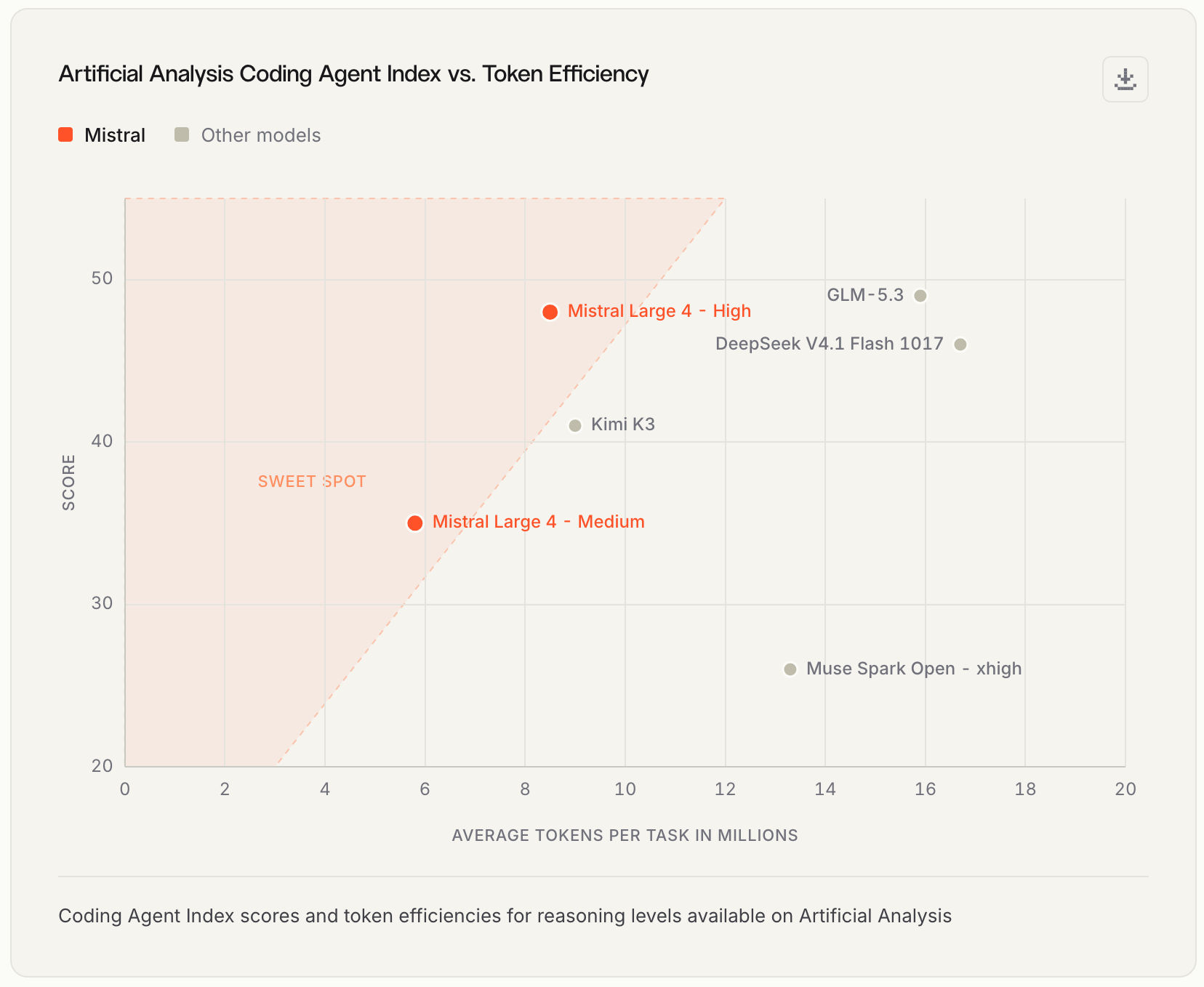
The updated model shows significant improvements in programming tasks. According to Artificial Analysis’s “Coding Agent Index,” “Mistral Large 4” is now the highest-performing open-weights model in its category, achieving a score of 41 percent. Furthermore, the model exhibits higher token efficiency than competing systems; on average, it requires 47 percent fewer tokens than GLM-5.3 to achieve comparable results.
In the area of cybersecurity, Artificial Analysis’s “Cyber Index” ranks the model behind Deepseek V4.1 Flash in terms of its defensive capabilities. However, Mistral Large 4 is characterized by stricter security measures and exhibits a higher rejection rate for dangerous or malicious queries compared to other open-weight models. While the public version prioritizes these security measures, specific versions with offensive capabilities can be made available to partners for penetration testing.
Model Architecture and Technical Specifications
Mistral Large 4 uses a Mixture-of-Experts (MoE) architecture with a total of 1 trillion parameters. The system consists of 128 experts—four of which are activated per token—as well as a common expert that is always active. This configuration results in approximately 52 billion active parameters per token.
Technical features include:
- Context window: The model supports a context length of one million tokens.
- Throughput optimization: Speculative decoding via Dspark (g+) has been implemented, which can increase throughput by up to 90 percent.
- Image processing capabilities: A new image processing encoder enables the model to process images of any size.
- Multilingual support: The model supports more than 160 languages.
- Training infrastructure: The training process was conducted using 3,800 Grace Blackwell GPUs.
 Mistral Large 4 Bench (Image © Mistral)
Deployment and API Pricing
As a model with open weights, Mistral Large 4 can be self-hosted and customized to meet specific organizational requirements. For those who prefer a managed service, Mistral offers API access. The pricing structure is 70 cents per million input tokens and 2.10 euros per million output tokens.
Hardware Requirements for On-Premises Hosting
Due to the enormous number of parameters, running the model on-premises requires data center-grade hardware. Memory requirements vary depending on the quantization level:
- 8-bit quantization: The standard version requires slightly more than 1 terabyte of memory, which typically requires a DGX system with eight H200 GPUs.
- 4-bit quantization (NVFP4): This version requires approximately 610 gigabytes of memory. This can be achieved with eight RTX Pro 6000 GPUs, a configuration with an estimated cost exceeding 100,000 euros.
- 1-bit quantization: The versions provided by Unsloth can run on two H200 GPUs; however, accuracy decreases significantly when quantization falls below 4 bits.
Users must also take into account the additional memory requirements for KV caches beyond the base model’s weights.