
 Computer Forum
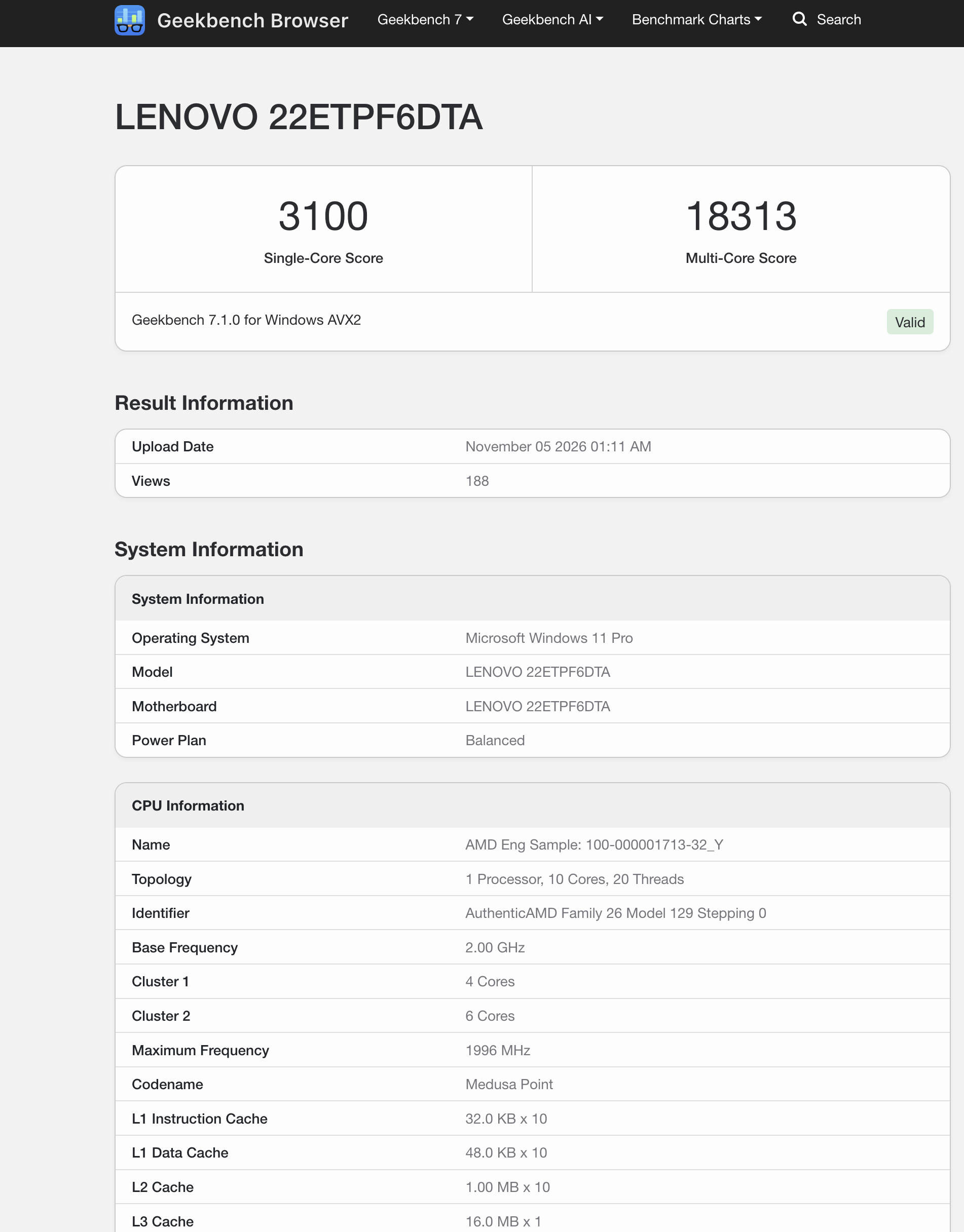 AMD Zen 6 Medusa Point Benchmarks geleakt (Image © Geekbench)
Single-Core Performance Scores
The 10-core engineering sample achieved a single-core score of 3,100. This result represents a 1.6 percent increase over the Ryzen 9 9950X3D, which has an average score of 3,051 points. The Medusa Point sample also outperformed the Ryzen 9 9950X (3,069 points) and the Ryzen 9 9900X (3,023 points). However, the processor was unable to outperform certain existing high-end models in this category. It trails behind the Ryzen 7 9850X3D, which scores 3,131 points, as well as the Ryzen 9 9950X3D2, which scores 3,164 points.
Multi-Core Analysis and Competitive Comparison
In the multi-core test, the Medusa Point test unit scored 18,313 points. That’s 5.3 percent more than the Ryzen AI MAX 390, which averages 17,393 points. It is noteworthy that the 10-core Zen 6 test model trails the Ryzen AI MAX PRO 390 (18,541 points) by only 1.2 percent, even though the latter uses a 12-core Zen 5 configuration.
Furthermore, according to the Geekbench 7 database, the Medusa Point scores for multi-core performance exceed those of the Intel Core i9-14900 and the Core i7-13700KF.
Technical Specifications
The processor is listed in the database as engineering sample 100-000001713-32_Y. The technical configuration consists of 10 cores and 20 threads, divided into two separate clusters with four and six cores, respectively. An important detail in this leak is the L3 cache, which is listed as 16 MB. This differs from an earlier leak in July regarding sample 100-000001713-33_N, which had 32 MB of L3 cache, suggesting that AMD is currently testing multiple hardware configurations.
The clock speeds for this specific sample are listed as a base frequency of 2.0 GHz and a maximum frequency of 1,996 MHz.
Architectural Positioning
Medusa Point is expected to be integrated into the next generation of mobile Ryzen processors. While earlier leaks showed that the hardware scored 3,329 single-core and 16,555 multi-core points in Geekbench 6, these figures are not directly comparable to current results due to the updated scoring system and workloads implemented in Geekbench 7. This is currently an engineering sample that does not represent the final product, and AMD has not yet commented on this generation.