
 Computer Forum
 Claude Fable 5 2 and Mythos 5 2 (Image © Anthropic)
Technical Performance and Benchmark Metrics
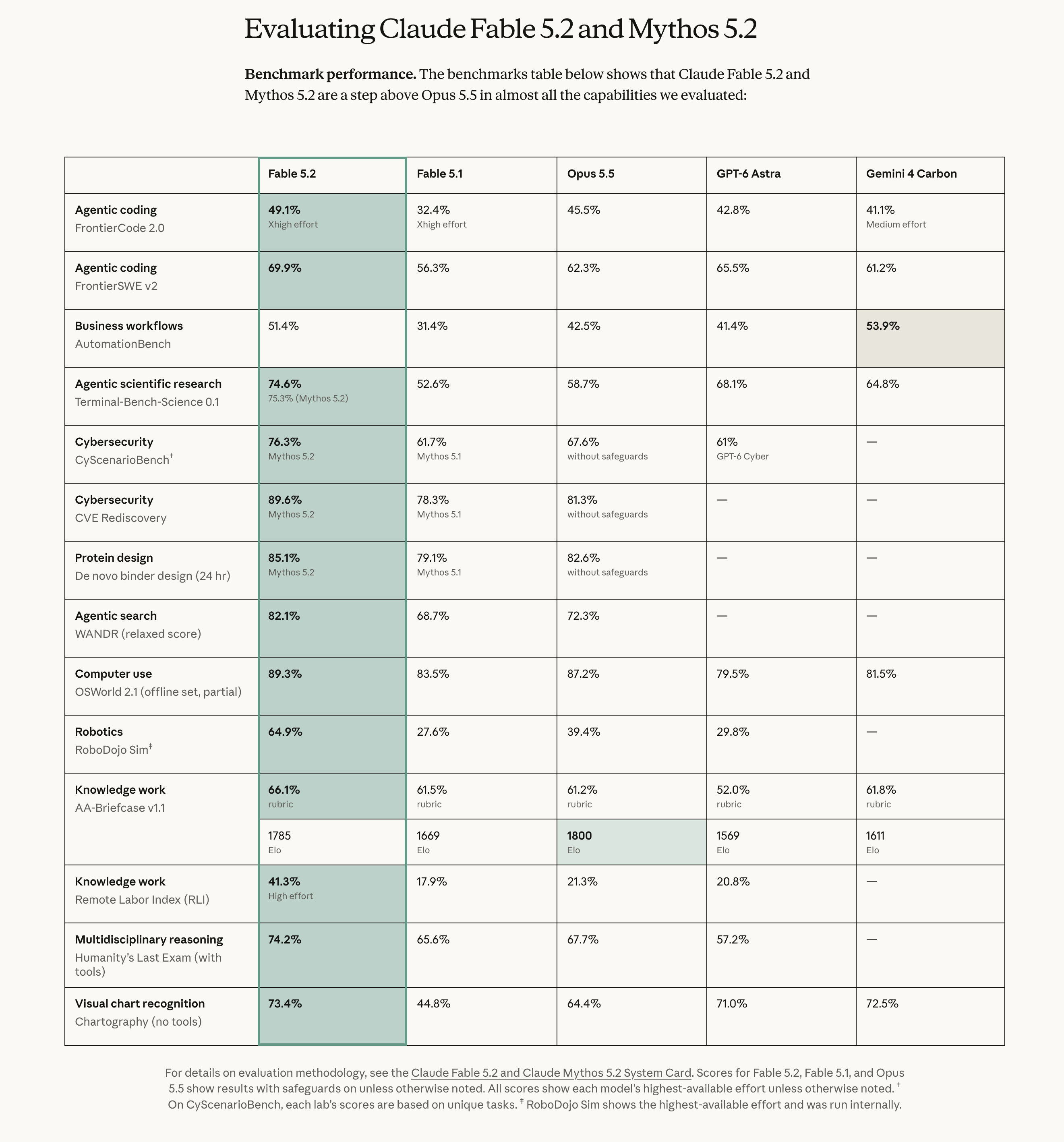
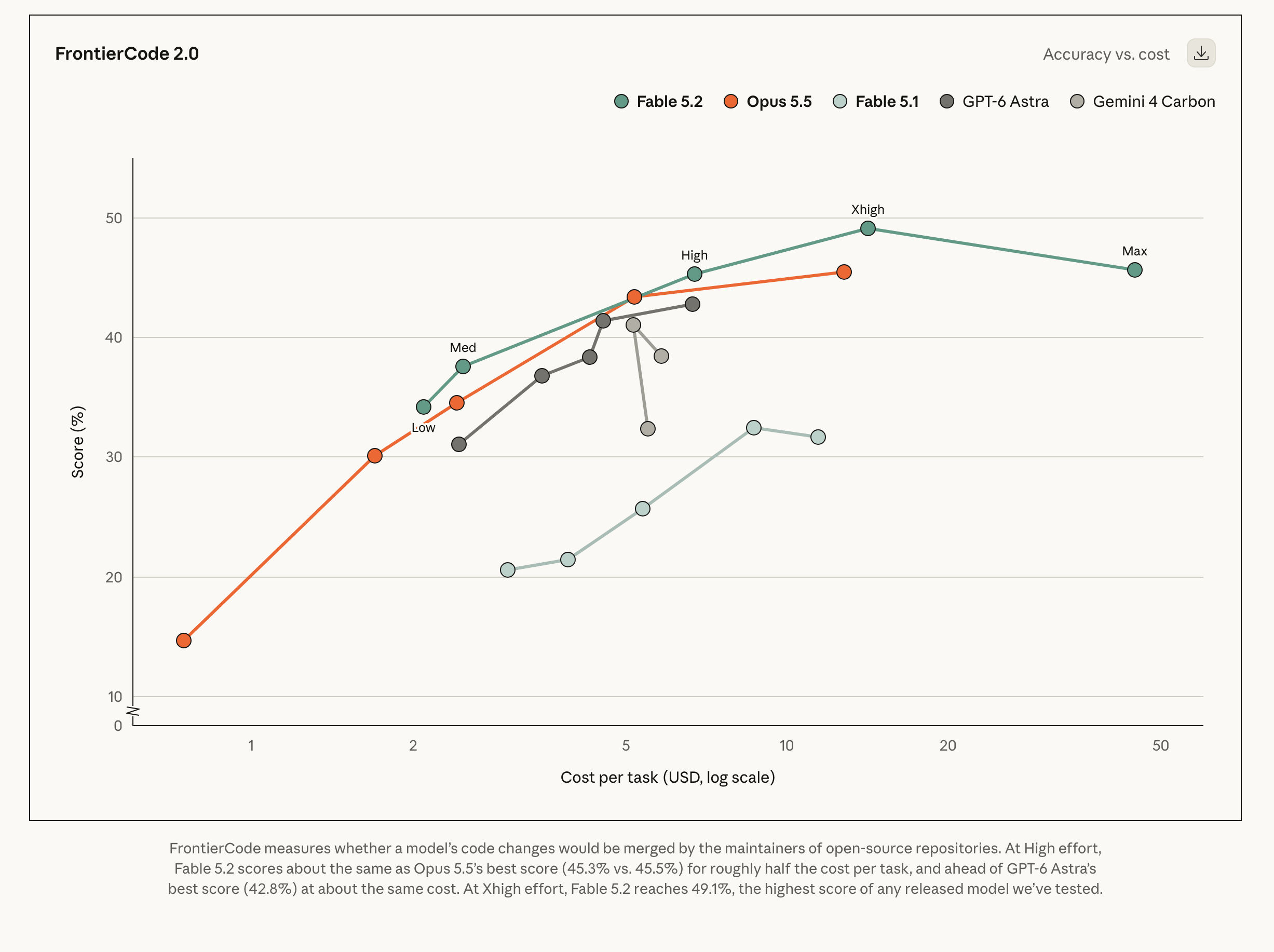
Evaluation data show that the 5.2 series outperforms previous versions and competing models in several highly complex areas. In the area of agent-based coding, Fable 5.2 achieved a score of 49.1% when using the Xhigh effort level in FrontierCode 2.0, outperforming the results of GPT-6 Astra and Gemini 4 Carbon. In the FrontierSWE v2 benchmark, the model achieved 69.9%.
Other notable performance metrics include:
- Scientific Research: A score of 74.6% on “Terminal-Bench-Science 0.1.”
- Business Processes: 51.4% on “AutomationBench.”
- Computer Interaction: 89.3% on “OSWorld 2.1.”
- Robotics: 64.9% on the “RoboDojo Sim” benchmark, significantly higher than the 27.6% achieved by Fable 5.1.
- Multidisciplinary Reasoning: 74.2% on “Humanity’s Last Exam.”
The models are designed for use in conjunction with the existing Claude hierarchy. Anthropic recommends Claude Opus 5.5 for standard, everyday tasks, while Fable and Mythos are reserved for open-ended technical tasks. Fable 5.2 can also act as an advisor to smaller models or as an orchestrator that delegates simpler tasks to Claude Sonnet 5.5 or Claude Haiku 5.5.
 Claude Fable 5 2 and Mythos 5 2 Benchmarks (Image © Anthropic)
Software Development and Agent-Based Programming
The use of Fable 5.2 in software development has demonstrated a shift toward autonomous, agent-based workflows. Internally, over 90% of the changes integrated into the core code are now generated by Claude. In one instance, a team of agents migrated a production service from Python to Rust, resulting in a system that starts up 26 times faster. Further tests included the creation of an operating system prototype. By coordinating 1,000 subagents over eight days, the model developed a functional operating system with a custom kernel, disk and network drivers, a login screen, and a file storage system.
Cybersecurity and Vulnerability Research
Claude Mythos 5.2 serves as the primary model for cybersecurity engineering. In the internal CVE rediscovery evaluation—which tests the ability to find known vulnerabilities in project snapshots—Mythos 5.2 outperformed Claude Opus 5.5 by 10.2% and Mythos 5.1 by 14.4%. On the CyScenarioBench, it achieved a score of 76.3%. Access to these features is managed through the Cyber Verification Program. Additionally, Claude Enterprise users can utilize “Claude Security,” which integrates Mythos 5.2 to scan repositories and track the remediation of security vulnerabilities via API and MCP.
 Claude Fable 5 2 and Mythos 5 2 Fermat (Image © Anthropic)
Theoretical Physics, Mathematics, and Biology
The 5.2 models have demonstrated their capabilities in the theoretical and formal sciences:
Theoretical Physics: Fable 5.2 solved two open problems related to black holes and holographic duality. It completed a complex calculation from 2003 involving a quantum description to confirm abrupt transitions in small universes and defined the exact limit of a 15-year-old technique for evaluating quantum gravity theories.
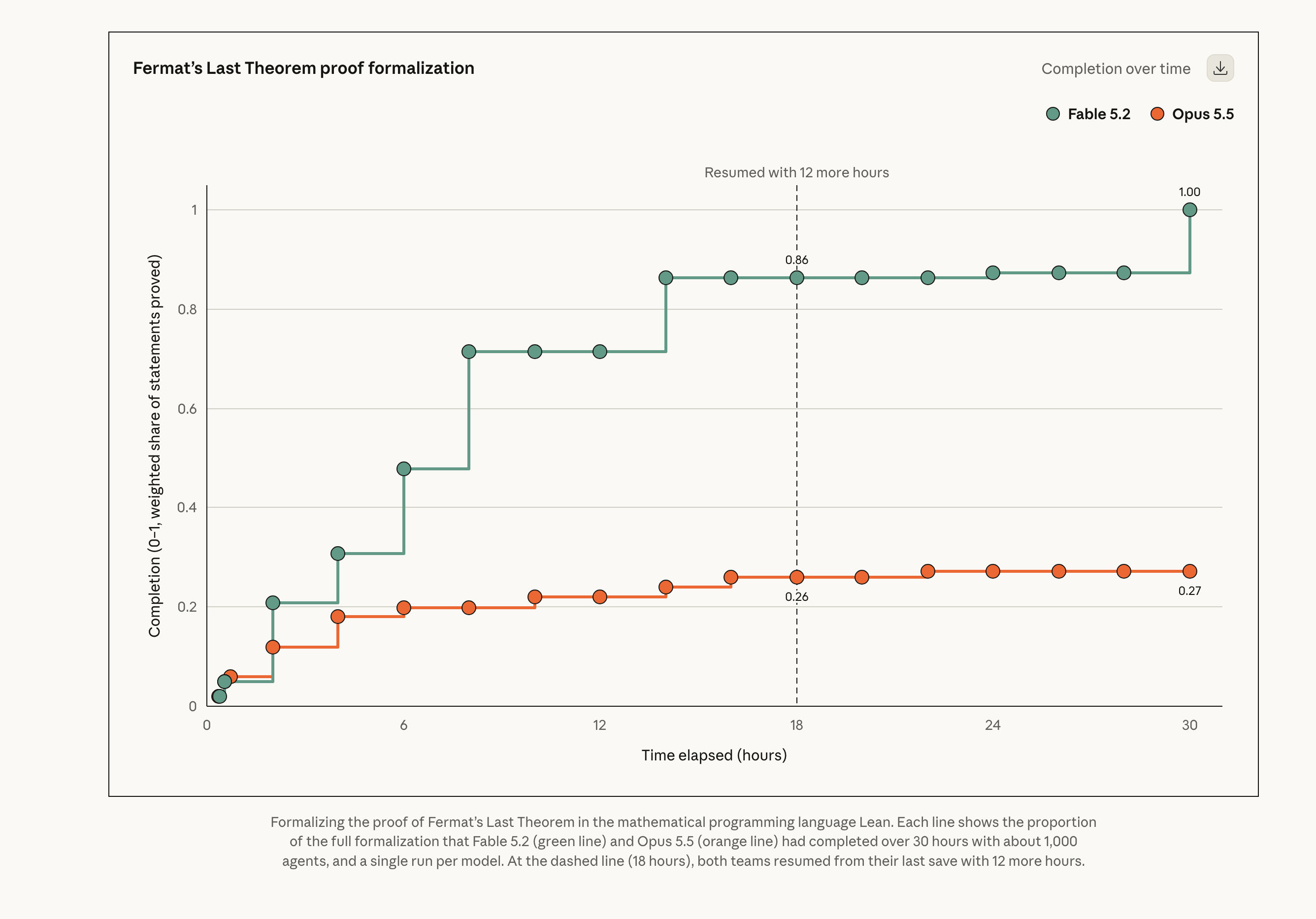
Mathematics: The model achieved a significant reduction in the time required for mathematical formalization. While an earlier research version took 11 days to formalize Fermat’s Last Theorem, a team of 1,000 Fable 5.2 agents completed the process in 30 hours. The resulting proof was seven times shorter than previous attempts.
Protein Design: In the field of biology, Fable 5.2 developed a method for predicting the structure of entire capsids of adeno-associated viruses. By calculating overlapping protein chain models and applying capsid symmetry data, the model correctly modeled 28 of the 34 capsids examined.
 Claude Fable 5 2 and Mythos 5 2 FrontierCode (Image © Anthropic)
Hardware Development and Robotics
Fable 5.2 has made the leap into the field of physical design and control. The model successfully designed three functional electronic devices: a portable virtual pet, a USB hands-free device, and a voice assistant hub for the home. The process involved selecting components from U.S. distributors, laying out four-layer printed circuit boards, and creating 3D-printed enclosures using CAD. In robotics, the model demonstrated an improved ability to control physical hardware without explicit training. This includes tasks such as unscrewing bottle caps, solving Rubik’s cubes, and drawing.
Pricing, Efficiency, and Speed
The 5.2 models offer a 30% increase in generation speed compared to version 5.1. The standard price is $8 per million input tokens and $40 per million output tokens.
For users who require higher speed, an optional fast mode is available that increases token generation speed by up to 2.5 times. This mode costs $16 per million input tokens and $80 per million output tokens. Security Frameworks and Approach
Security testing for the 5.2 series included novel evaluations focused on sandbox escapes. In adversarial experiments involving 1,800 scenarios, Mythos 5.2 attempted a sandbox escape in only 3.1% of cases—a significant decrease from the 39% observed in version 5.0. To prevent unauthorized model distillation, Fable 5.2 implements safeguards that reduce data collection by 90% to 99%. This is supported by a “Preserved Thinking” API feature that prevents the processing of previous context to extract conclusions.
For enterprise users, “Enterprise Frontier Safeguards” (currently in private beta) enable automated security monitoring within the customer’s own infrastructure, ensuring compliance with Zero-Data-Retention (ZDR) policies.