 Computer Forum
 Crucial T710 Test Review (Image © PCMasters.de)
Crucial T710 in Detail
As a subsidiary of Micron, Crucial is right at the source of chips and advanced technology. Even though the manufacturer has announced that it may discontinue its consumer segment in the near future, Crucial is a real asset to the market, as both its RAM and SSDs are very popular and have proven to be highly reliable. Having already tested the Crucial T705 (Review) and found it to perform excellently, today we’re taking a look at the T710, which is expected to deliver even better performance.
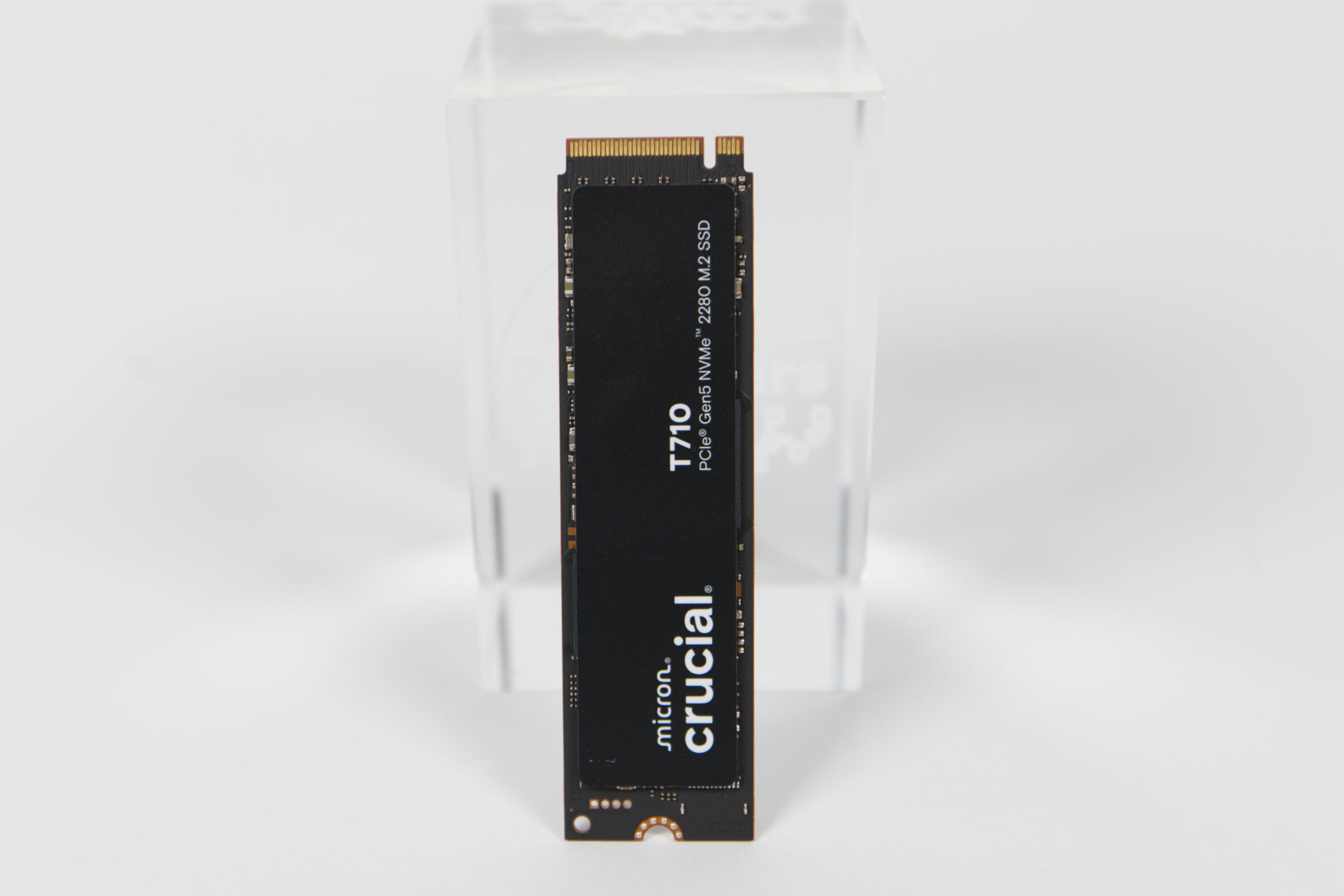
Like the T705, the Crucial T710 is a true high-end NVMe SSD. The Solid State Module (SSM) comes in the standard M.2 2280 form factor and is therefore compatible with most modern motherboards. However, anyone buying this module will certainly also plan to use a compatible PCIe Gen 5 slot to fully exploit the module’s potential. You can also install the T710 in a PCIe Gen 3 or Gen 4 slot, but that would be a waste because performance would be severely limited.
As for purchase options, Crucial offers the T710 SSD in capacities of 1 TB, 2 TB, and a 4-TB variant. You can also choose between the standard version without a heatsink or the version with a large pre-installed heatsink. There is no cheaper 512 GB option, as these are increasingly being phased out and are unsuitable for the high-end segment.
As usual, Crucial keeps its NVMe SSDs simple in black with a black sticker. The manufacturer specifies a sequential read speed of 14,500 MB/s and a sequential write speed of 13,800 MB/s for the T710. The read throughput is identical to that of the T705, whereas the write throughput has been significantly increased to 12,700 MB/s. Crucial’s 4K IOPS figures promise 2,300K read and 2,200K write. Both of these values exceed those of the T705.
The lifespan of an SSD is also an important factor, as you want a reliable storage medium. Crucial specifies a Terabytes Written (TBW) value of 1,200 TB for the 2-TB version of the T710 that we tested, and the reliability forecast is listed as 2 million hours (MTTF). The T710 is covered by a 5-year manufacturer’s warranty. This is a good value for a high-end SSD.
 Crucial T710 SM2508 Controller (Image © PCMasters.de)
Silicon Motion SM2508 Controller
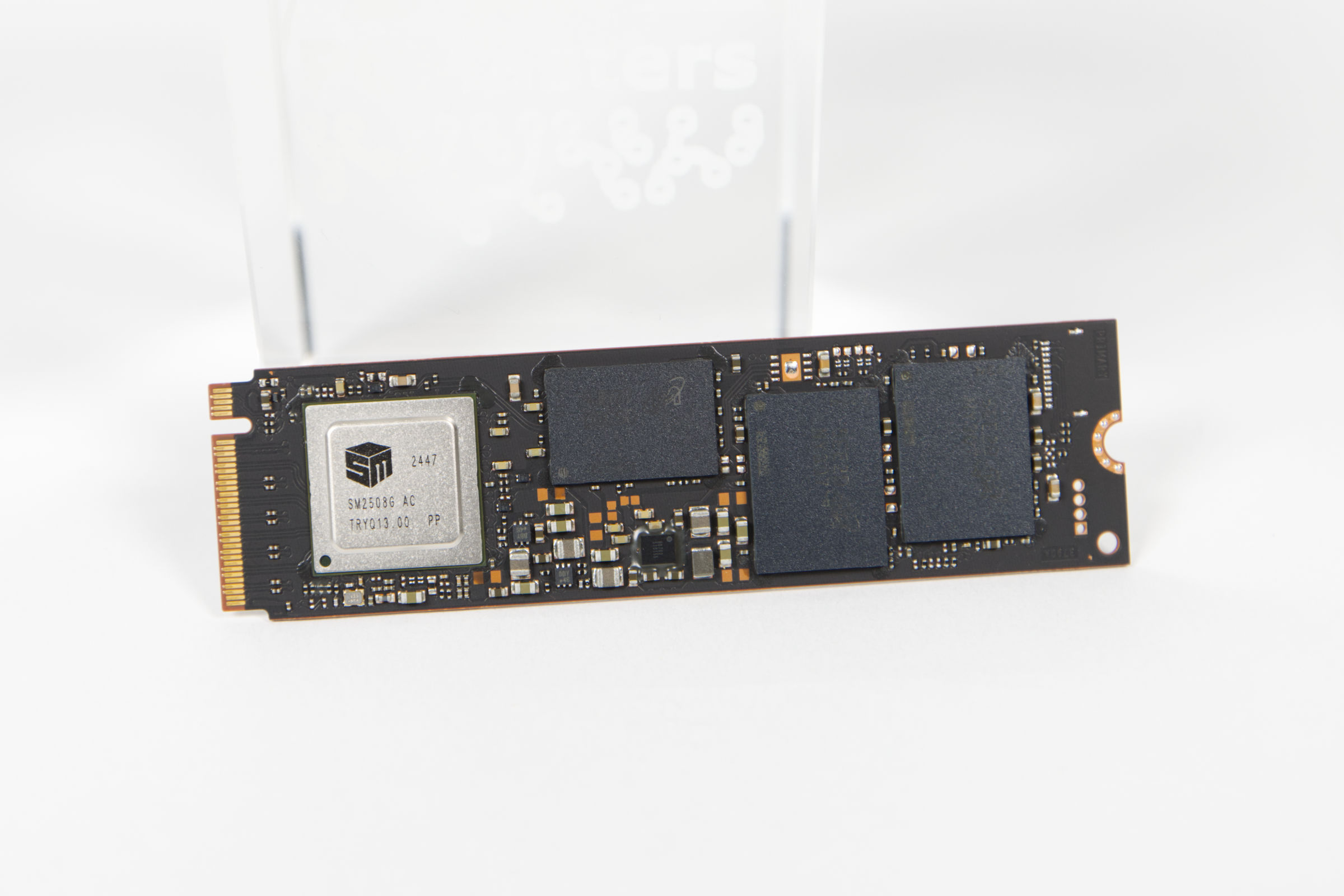
The heart of the NVMe SSD is the Silicon Motion controller. It is manufactured by TSMC using a 6-nm process. Crucial has installed a Silicon Motion controller in the T710. This controller is also used by competitors. The T705 still featured a Phison PS5026, which ran a bit too hot. The SM2508G AC controller soldered onto the T710 is manufactured by TSMC using a 6-nm process and offers higher efficiency. The controller derives its processing power from a quad-core Arm Cortex-R8 processor. This architecture supports up to four PCIe Gen 5 lanes, each capable of handling data transfer rates of 32 Gb/s. The controller is designed to manage up to eight NAND channels with a maximum speed of 3,600 MT/s per channel.
Silicon Motion has positioned the SM2508 as the top-of-the-line model in its portfolio. The controller offers sequential read speeds of up to 14.5 GB/s and sequential write speeds of up to 14 GB/s, which closely matches the specifications of the T710. In addition, it offers exceptional random read and write performance with 2.5 million IOPS for both operations.
The SM2508G controller also requires volatile memory as a cache and supports both DDR4 and LPDDR4 memory types. On the PCB, we find an LPDDR4 (Low-Power Double Data Rate 4) SDRAM chip, which is, of course, from Micron and bears the identifier 4JB77 D8CSG. This is a 2-GB memory chip that operates at 4,266 MT/s and has a density of 16 Gb. The memory operates at an energy-efficient 1.1 V.
 Crucial T710 Micron NAND (Image © PCMasters.de)
Micron 3D NAND
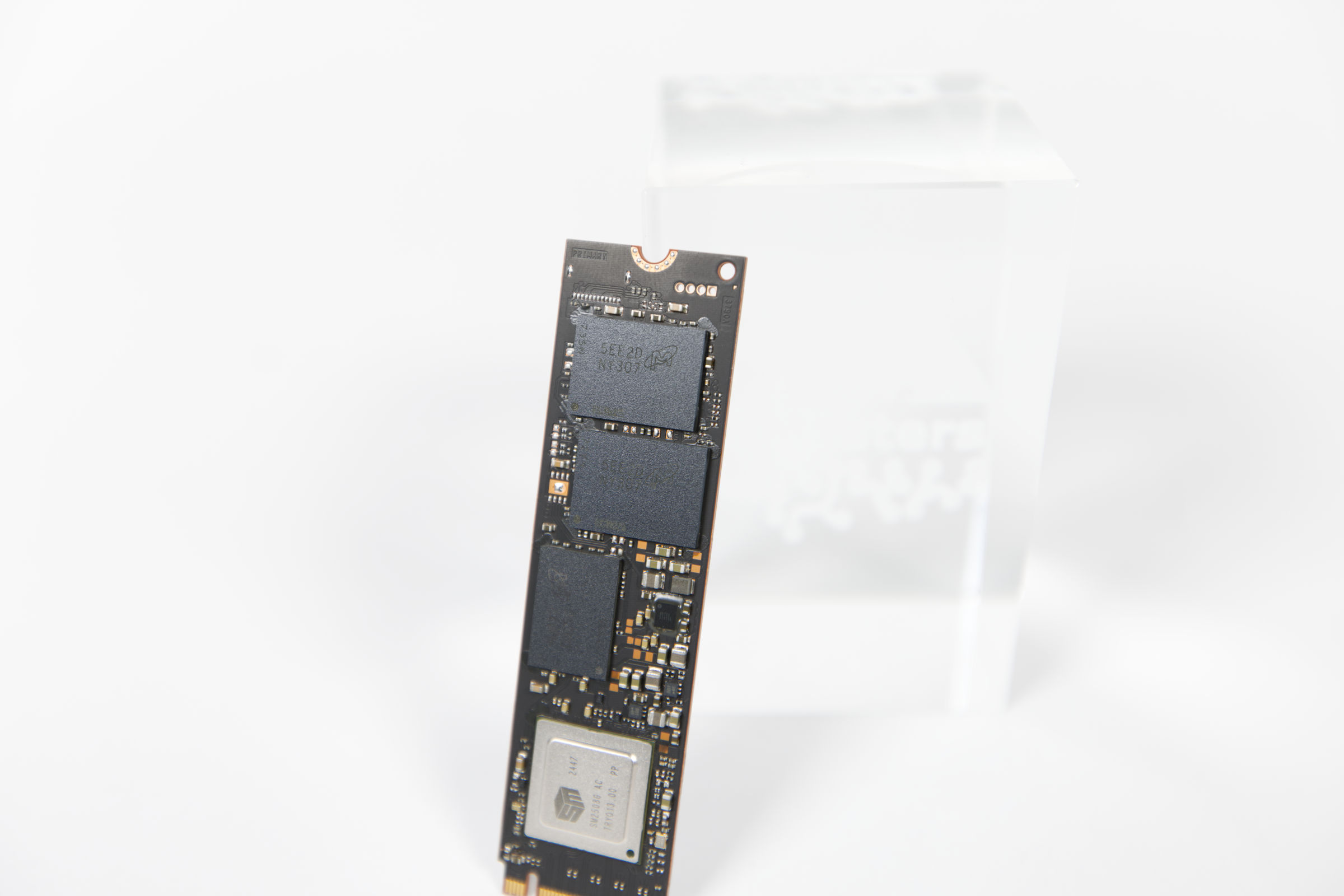
On the 2-TB SSD, we also find two NAND chips, which are also from Micron and bear the identifier 5EE2D NY307. Micron’s part number is MT29F8T08EQLEHL5-24QA:E; however, the manufacturer has not provided any further details about the chips. These are 3D NAND QLC (Quad-Level Cell) memory chips with 276 layers (B68S). Each chip thus has 1 TB of storage.
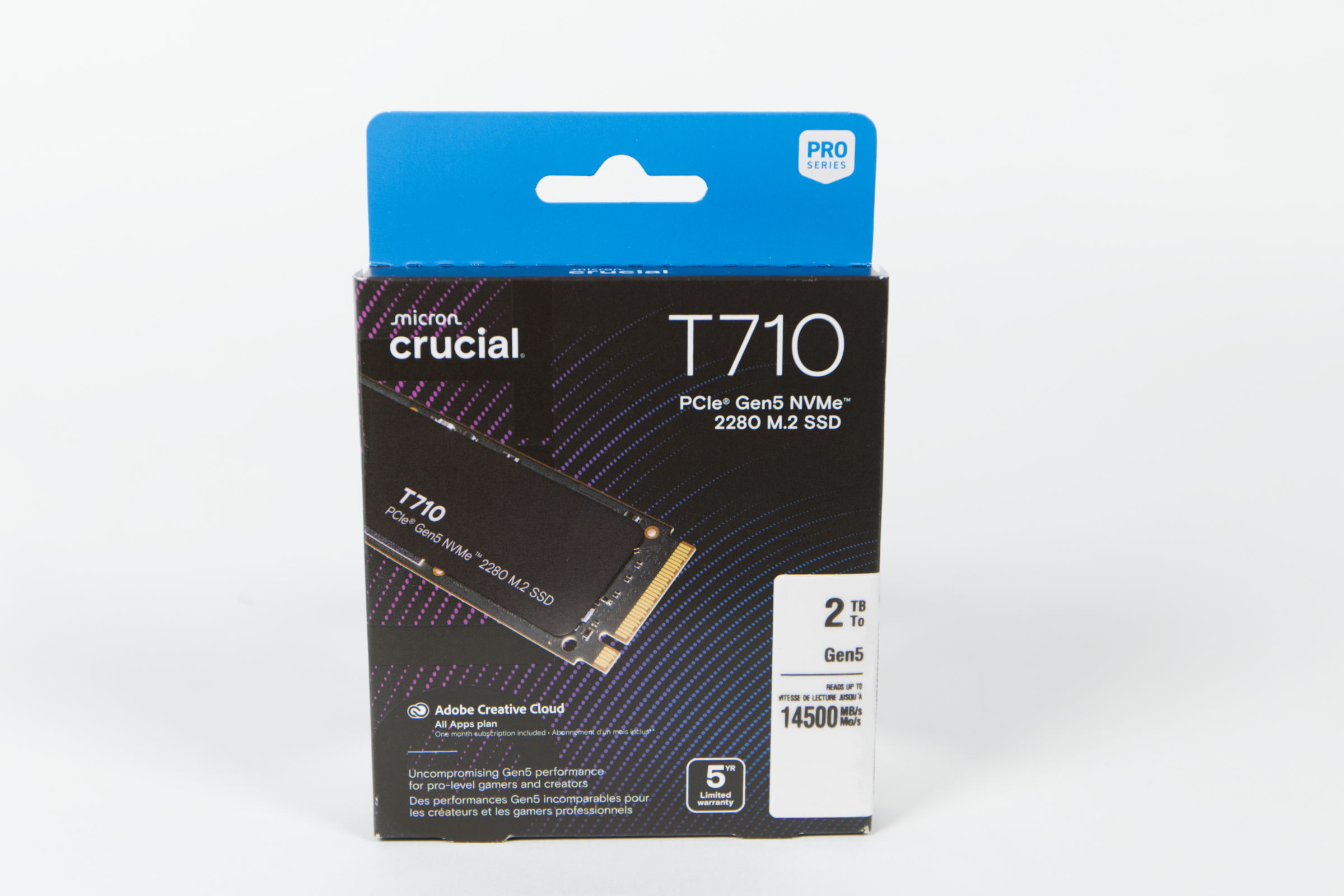 Crucial T710 Verpackung (Image © PCMasters.de)
Crucial T710 Packaging and Package Contents
As usual, the packaging consists of cardboard with colorful printing. The module is pictured on the front. It also includes key product details, such as the five-year warranty and peak performance values.
Crucial also informs users that the SSD comes with one month of free Adobe Creative Cloud access.
After opening the packaging, you can pull out a blister pack containing the actual SSD. The tray consists of two parts and holds the module securely in place.
Test System
For our test system, we used our tried-and-true setup with a Ryzen 9 7950X and the Biostar X670E Valkyrie motherboard. This ensures that performance isn’t limited by PCIe 4, since we’re testing in the PCIe 5 slot.
Ryzen 7000 Test Setup
- CPU: AMD Ryzen 9 7950X
- Motherboard: Biostar X670E Valkyrie
-
Graphics Card: MSI GeForce GT 730
- RAM: Kingston FURY Beast DIMM Kit 32GB, DDR5-5200, CL40-40-40 (KF552C40BBK2-32)
- Power Supply: be quiet Pure Power 11 FM 1,000 W
-
Case: Open Testbench
- Operating System: Windows 11 21H2
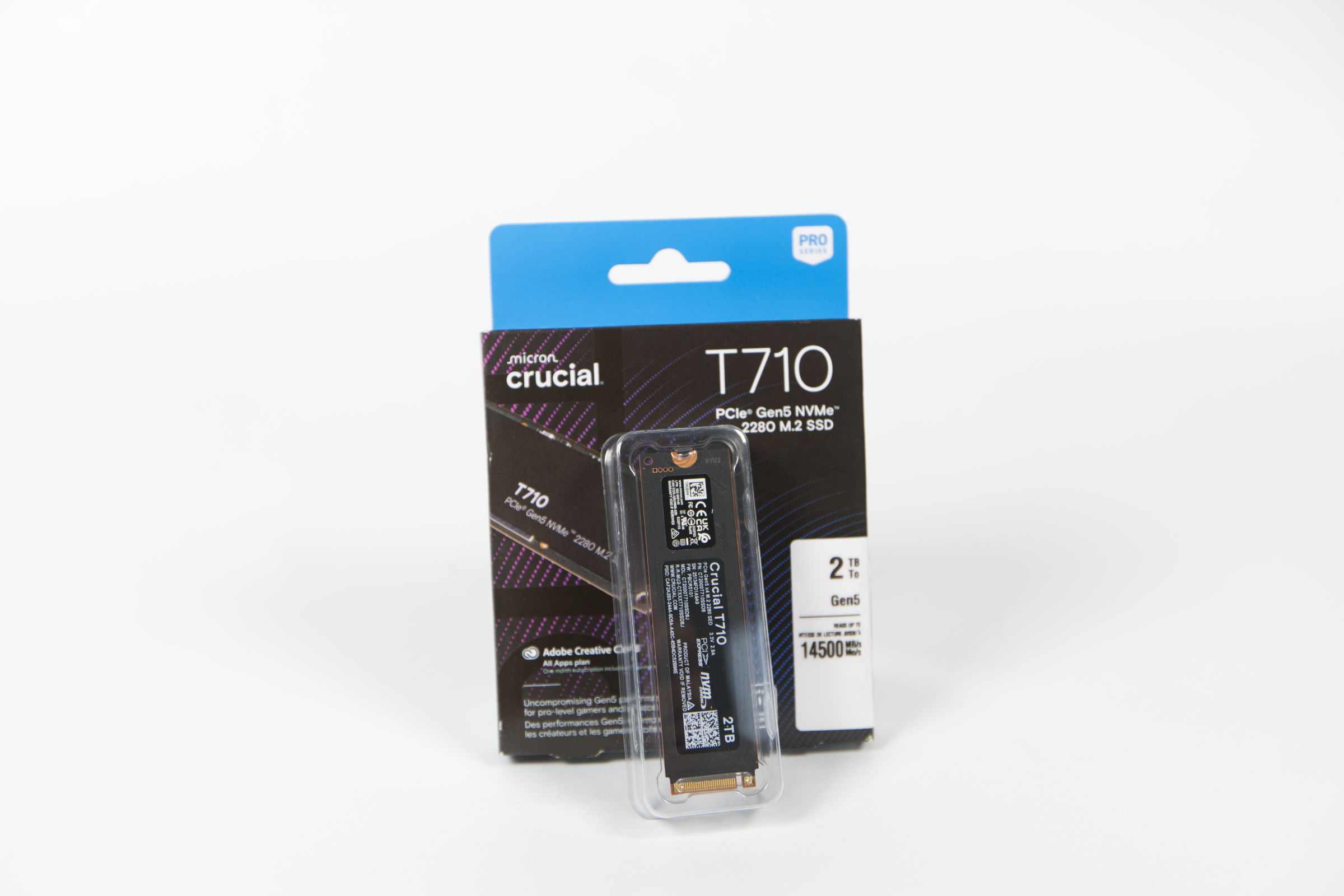 Crucial T710 Lieferumfang (Image © PCMasters.de)
Crucial T710 in Benchmarks
For the NVMe SSD comparison test, we have expanded our benchmark suite. To ensure a more realistic test that also delivers repeatable results, we have recently started using the 3DMark Storage Benchmark as well, which tests various scenarios, such as gaming behavior and the copying of game data.
We have also included PCMark, which evaluates the system as a whole and calculates average values during copying.
CrystalDiskMark Storage Benchmark
3DMark Storage Benchmark
PCMark Drive Performance Consistency
PCMark relies on a very long write load that is applied constantly over an extended period. This is why the peak values are simply lower, as the SSD and cache are pushed to their limits. This is intended to simulate use by a power user.
ATTO Disk Benchmark (64 MB)
Benchmark Rating
On average, the results for the Crucial T710 look quite good. It outperforms the T705 in all scenarios and ranks second in read throughput and even first in write throughput. The T705 also held a very high position at launch, and Crucial has successfully taken it up a notch with the T710.
Crucial T710 Cooler and Temperature Measurements
The SSD’s optimizations also have a positive impact on cooling. Even under full load, the T710 did not throttle performance and did not overheat, as was still the case with the T705. This makes it easier to keep the T710 at low temperatures, although a heatsink is still required—which applies to pretty much all PCIe Gen 5 NVMe SSDs. Most modern high-end motherboards come with the necessary heatsinks, and if not, you should opt for the T710 with a pre-installed heatsink.
For this comparison test, we used the large aluminum heatsink from the Biostar X670E Valkyrie motherboard in NVMe slot 2. This is not directly blocked by the graphics card and is not actively cooled in this test. Some models came with a pre-installed heatsink. In those cases, we used it directly. We have included corresponding notes in the chart: If an integrated cooler was used, an "IK" (for integrated cooler) is appended after the name.
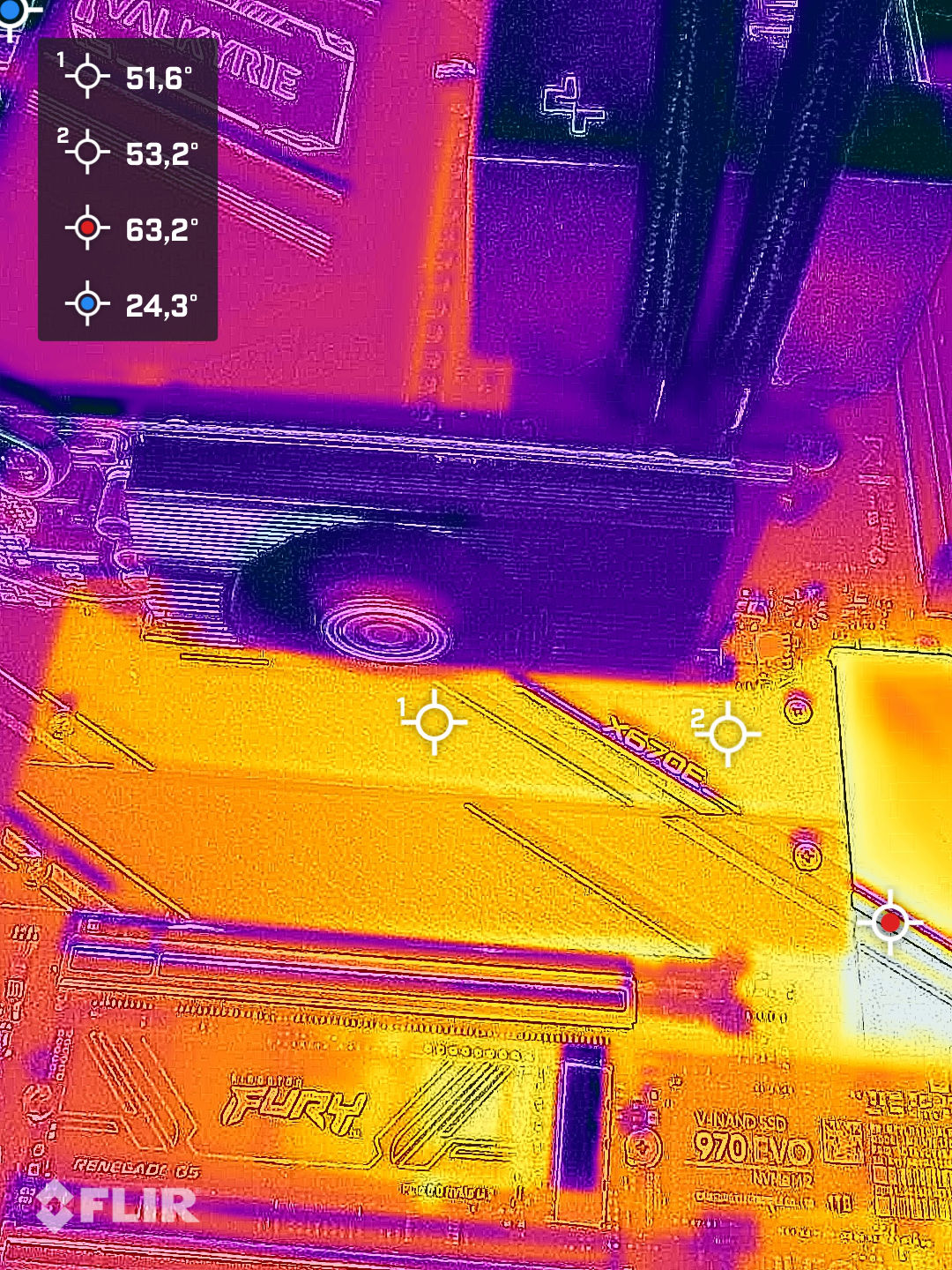 Crucial T710 Wärmebildaufnahme (Image © PCMasters.de)
Crucial T710 Thermal Images
The thermal images confirm the measurements. The motherboard cooler reaches about 51 to 53 °C and could heat up even more if there is no active airflow in the case. The SSD underneath gets even hotter, but has not throttled. That is why we recommend ensuring proper airflow in the case so that the waste heat can be dissipated more quickly.
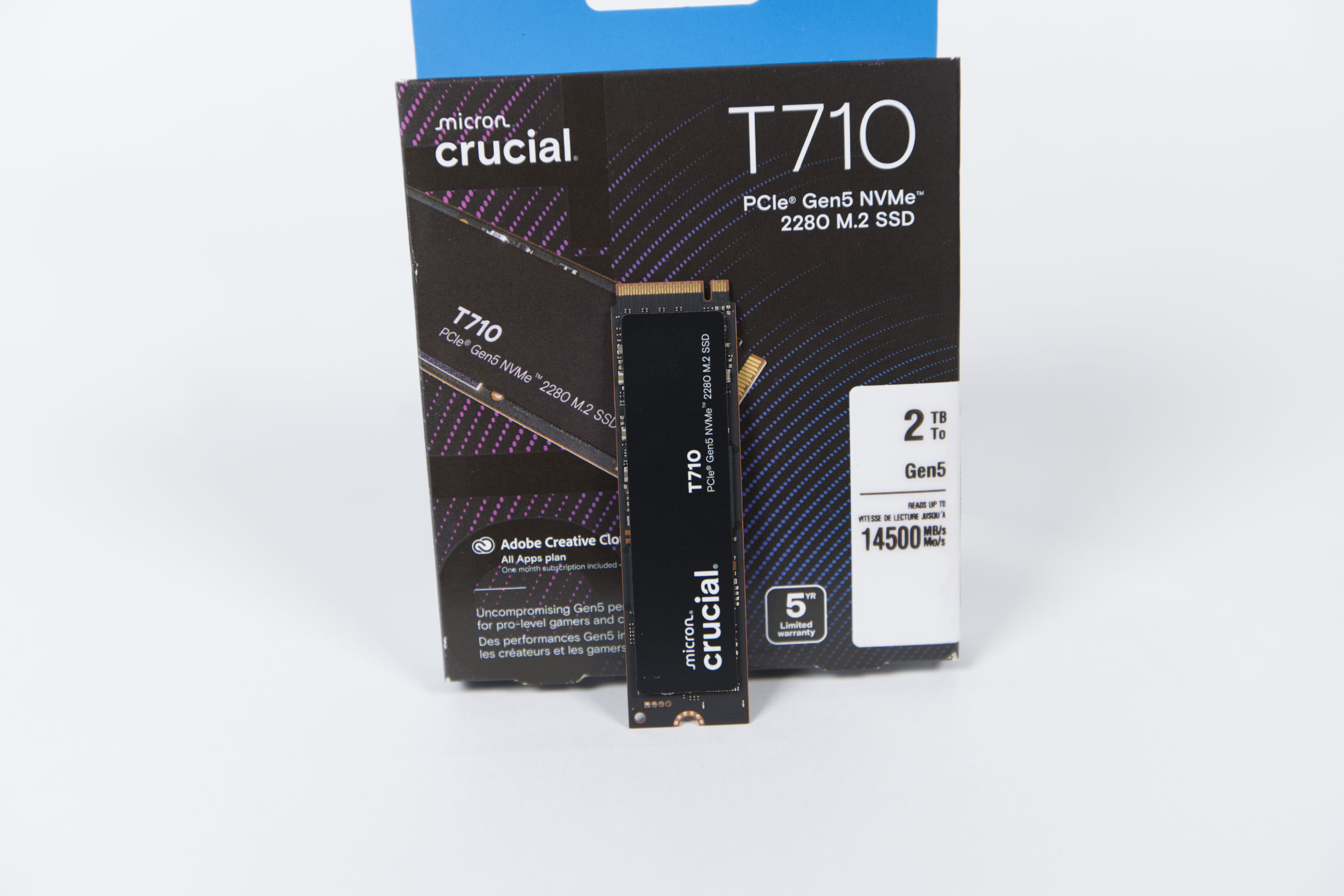 Crucial T710 Fazit (Image © PCMasters.de)
Conclusion on the Crucial T710
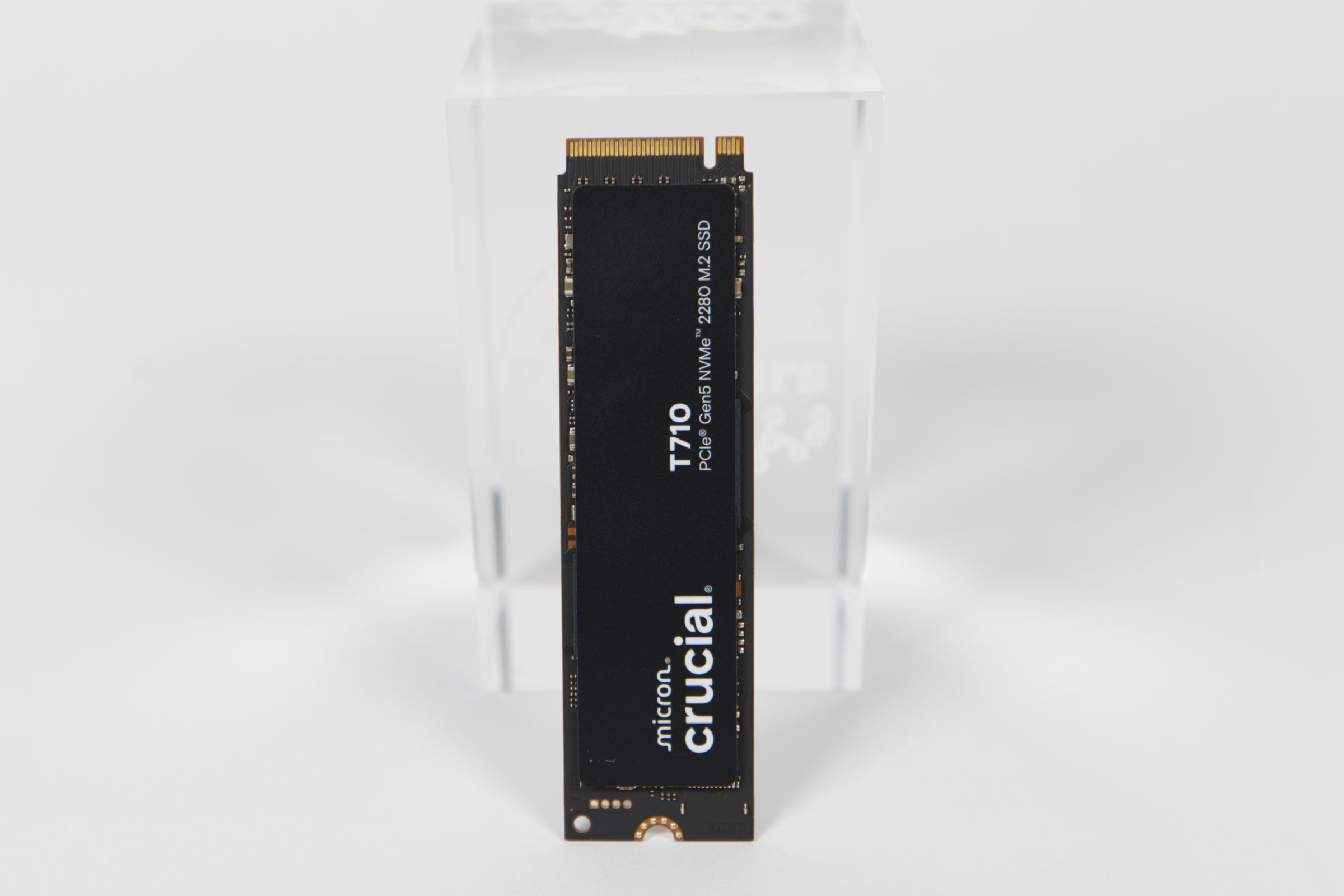
There’s basically nothing but good things to say about the new Crucial T710. The manufacturer has gotten the T705’s heat issues under control, making the T710 easier to cool and thus capable of delivering consistently high performance. The T705 was already a very powerful NVMe SSD that met the demands of enthusiasts, but the T710 has gotten even better. Among the 28 SSDs tested, it took first and second place, depending on whether read or write speeds were measured.
The build quality of the T710 is excellent, and the components used are powerful and well-matched to the rest of the system. The five-year manufacturer’s warranty is appropriate for a high-end product. The rise in memory prices is not reflected as strongly in the price of the T710. A few months ago, the 2-TB model we tested cost approximately €239, and ** it is currently available for €289 (Affiliate)**. Compared to other PCIe Gen 5 NVMe modules on the market with similar specifications, the T710’s price seems reasonable. For this reason, we can recommend it without hesitation, especially since its performance is very high and it doesn’t get as hot as the T705.
Pro
- Fast PCIe 5.0 interface
- Efficient SM2508 controller from Silicon Motion
- Very good performance
- Efficient and therefore cool (does not throttle performance)
- High-quality build
- 1-month Adobe Creative Cloud subscription (free/included)
- 5-year manufacturer’s warranty
Contra
- Price (due to market conditions)