
 Computer Forum
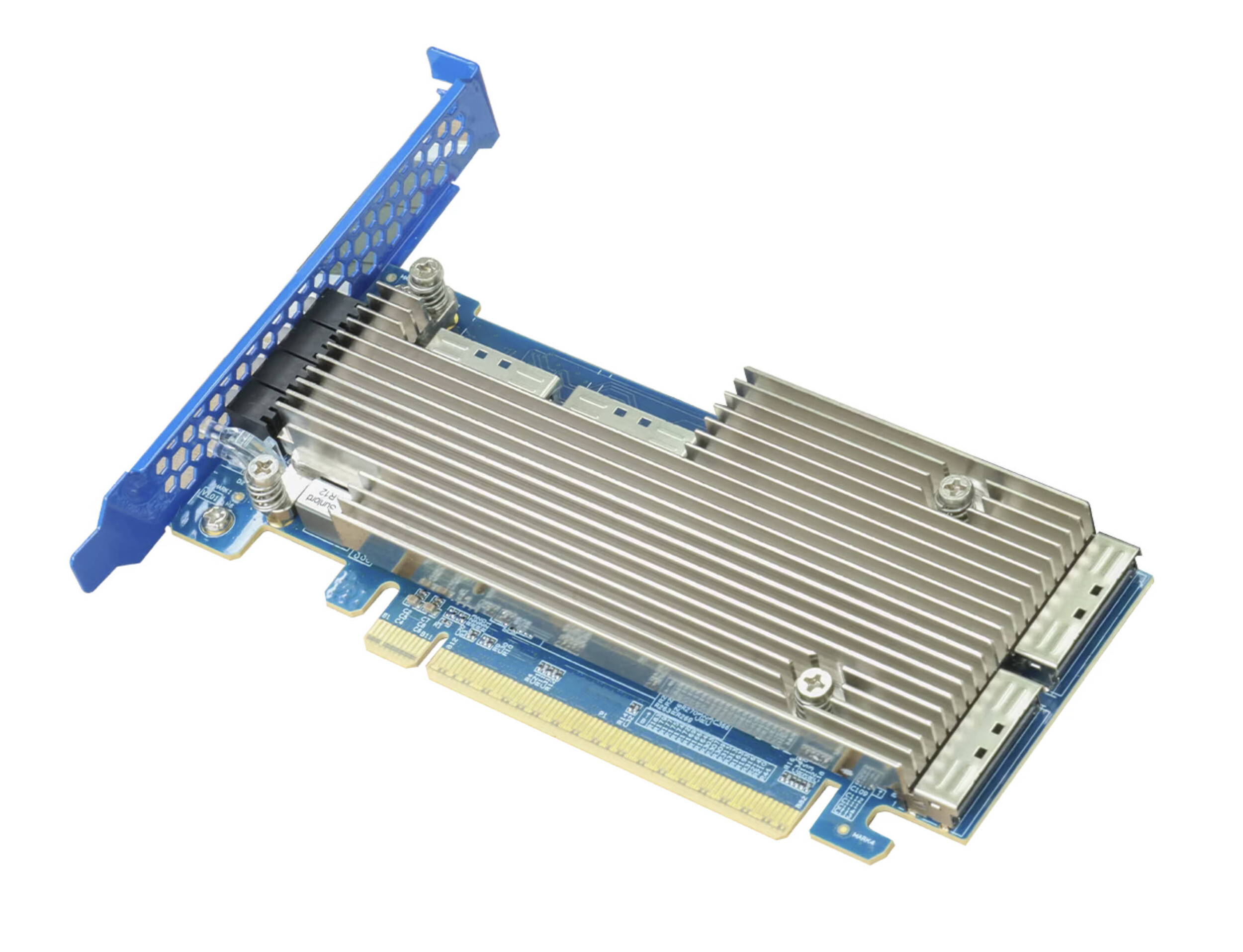 HighPoint PCIe Gen 5 MCIO Karten (Image © HighPoint)
As AI inference and multi-GPU clustering become increasingly complex, system architects often run up against physical and electrical limitations. Standard server chassis often lack the necessary slots on the motherboard for multiple accelerator cards, SmartNICs, or DPUs. While rigid PCIe risers are a common alternative, they often restrict airflow and cause mechanical interference. Additionally, many host platforms do not offer the flexible BIOS configuration required to manage additional expansion cards.
To solve these problems, HighPoint has implemented a three-tier architecture that enables the distribution of PCIe 5.0 x16 bandwidth—with a total throughput of 64 GB/s—throughout the chassis using flexible SFF-TA-1016 (MCIO) cabling.
The first tier focuses on direct expansion of the motherboard. By using a passive bridge card, native MCIO-8i ports on AMD EPYC and Intel Xeon motherboards are converted into physical PCIe 5.0 x16 slots. This approach allows administrators to install accelerators or 400-GbE network cards in additional slots without occupying existing physical PCIe slots on the motherboard.
The second tier utilizes retimer-based signal extension via the Rocket 1624L and Rocket 1624M models. These devices act as signal conditioners and extend PCIe 5.0 signals over longer internal or external cable runs. This allows high-performance accelerator cards to be placed in optimal thermal zones inside or outside the primary chassis to prevent overheating.
The MCIO-PCIEX16-G5 bridge card, the Rocket 1624 series, and the Rocket 1628A/1624A adapters are now available through authorized resellers and in the HighPoint online store.