
 Computer Forum
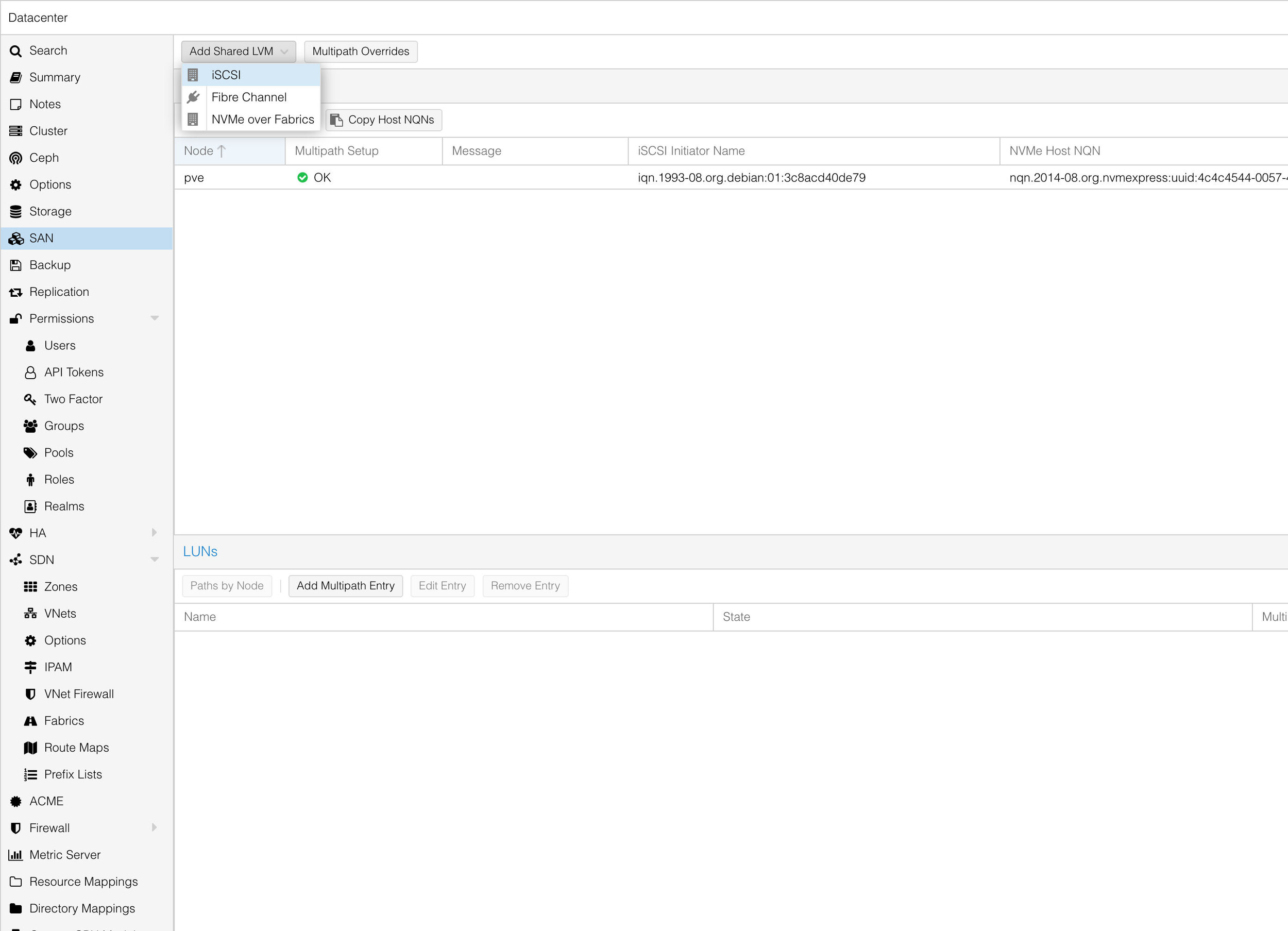 Erweitertes SAN Management (Image © Eigene)
Advanced SAN Management and Snapshots of Volume Chains
The release of Version 9.3, including Version 9.3.1, marks the transition from manual, node-by-node storage configuration to centralized multipath management. The new cluster-wide SAN view, located under the Data Center > SAN menu, enables real-time status monitoring of LUN paths across all nodes. We found the storage management in particular to be confusing and, in our opinion, inadequately implemented. Through this interface, administrators can monitor local LUNs, path status, load balancing, and active iSCSI sessions from a single dashboard.
The platform now includes a guided workflow for provisioning shared LVM storage via iSCSI, Fibre Channel, and NVMe-over-Fabrics LUNs directly through the web interface. In addition, the update introduces full production support for volume-chain snapshots on thick-provisioned LVM. This feature, which includes support for Shared LVM in SAN environments, can be enabled via the advanced storage settings by selecting the option to allow snapshots as volume chains.
To improve extensibility, third-party storage plugins can now be managed directly via the web interface. Proxmox VE dynamically generates configuration forms based on the plugin’s property schema, ensuring compatibility across different storage API versions while masking sensitive login credentials such as keys and passwords.
Guest Identity and Cluster Maintenance
Proxmox VE 9.3 implements unique guest identities for virtual machines and containers. These identifiers are preserved during migrations, backups, and restores, even if the VMID changes or the guest is restored to a different cluster. This provides a reliable mechanism for backup software and external management tools to track a guest throughout its entire lifecycle.
Several updates have been made to simplify routine maintenance and troubleshooting:
-
GUI-based HA maintenance: High-availability maintenance mode for individual nodes can now be toggled directly from the HA status window or via a new API endpoint, eliminating the need to use the
ha-managercommand-line tool. - System Logging and Auditing: The update introduces a color-coded, filterable system log, a dedicated API access log, and an APT history view to track package transactions and change logs.
- Advanced Notification Forwarding: A new tree-based drag-and-drop editor enables the creation of nested matching rules for alerts. Administrators can now combine, invert, and nest conditions—including specific time windows and days of the week—within a single forwarding logic.
- Installation Network: The installer now supports configuring management networks via bond connections, VLANs, or a combination of both—both through the GUI and the TUI, as well as during automated installations.
Software-Defined Networking (SDN) and Isolation
The integrated SDN stack has been enhanced to improve network isolation. Simple zones now support Virtual Routing and Forwarding (VRF) instances, enabling isolated routing tables with unique static routes. In addition, WireGuard Fabrics now report the status of peers and interfaces directly in the management interface, ensuring transparency regarding tunnel statuses.
Technology Stack and Hyperconverged Storage
Proxmox VE 9.3 is based on Debian 13.8 Trixie and ships with the Linux kernel 7.0 by default to ensure broad hardware compatibility; the Linux kernel 7.3 is available as an optional, upstream-stable branch. The core stack also includes QEMU 11.1, LXC 7.0, and ZFS 2.4.
For hyperconverged storage, the platform supports Ceph Tentacle 20.2 (stable) and introduces a technology preview of Ceph Umbrella 21.2. The Umbrella version offers an optimized I/O path for erasure coding, hardened CephX authentication with new standard encryption, and online key rotation for daemons.
For air-gapped environments, Proxmox Offline Mirror 0.8 has been updated and now includes automated snapshot pruning, parallelized package synchronization to reduce storage requirements, and symbolic links to the latest snapshot.
Availability and Support
Proxmox VE 9.3 is available as open-source software. For bare-metal deployments, the ISO installation image is provided, and existing systems can be updated via the standard APT package management system. The platform can also be installed on a clean Debian system. For production environments, the company offers tiered support plans based on CPU sockets, ranging from the “Basic” plan with ticket-based technical support to optional 24/7 support and support for Arm64 architectures.