
 Computer Forum
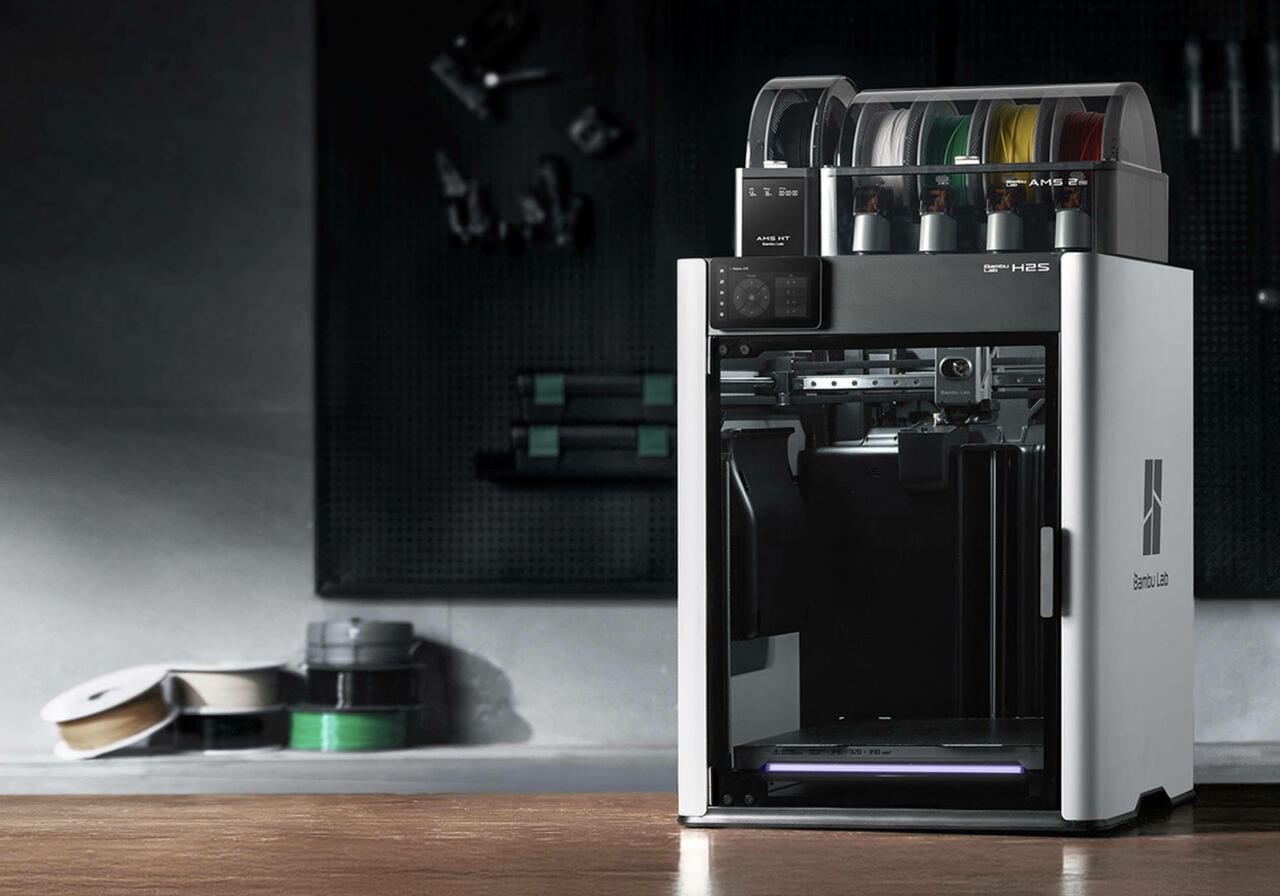 Bambu Lab H2S 3D Drucker (Image © Bambu Lab)
The main differences between the two models lie in the mechanics of the Z-axis. The H2S and the H2D share a fast drive system, a heated chamber, and multiple tooling options, but are aimed at different users.
A Shared Platform
Both models feature a closed, sophisticatedly designed chassis. They offer a build volume of 340x320x340 mm, enabling the printing of single parts that would often need to be split across smaller machines. The motion system achieves a print head speed of up to 1,000 mm/s with an acceleration of a seemingly absurd 20,000 mm/s² and is supported by a die-cast aluminum frame, which suppresses vibrations so that speed gains do not come at the expense of surface quality.
Designed for technical filaments
A 350 °C metal hotend and an actively heated 65 °C chamber extend the material capabilities beyond PLA and PETG to include PC, PA, and fiber-reinforced composites. The thermal profile of the enclosure is optimized for warpage control in larger geometries, making functional parts more predictable during long print runs.
AMS2 as a Combo
Both printers can be connected to the company’s automatic material system. Users can connect up to four AMS 2 Pro units or eight AMS HT units, enabling workflows with multiple materials and colors using up to 24 loaded filaments. For production or design labs, this means color coding, soluble supports, and custom blends without constant spool changes.
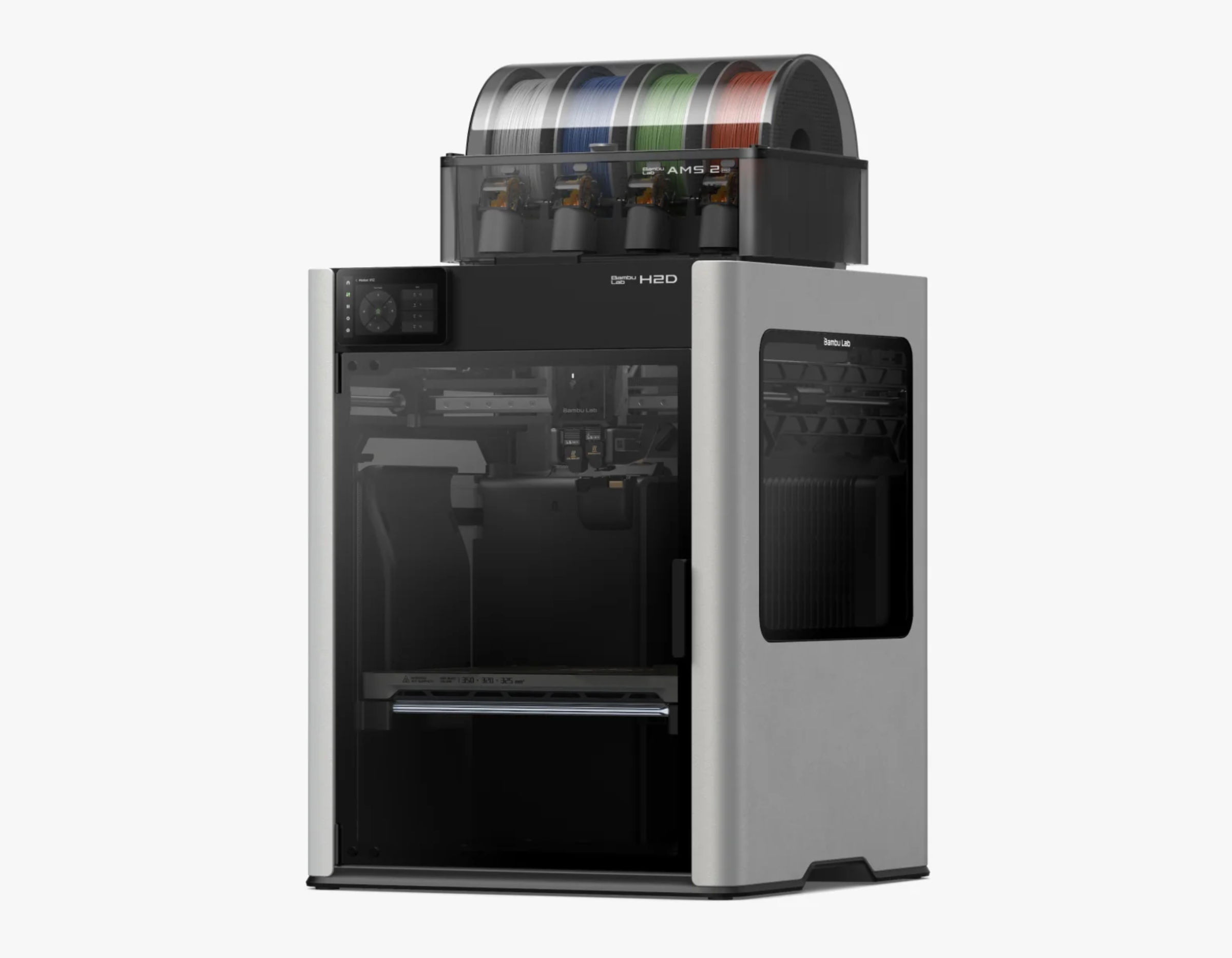 Bambu Lab H2D mit AMS2 (Image © Bambu Lab)
Differences between H2D and H2S
-
The H2D features a dual ball screw Z-axis designed for stability, minimal backlash, and repeatable layer registration for tall parts. This configuration is intended for applications with high height requirements or tight tolerances, such as interlocking mechanisms, precision fixtures, and research setups.
-
The H2S uses a Z-axis with a threaded spindle tuned for sub-50 µm tracking. It is designed for most use cases where speed, capacity, and consistent fit are priorities, ranging from small-batch production to educational labs and service providers.
In short:
- H2D for maximum mechanical accuracy;
- H2S for maximum value in most tasks.
| Bambu Lab H2S | Bambu Lab H2D | |
|---|---|---|
| Process | Fused Filament Fabrication (FFF) | Fused Filament Fabrication (FFF) |
| Configuration | 1x movable print head (forward/backward, left/right), 1x movable print bed (up/down) | 1x movable print head (forward/backward, left/right), 1x movable print bed (up/down) |
| Construction | All-metal frame, pre-assembled model, onboard controller, enclosed print chamber | All-metal frame, pre-assembled model, onboard controller, enclosed print chamber |
| Recommended materials | 1.75mm filament, ABS, PETG, PLA, TPU | 1.75mm filament, ABS, PETG, PLA, TPU |
| Print size | 340x320x340mm (WxHxD) | 300x325x320mm (WxHxD) (dual nozzle) |
| Contour formation | 1x print head (1x print nozzle with mono-feed, 0.40mm, steel, replaceable, max. 350°C), 1x direct extruder | 1x print head (2x print nozzles with mono-feed, 0.40mm, steel, replaceable, max. 350°C), 2x direct extruders |
| Speeds | max. 1000 mm/s printing | max. 600 mm/s printing |
| Print bed | rectangular, heated (0-120°C) | rectangular, heated (0-120°C) |
| Interfaces | 1x USB-B 2.0 (480 Mb/s), Wi-Fi 4 (802.11a/b/g/n) | 1x USB-B 2.0 (480 Mb/s), Wi-Fi 4 (802.11a/b/g/n) |
| Camera | 1920x1080 pixels (2.1MP) | 1920x1080 pixels (2.1MP) |
| Screen | 5" diagonal (1280x720 pixels), touchscreen, color | 5" diagonal (1280x720 pixels), touchscreen, color |
| Power supply | 1,170 - 2,050 W | 1,050 - 2,200 W |
| Dimensions (WxHxD) | 492 x 626 x 514 mm | 492 x 626 x 514 mm |
| Weight | 30 kg | 31 kg |
| Extras | - | 1x printer, laser engraving module |
| Features | Build chamber lighting, build chamber heating, build chamber ventilation (air filter, activated carbon filter, HEPA 12), Android | Build chamber lighting, laser engraving, Android |
| Operating environment | 0 - 35 °C | 0 - 35 °C |
| Price | €1,149 without AMS2 / €1,399 with AMS2 / €1,999 H2S Laser Full Combo | €1,899 without AMS2 / €2,199 with AMS2 / €2,799 H2S Laser Full Combo |
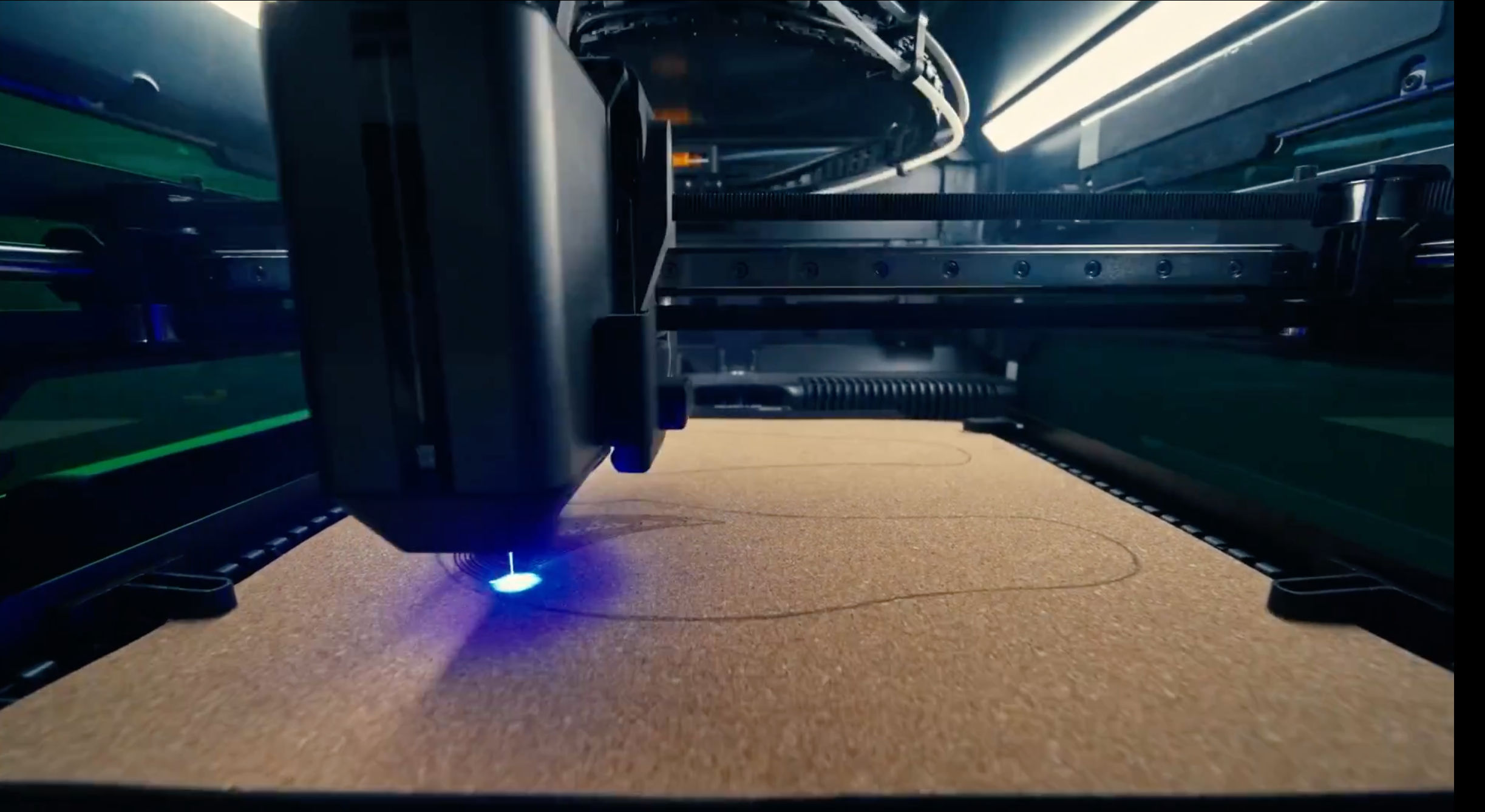 Bambu Lab H2D Laser (Image © Bambu Lab)
Multi-Tool Workflow for Both Models
Each enclosure supports a 10-W 455 nm laser module for cutting and engraving, a digital cutting tool for thin materials, and a drawing module for automated sketching. Typical functions include cutting ~5 mm plywood and engraving wood, leather, and dark acrylic with the laser, while the cutter processes paper, vinyl, and other thin materials for labels and stickers.
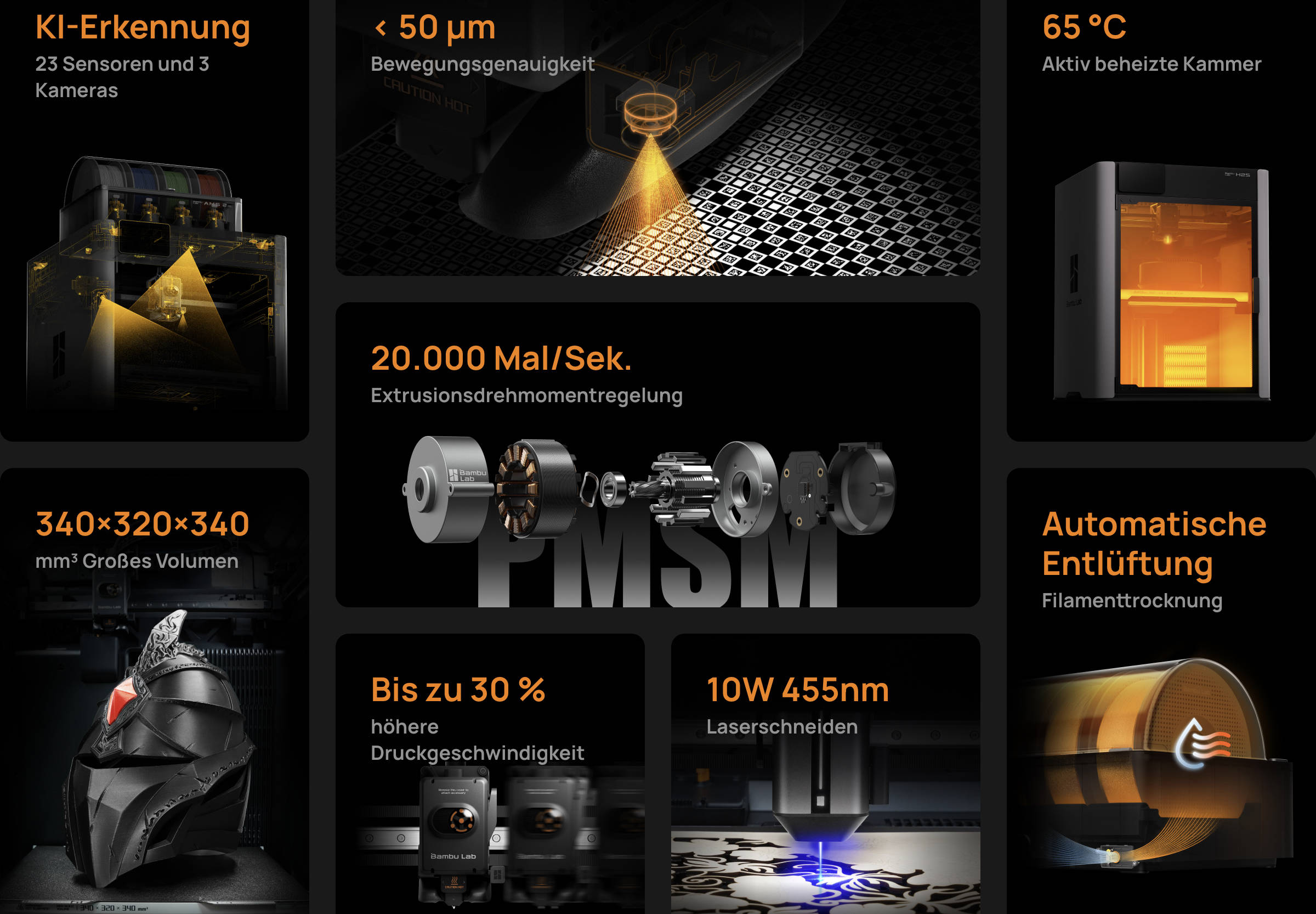 Bambu Lab H2S Features (Image © Bambu Lab)
The working areas vary slightly depending on the model:
- H2S at ~310 × 260 mm (laser) and ~297.5 × 300 mm (cutting)
- H2D at ~310 × 270 mm (laser) and ~300 × 285 mm (cutting)
A sensor suite with 23 inputs and three integrated cameras feeds an AI-based image processing system that detects common issues such as stringing or blob formation and verifies the start parameters before the first layer. Active vibration damping ensures consistent surface quality at higher speeds, while automatic hole and contour compensation helps parts land closer to nominal dimensions. Maintenance is optimized by a tool-free nozzle change that takes only a few seconds.
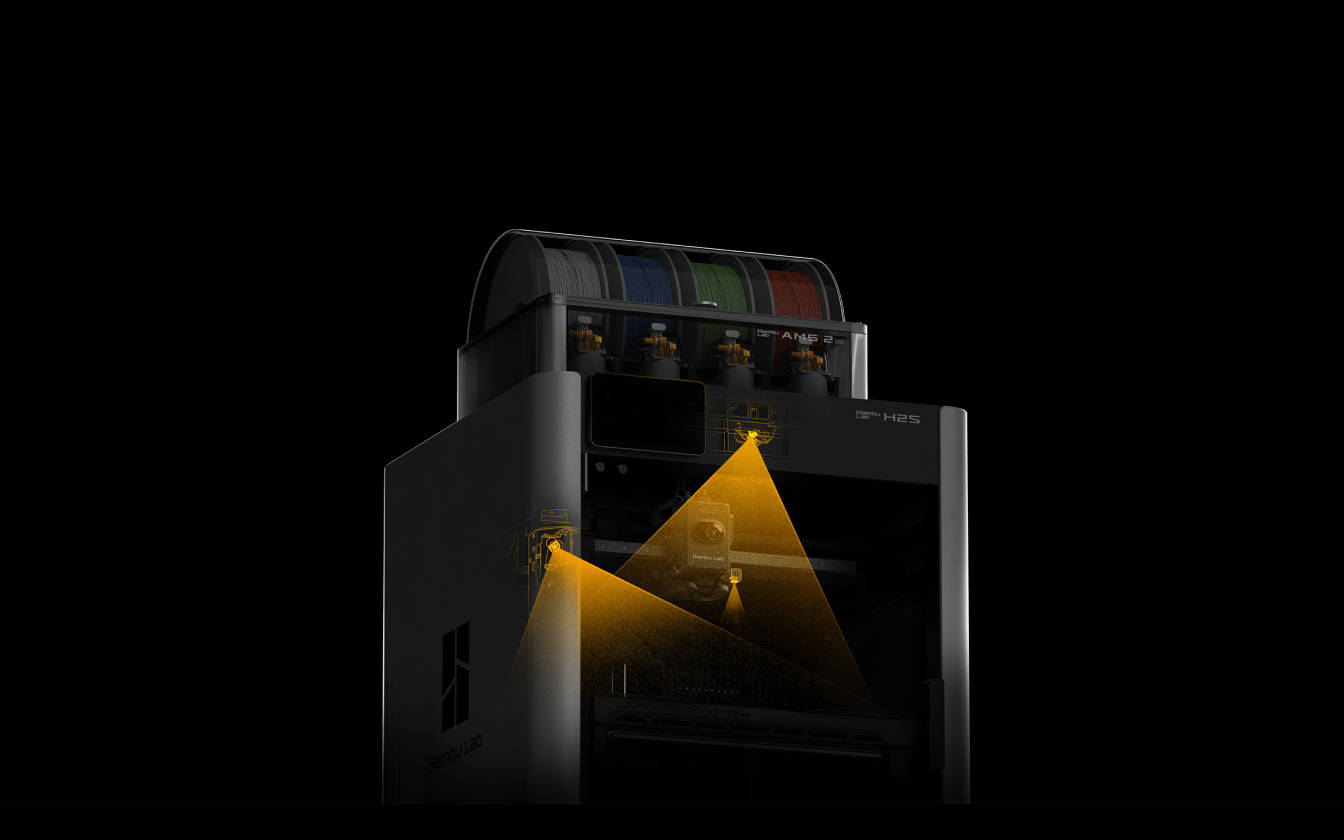 Bambu Lab H2S H2D Messung (Image © Bambu Lab)
Who the H2D and H2S are designed for

The H2S is the all-rounder: fast, large-format, and compatible with multiple tools, with Z-axis precision that meets nearly all professional and educational requirements.
The H2D is the specialist: an upgrade for teams that regularly print very tall components or assemblies with tight tolerances, where the rigidity and repeatability of the Z-axis are essential.