
 Computer Forum
 Claude Haiku 5 5 Release (Image © Anthropic)
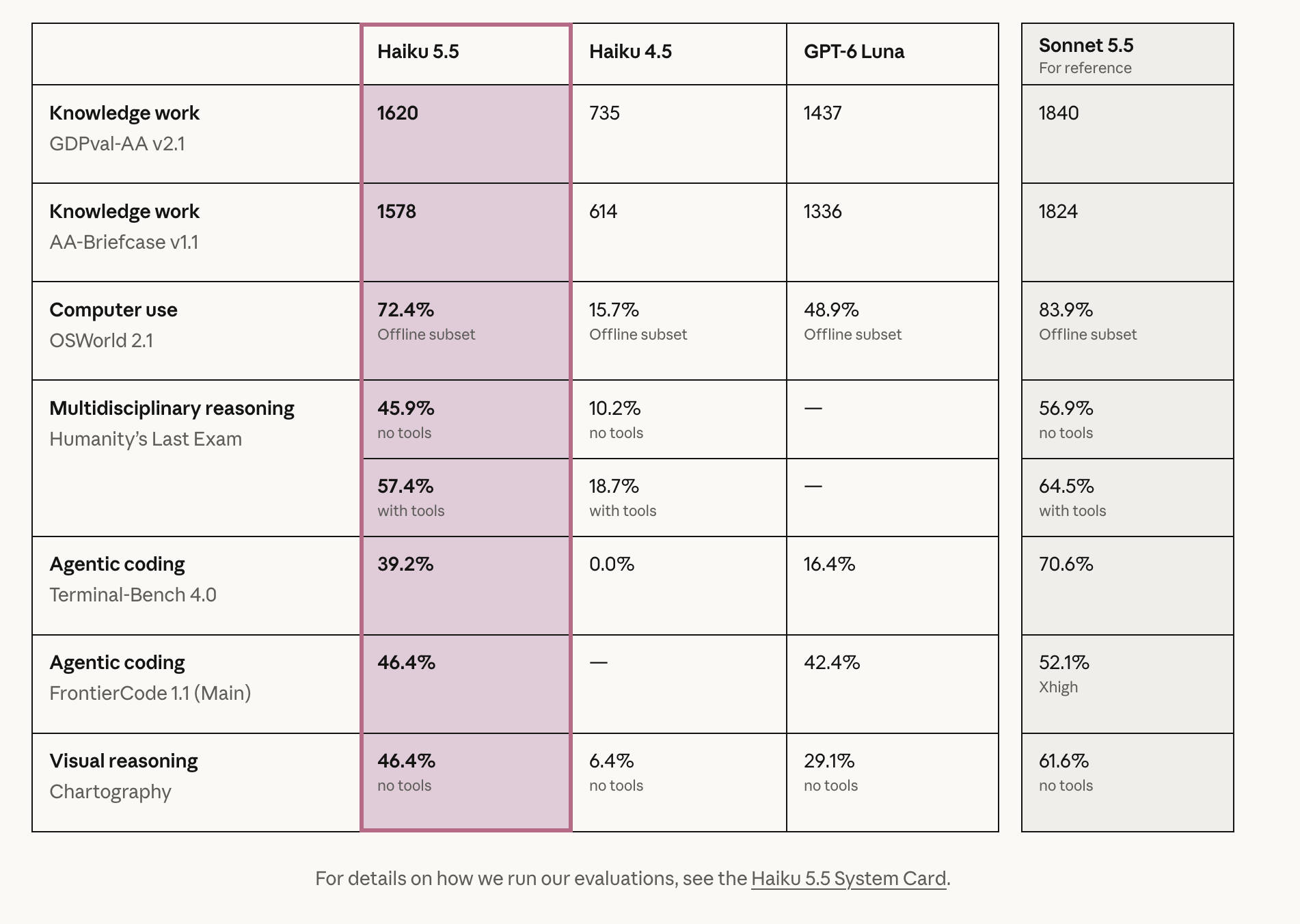
Claude Haiku 5.5 shows significant performance improvements over its predecessor, Haiku 4.5, and can compete with other small models such as GPT-6 Luna. In knowledge-work evaluations, the model scored 1,620 points on GDPval-AA v2.1 and 1,578 points on AA-Briefcase v1.1, representing a significant increase over the 735 and 614 points, respectively, achieved by Haiku 4.5.
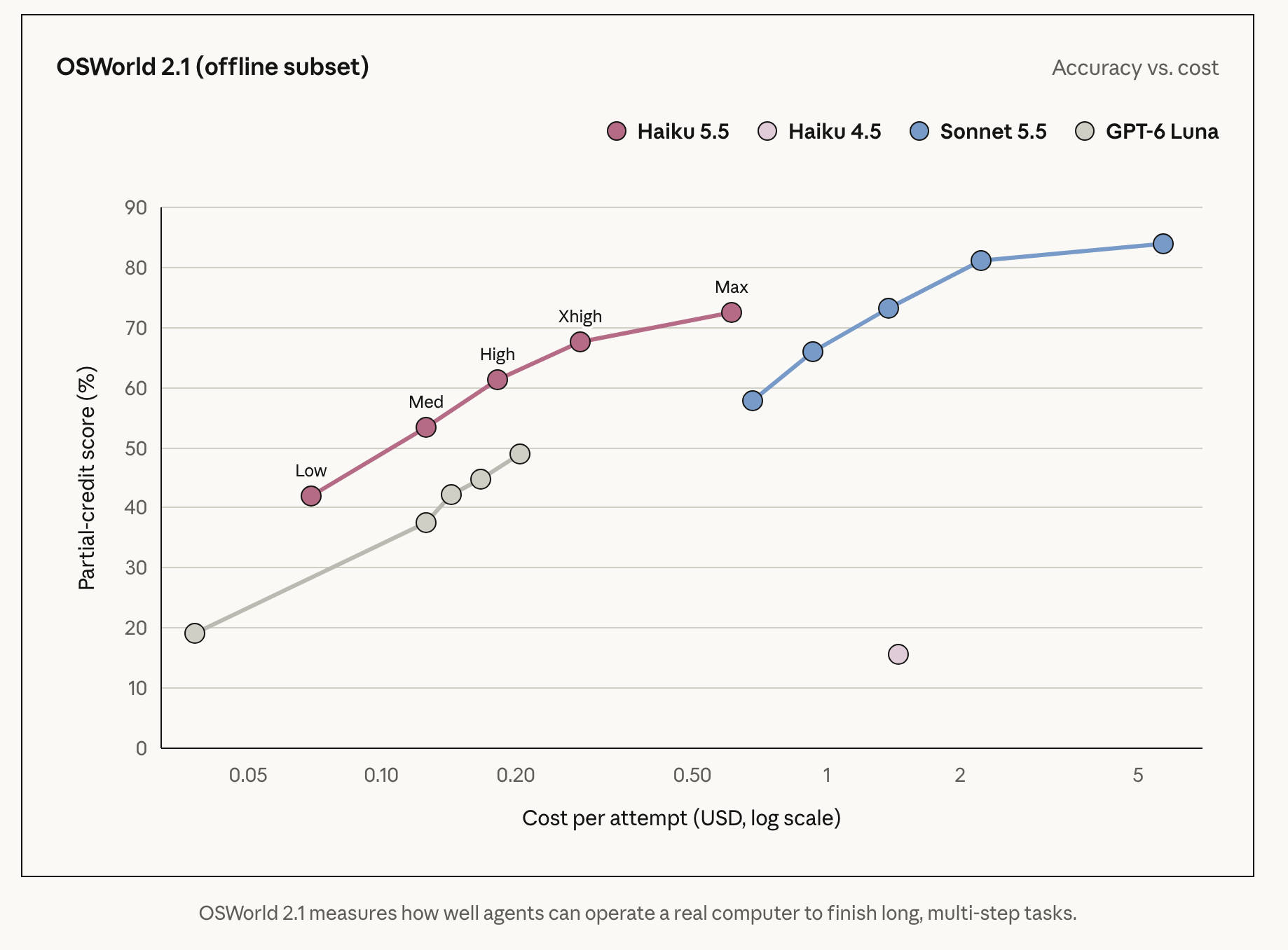
In the area of computer use, the model achieved an accuracy rate of 72.4% on the offline subset of OSWorld 2.1, significantly outperforming Haiku 4.5 (15.7%) and GPT-6 Luna (48.9%). Multidisciplinary reasoning tests using “Humanity’s Last Exam” yielded a success rate of 45.9% without aids, which increased to 57.4% when aids were used. In addition, the model demonstrates improved capabilities in agentic coding, achieving 39.2% on “Terminal-Bench 4.0” and 46.4% on “FrontierCode 1.1.” Its performance in visual reasoning was also remarkable: on “Chartography,” it achieved 46.4% without aids.
 Claude Haiku 5 5 Benchmarks (Image © Anthropic)
 Claude Haiku 5 5OSWorld 2 1 (Image © Anthropic)
A new feature of the Haiku class is the adjustable effort level. This allows operators to balance computational effort against intelligence level and adapt the model’s processing depth to the specific requirements of the task.
 Claude Haiku 5 5 Preise (Image © Anthropic)
Claude Haiku 5.5 Pricing Structure
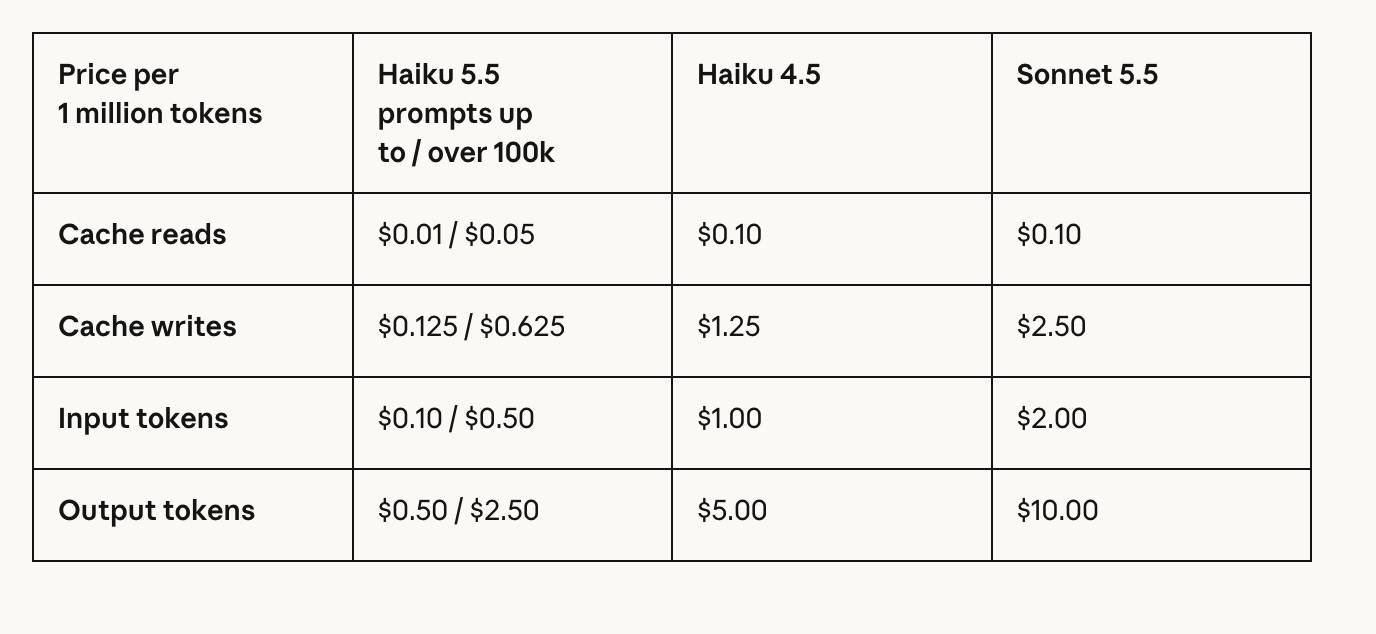
The operating costs of Claude Haiku 5.5 have decreased by approximately 75% compared to Haiku 4.5. The pricing model is tiered based on input length and offers the greatest value for queries under 100,000 tokens.
The following costs apply to inputs under 100,000 tokens:
- Cache reads: $0.01 per million tokens
- Cache writes: $0.125 per million tokens
- Input tokens: $0.10 per million tokens
- Output tokens: $0.50 per million tokens
For prompts with more than 100,000 tokens, the costs increase to $0.05 for cache reads, $0.625 for cache writes, $0.50 for input tokens, and $2.50 for output tokens.
Security, Alignment, and Governance
Compared to Haiku 4.5, the model exhibits improved alignment, with a reduction in misbehavior and a lower tendency to cooperate with requests for abuse.
Cybersecurity measures have been refined and are now more restrictive than in Haiku 4.5, though they remain less stringent than the measures applied to the Sonnet and Opus series. Specifically, the model permits defensive cybersecurity tasks but blocks techniques associated with penetration testing and offensive attacks. The biosecurity measures are aligned with those of the Sonnet and Opus series and permit legitimate research requests while restricting access to information that could facilitate biological harm. Organizations requiring more extensive access can apply through the “Life Sciences” and “Cyber Verification” programs.
Integration and Availability
Claude Haiku 5.5 is now available for use on various cloud platforms, including Amazon Web Services, Google Cloud, and Microsoft Azure. Developers accessing the Claude platform can implement the model using the claude-haiku-5.5 identifier.
Model Family Updates and API Credits
In conjunction with the release of Haiku 5.5, pricing adjustments have been made for Claude Sonnet 5.5. The cost of cache reads for Sonnet 5.5 has been reduced by 50% and is now $0.10 per million tokens. This change results in a cost reduction of approximately 20% for most agent-based tasks that use Sonnet 5.5. To facilitate the development of new applications and agents, a monthly API credit system has been introduced for Max and Team subscribers. These credits are distributed as follows:
- Max 5x users: $100 per month
- Max 20x users: $200 per month
- Team subscribers: Up to $500, split among users
In addition, the Python and TypeScript SDKs have been updated and now offer beta support for use in the browser and on the desktop, leveraging the speed and cost-efficiency of the Haiku 5.5 architecture.