
 Computer Forum
[page “Technical Background of the Tensor Restriction”]
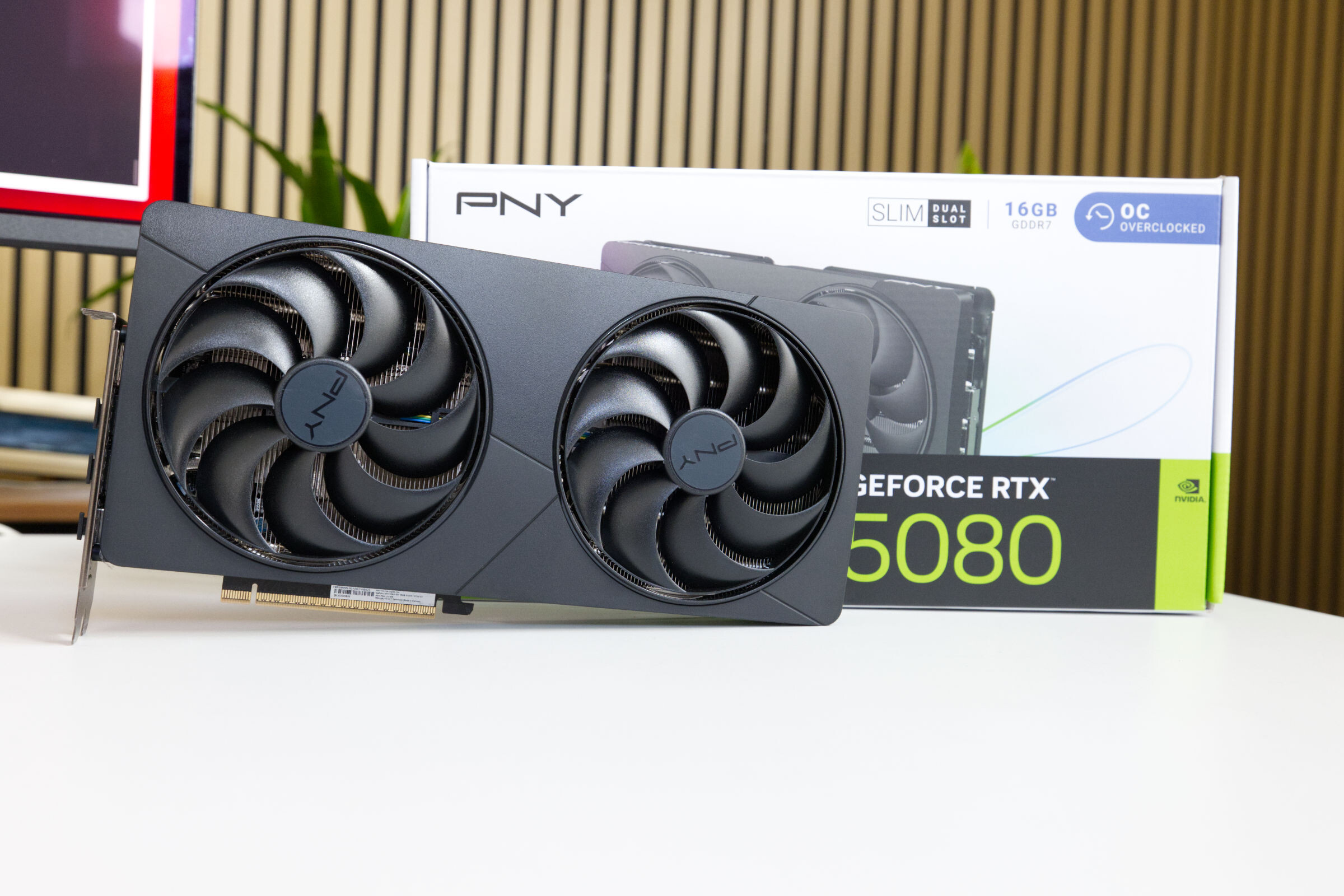 PNY GeForce RTX 5080 SLIM OC Fazit (Image © PCMasters.de)
Currently, three separate developer projects have successfully circumvented these restrictions on select GeForce RTX 20 (Turing), RTX 30 (Ampere), and RTX 40 (Ada Lovelace) hardware. These workarounds run in Linux environments and are based on previous research into the firmware of Nvidia’s CMP-series mining cards.
Technical Background of the Tensor Restriction
The restriction does not apply to all Tensor operations. Instead, it targets specific combinations of number formats and accumulation methods. This is particularly evident with BF16, a format widely used in modern AI models. On affected GeForce cards, BF16 computations with FP32 accumulation are forcibly routed through a restricted computation path.
The workaround projects modify the GPU configuration so that the Tensor cores can operate at a higher throughput for these specific operations. This process involves neither adding new processing units nor expanding the graphics memory. The implementation for Ampere and Ada Lovelace uses a Linux kernel module that is loaded during the initramfs phase. This allows the module to run before the standard NVIDIA driver takes control of the GPU. The system boots a signed NVIDIA firmware with a payload that configures the registers of the streaming multiprocessors for a higher compute rate and resets the PCIe functionality. The original NVIDIA driver then initializes the GPU as usual. This method does not require a modified VBIOS or patched drivers; however, the changes are volatile and must be reapplied after every reboot.
Ampere Architecture and the gpu-unlock Project
The most mature solution is offered by the “gpu-unlock 1.0.0” project developed by Zagitta. This kernel module supports processors from GA102 to GA106, covering a large portion of the RTX 30 series.
The performance gains in synthetic tests are substantial. On a GeForce RTX 3090 Ti with a power limit of 450 watts, the BF16 throughput increased from 87.5 to 157.4 TFLOPS. The TF32 performance saw an even greater jump, rising from 42.6 to 82.6 TFLOPS.
Installation is automatic via the “make install” command, which creates a package for the detected Linux distribution. Activation is then performed using the kernel parameter “gpu_unlock.targets=all.” User reports indicate that the system remains stable even when the GPU is driving a display at the same time.
Ada Lovelace and the “gpu-unlock-ada” Project
For the RTX 40 series, the “gpu-unlock-ada 1.1.1” project targets the AD102 processor. On a GeForce RTX 4090, the throughput for FP16 and BF16 computations with FP32 accumulation nearly doubled from 165.6 to 331.6 TFLOPS. Experimental support for the RTX 4070 Ti Super with the AD103 processor has also been documented. While the FP16, BF16, and TF32 rates increased significantly, the FP8 throughput showed only a negligible improvement of just 0.3 percent.
Turing Architecture and Experimental Status
Development for the RTX 20 series is not yet as far along. The “Turing Unlock” project has demonstrated a successful proof of concept using an Asus GeForce RTX 2080 Ti. Unlike the Ampere and Ada solutions, this project uses an EFI loader that runs before the operating system boots. In theoretical tests, the FP16 matrix computation performance on the RTX 2080 Ti increased from 46.9 to 93.7 TFLOPS. A cuBLAS matrix multiplication test showed a 77 percent performance increase. Currently, there is no installer for this project, and it remains limited to a single documented hardware configuration.
Impact on Local AI Workloads and Image Generation
Higher tensor throughput does not linearly translate to faster AI performance for all tasks. The benefit depends on whether the respective workload is limited by matrix operations or by memory bandwidth. For large language models, the “prefill” phase—during which the model processes the initial prompt—benefits the most. Users have reported speed increases of between 14 and 36 percent during this phase. However, the actual generation of text tokens shows little to no improvement. This is because token output is primarily limited by the memory bandwidth of the GDDR6X VRAM, which these firmware optimizations do not affect.
More significant gains can be achieved in image generation. When using ComfyUI with BF16 models on an RTX 3090 Ti, throughput increased by 47 to 59 percent. This is due to the repetitive, computationally intensive matrix calculations required during the image synthesis process.
| Card | Mode | Stock Quantity | Unlocked | Boost |
|---|---|---|---|---|
| RTX 4090 | f16/f32 | 165.6 | 330.8 | 2.00× |
| RTX 4090 | bf16/f32 | 165.5 | 330.3 | 2.00× |
| RTX 4070 Ti SUPER | f16/f32 | 95.0 | 189.0 | 1.99× |
| RTX 4070 Ti SUPER | tf32 | 47.5 | 94.5 | 1.99× |
| RTX 2080 Ti | f16/f32 | 50.3 | 68.3 | 1.36× |
| RTX 2080 Ti | f16/f32 | 55.7 | 91.4 | 1.64× |
| RTX 2080 Ti | f16/f32 | 53.7 | 81.7 | 1.52× |
| >RTX 2080 Ti | f16/f32 | 52.8 | 77.9 | 1.48× |
Graphics Cards Tested:
These are some of the graphics cards that can be unlocked:
- GeForce RTX 4090: 10de:2684AD102 +99–100%
- GeForce RTX 4070 Ti SUPER: 10de:2705AD103 +99%
- GeForce RTX 2080 Ti: 10de:1e07TU102 +36–64%
- GeForce RTX 3090 Ti: 10de:2203GA102
- GeForce RTX 3090: 10de:2204GA102
- GeForce RTX 3080 10 GB: 10de:2206GA102
- GeForce RTX 3080 20 GB (memory upgrade): 10de:2206GA102
- GeForce RTX 3070: 10de:2484GA104
[end of page]