 Computer Forum
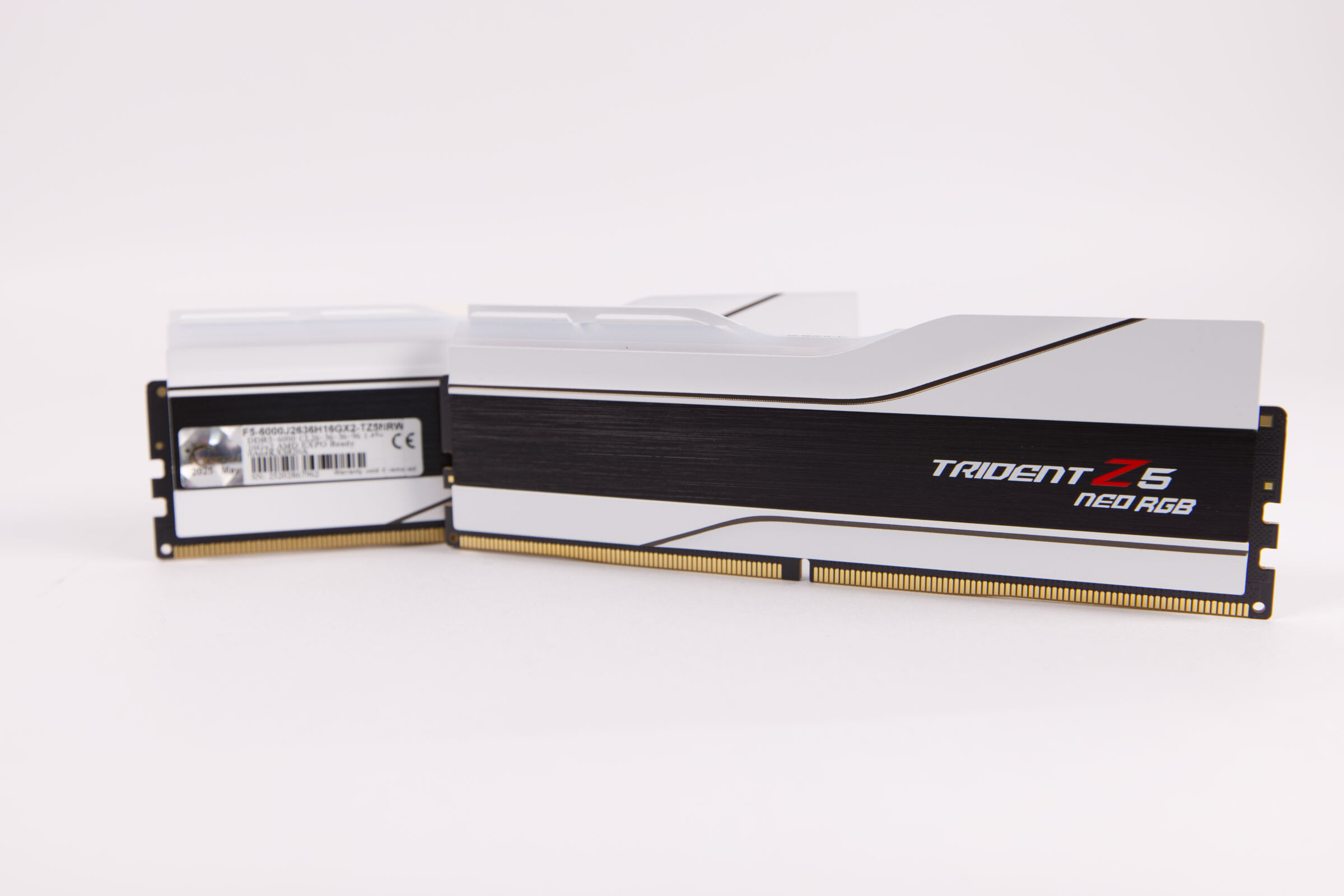 G Skill Trident Z5 NEO RGB 32 GB Kit DDR5 6000 CL26 Test Review (Image © PCMasters.de)
G.Skill Trident Z5 NEO RGB DDR5-6000 in Detail
The Trident Z5 NEO RGB kits are available in black and white. When it comes to specifications, there’s much more variety, and Geizhals currently lists a total of 68 variants in the series. The range extends from DDR5-6000 to DDR5-8000, and the higher clock speeds are controlled via dedicated EXPO/XMP profiles. G.SKILL pre-tests the memory modules against these specifications. The variant in our test is "only" rated for 6,000 MT/s, but it operates at crisp CL26-36-36-96 timings. This leaves plenty of room for anyone who wants to manually overclock the RAM to even higher frequencies.
There are also many options when it comes to capacities, as G.Skill offers various kits ranging from 24 to 256 GB. Prices have skyrocketed due to the memory crisis, which is why even 32-GB kits are already very expensive. We couldn’t find any 16-GB kits, and the only ones in stock were the 24-GB versions, which cost €472. This is primarily due to the shortage, which continues to drive up prices. The kit in our test cost 240 € a year ago and, at the time of testing, is listed by only one retailer for 1,439 €. Prices are now far beyond what is affordable and what an end customer would be willing to pay.
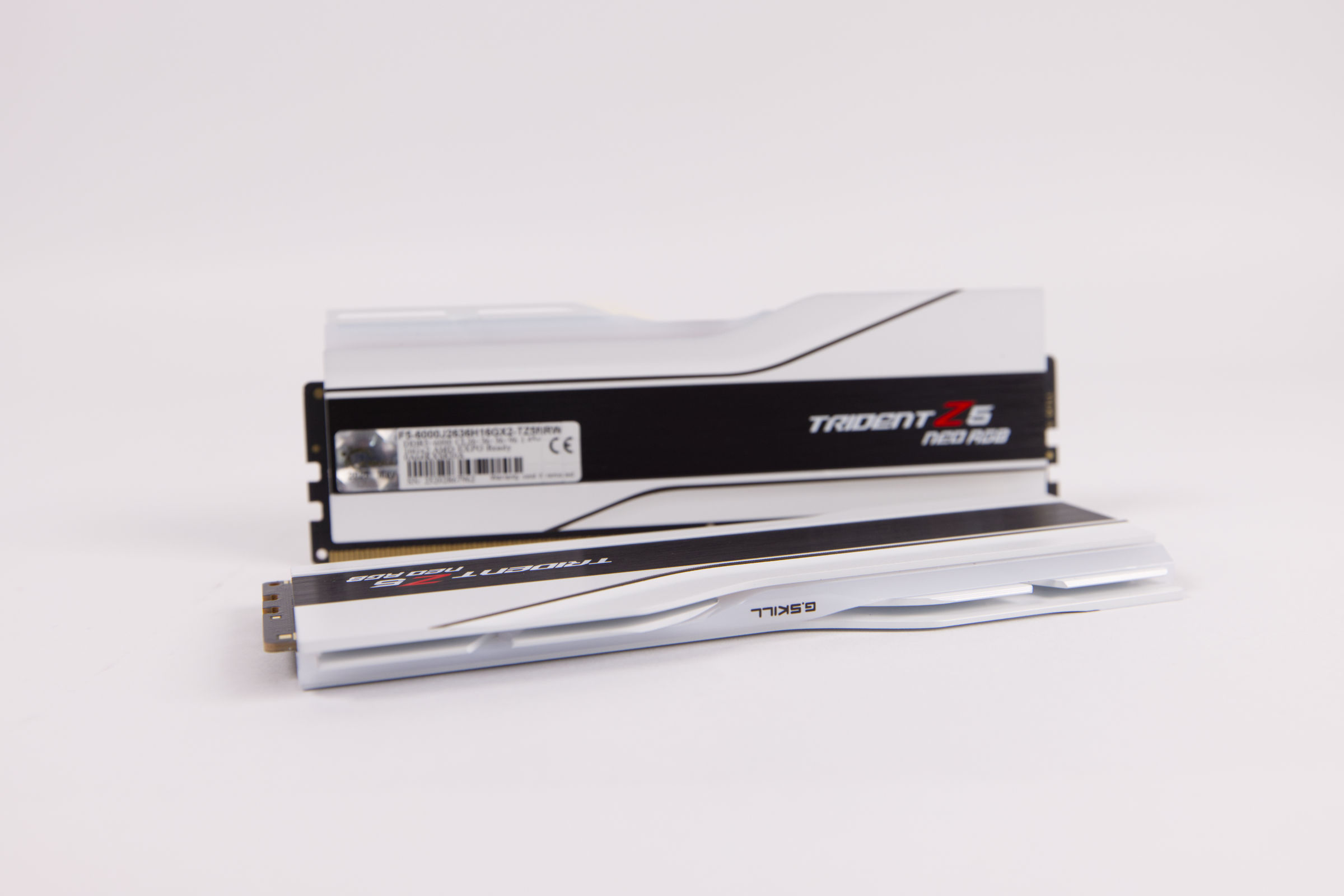 G Skill Trident Z5 NEO RGB 32 GB Kit DDR5 6000 CL26 Logo oben (Image © PCMasters.de)
The design remains true to the Trident Z series and continues to feature a sandwich-style cooler with many curved shapes. With a white kit, we would have actually expected the thick black stripes on the sides to be absent, as they stand out quite noticeably. The two elements on the sides are made of aluminum and are mostly matte with some polished lines on the surface. Aluminum is an ideal material because it also dissipates the waste heat from the DDR5 chips more effectively. As usual, the aluminum elements are glued to the memory modules.
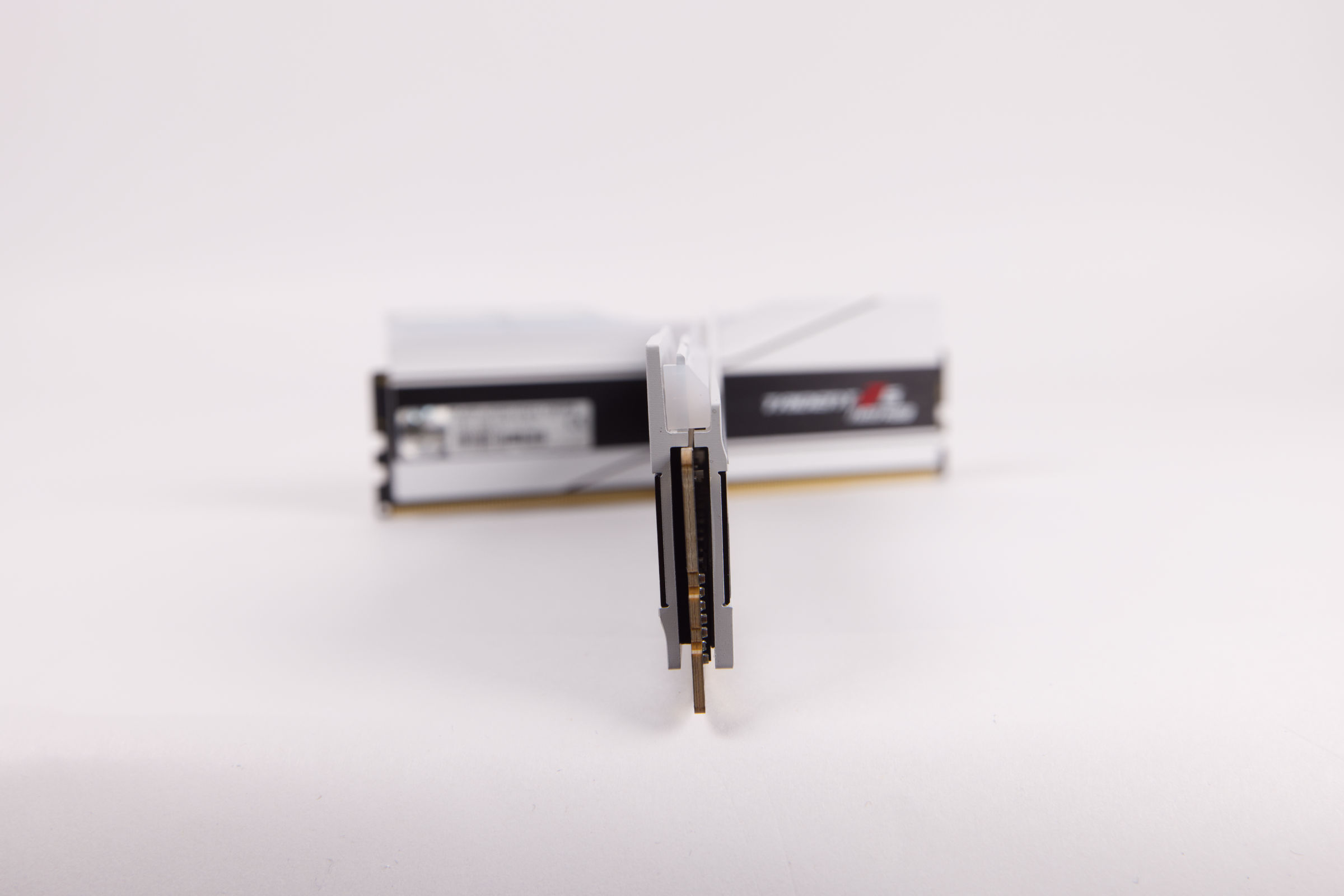 G Skill Trident Z5 NEO RGB 32 GB Kit DDR5 6000 CL26 RAM Aufbau (Image © PCMasters.de)
With a height of 43.5 mm, the RAM is about average and shouldn’t have any compatibility issues.
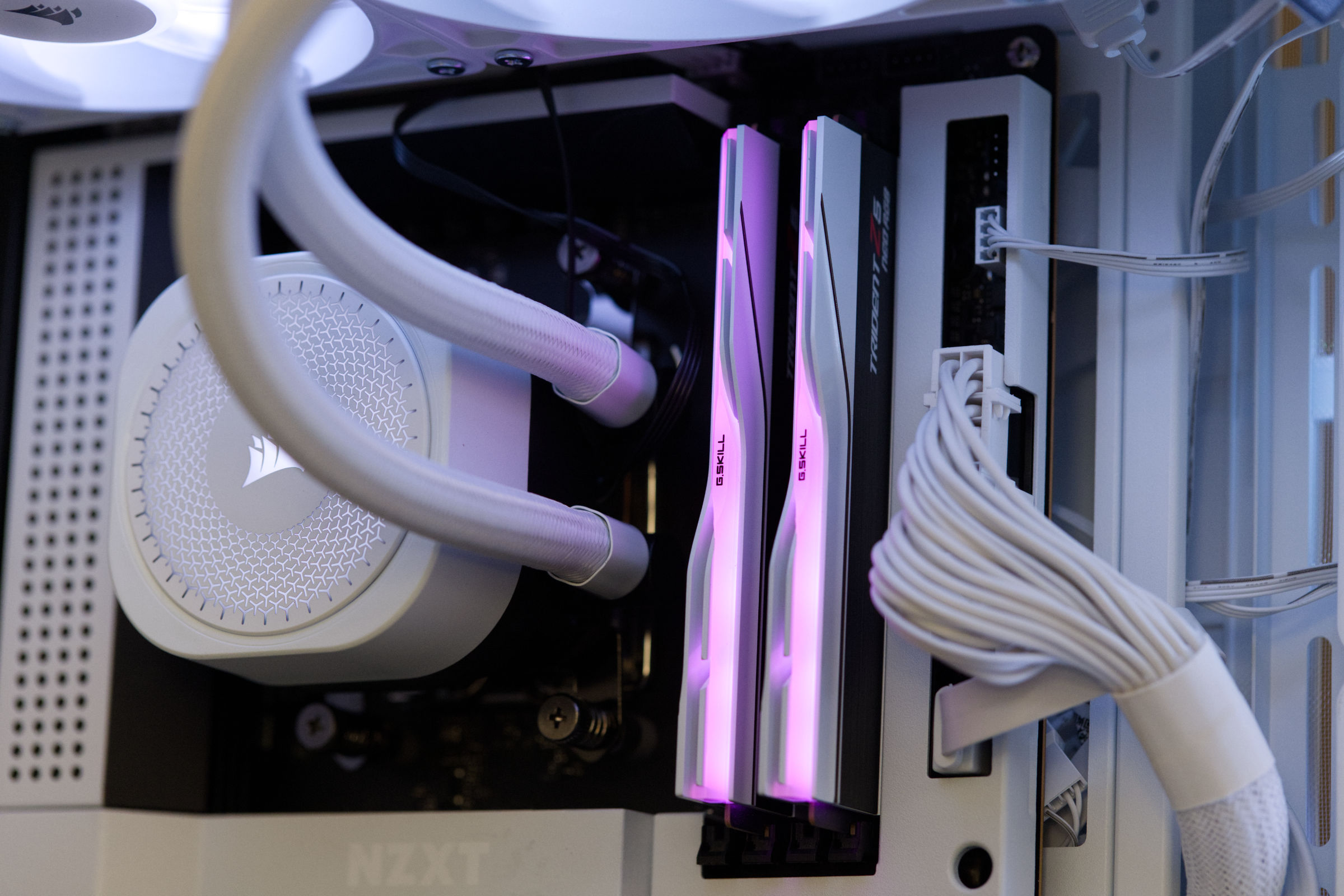 G Skill Trident Z5 NEO RGB 32 GB Kit DDR5 6000 CL26 RGB (Image © PCMasters.de)
ARGB Lighting with a Great Effect
As soon as the system is powered on, the subtly recessed ARGB lighting turns on. The milky plastic in the center of the memory module then lights up, and the light is further diffused by the aluminum on the sides, creating a very beautiful effect. Depending on your perspective, you may not see the entire strip, which further emphasizes the wave-like design.
If you want to control the lighting, you can use G.Skill’s Trident Z Lighting Control software, or you can synchronize it via your motherboard’s software. All common interfaces are supported, including ASUS Aura Sync, Gigabyte RGB Fusion 2, MSI Mystic Light Sync, and ASRock Polychrome Sync.
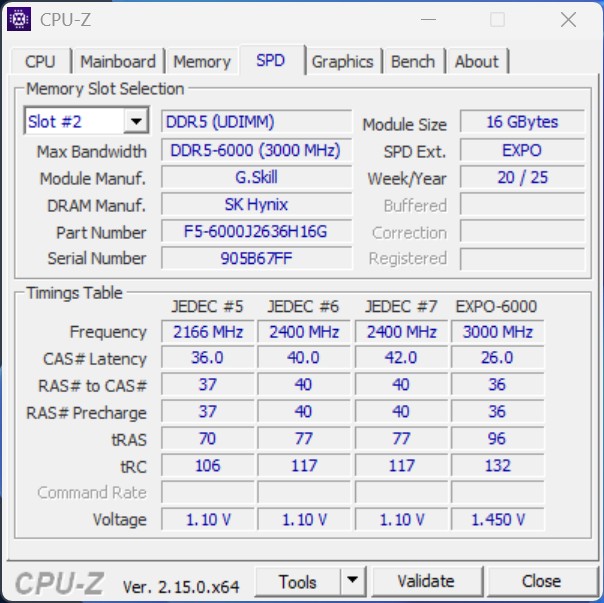 G Skill Trident Z5 NEO RGB 32GB DDR5 6000 CPU z SPD (Image © PCMasters.de)
Profiles for Intel and AMD Platforms
G.Skill’s Trident Z5 NEO RGB series also offers support for both Intel and AMD memory profiles. The memory is compatible with Intel XMP 3.0 and AMD EXPO. However, the focus is on the AM5 platform, so you’re always on the safe side with Ryzen 7000 and 9000 series processors. To activate these performance settings, you must select the appropriate profile in the BIOS at system startup, which triggers a reboot to apply the configuration.
The modules feature on-die error correction (ECC), a standard feature of DDR5 that internally detects and corrects bit errors. This feature is designed to ensure data integrity during resource-intensive tasks such as software compilation, 3D rendering, and complex simulations. However, it is not true ECC RAM and is unbuffered.
Power management is handled by an integrated Power Management Integrated Circuit (PMIC) located directly on the memory module. This component regulates the voltage and minimizes fluctuations, ensuring stability when power profiles are active.
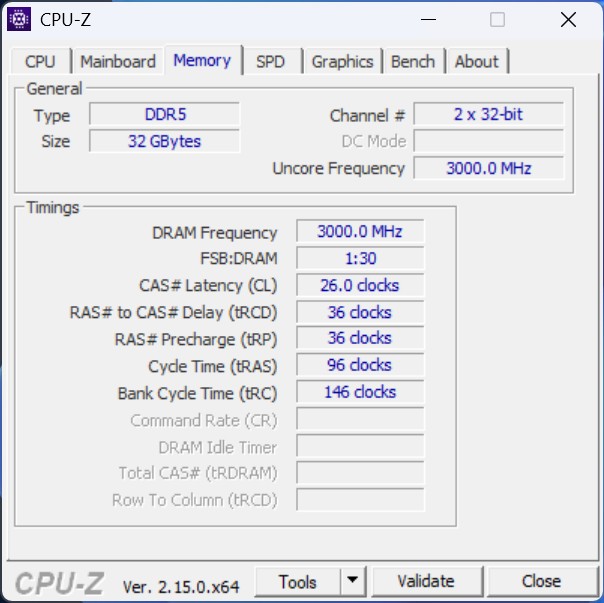 G Skill Trident Z5 NEO RGB 32GB DDR5 6000 CPU z Memory (Image © PCMasters.de)
Under standard JEDEC SPD settings, the memory runs at 2,400 MHz with CAS latencies of 42-40-40-77-117 at 1.1 V. These default settings ensure broad system compatibility and stability during the first system boot. To achieve the product’s rated speeds, the EXPO profile is activated, which increases the operating voltage to 1.450 V. The timings, however, then drop to a crisp 26-36-36-96-132.
G.Skill Trident Z5 NEO RGB 32 GB DDR5-6000 Specifications
The modules’ specifications include two JEDEC profiles, as well as one XMP-6000 profile and one EXPO-6000 profile. Below is a list of the available profiles:
| JEDEC #5 | JEDEC #6 | JEDEC #7 | EXPO-6000 | |
|---|---|---|---|---|
| Clock Rate | 2,166 | 2,400 | 2,400 | 3,000 |
| MT/s | 4.332 | 4.800 | 4.800 | 6.000 |
| CAS Latency CL | 36 | 40 | 42 | 26 |
| RAS# to CAS# Read Delay | 37 | 40 | 40 | 36 |
| RAS# to CAS# Write Delay | 37 | 40 | 40 | 36 |
| RAS# PRE Time | 70 | 77 | 77 | 96 |
| Row Cycle Time (TRC) | 106 | 117 | 117 | 132 |
| Voltage | 1.1 V | 1.1 V | 1.1 V | 1.45 V |
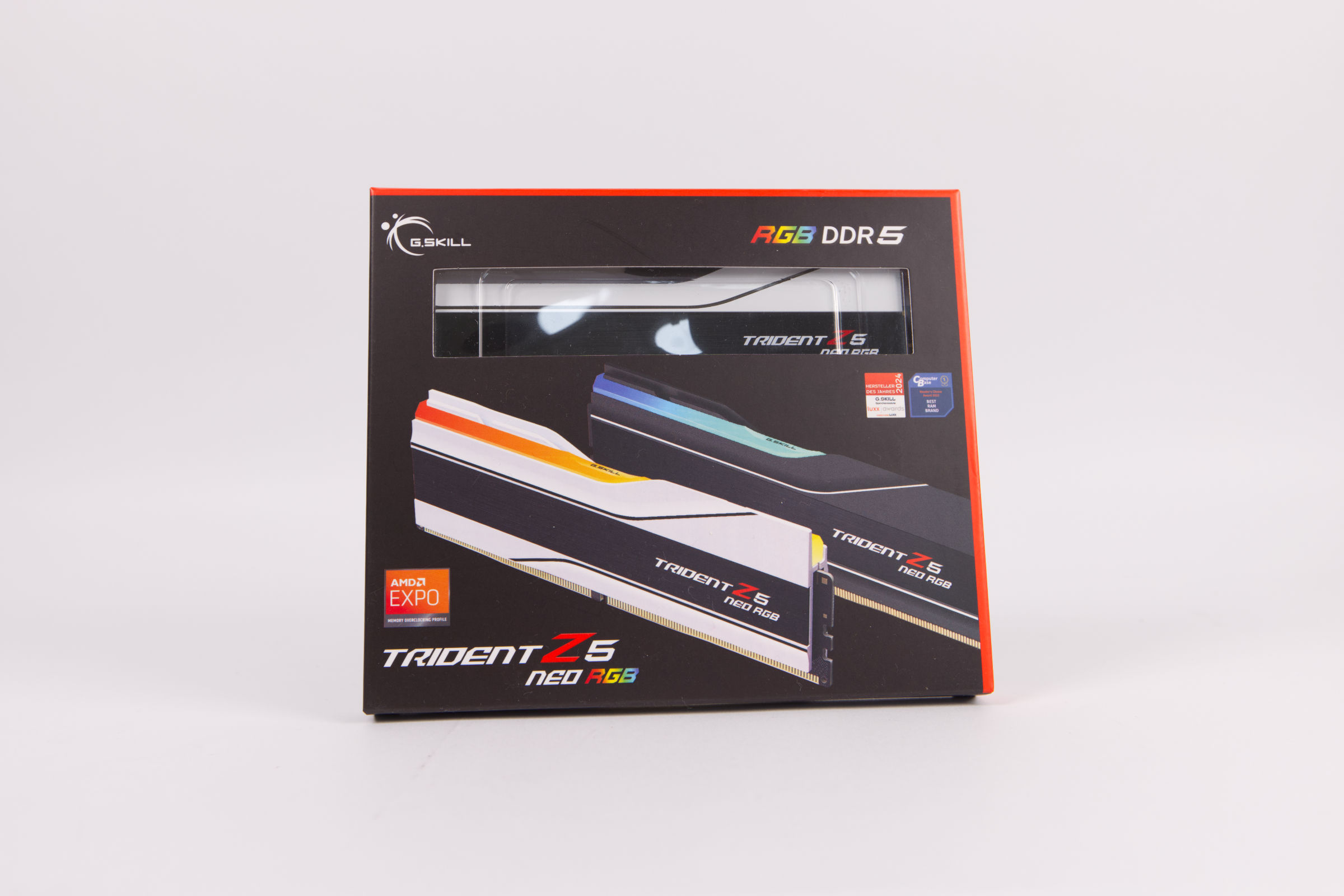 G Skill Trident Z5 NEO RGB 32 GB Kit DDR5 6000 CL26 Verpackung (Image © PCMasters.de)
Packaging and Contents
The packaging features a design typical of G.Skill. The outer layer is made of printed cardboard, providing space for information and feature highlights. There is an opening at the top that offers a view of the actual RAM module. You can see the specs and serial numbers through the opening.
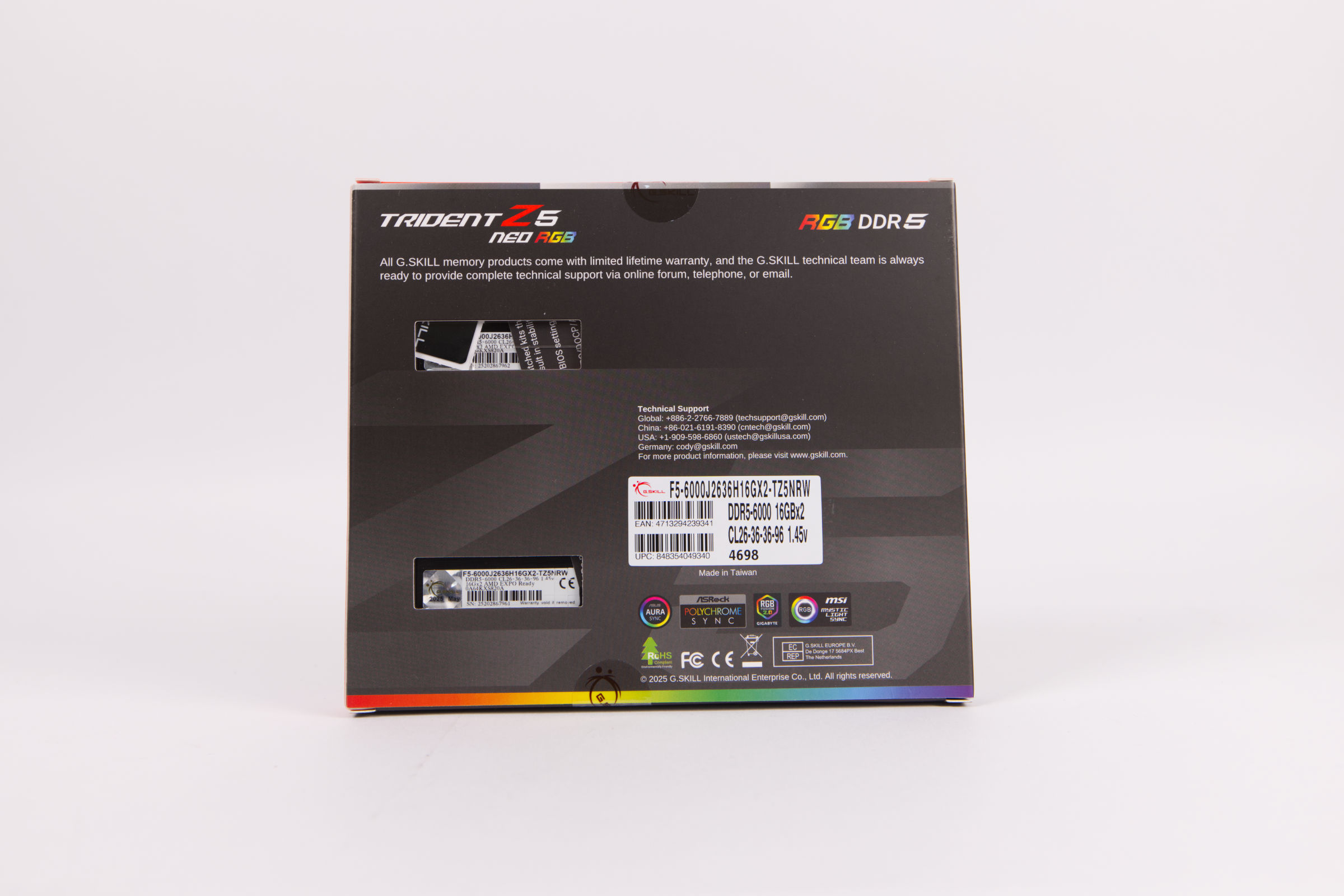 G Skill Trident Z5 NEO RGB 32 GB Kit DDR5 6000 CL26 Verpackungsrückseite (Image © PCMasters.de)
The back of the box provides detailed information and includes a sticker for identifying the modules inside the box. Inside the packaging, the RAM is secured in a blister pack.
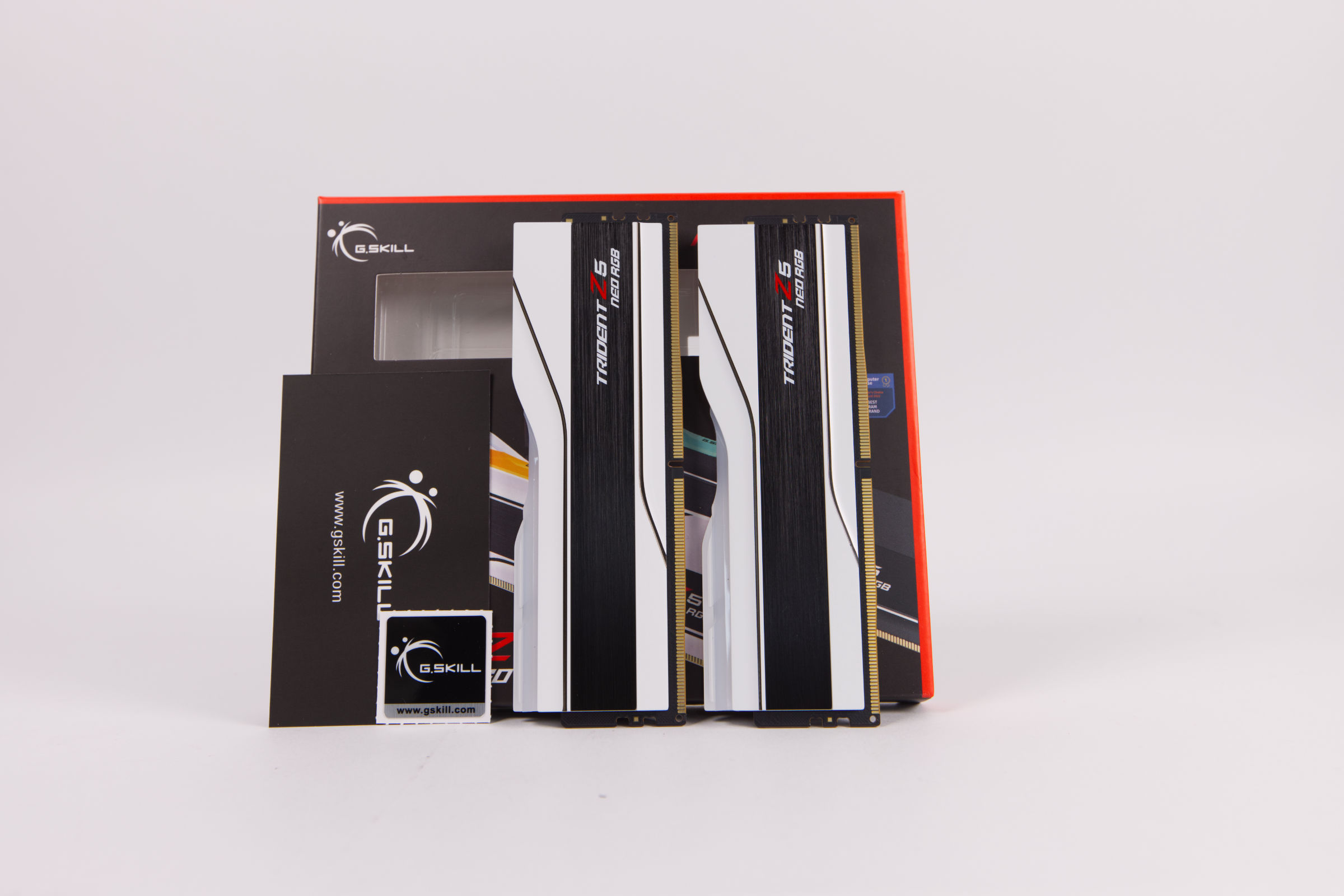 G Skill Trident Z5 NEO RGB 32 GB Kit DDR5 6000 CL26 Lieferumfang (Image © PCMasters.de)
In addition to the two RAM modules, the package also includes an information card and a G.Skill sticker for the PC case.
The Test System
The tests are conducted on the CPU test system. The setup is as follows:
The Test System
-
CPU: AMD Ryzen 7 7800X3D
- Motherboard: ASUS ROG CROSSHAIR X870E HERO
- M.2 SSD: G.Skill MP600 Elite, WD_Blue SN580 1 TB
- CPU cooler: DeepCool LS720
-
Power supply: NZXT C1500 Platinum
- Fans: 0
- Case: CoolerMaster Benchtable (open)
This memory is up against other modules we’ve already tested. Below is a table of the key specifications.
| G.Skill Trident Z5 NEO RGB 32 GB, @DDR5-7800 | G.Skill Trident Z5 NEO RGB 32 GB, DDR5-6000 | G.Skill Trident Z5 Royal RGB 48 GB, DDR5-6800 | G.Skill Dominator Titanium 48 GB @8000 MT/s | G.Skill Dominator Titanium 48 GB @7000 MT/s | G.Skill Dominator Titanium 48 GB DDR5-6000 | Lexar ARES 2 RGB Black DIMM Kit 32 GB, DDR5-8000 | Lexar ARES RGB Black DIMM Kit 32GB, DDR5-6400 | XPG LANCER NEON RGB 32 GB DDR5-6000 | G.Skill Trident Z5 Royal RGB Silver 64 GB, DDR5-6400 | |
|---|---|---|---|---|---|---|---|---|---|---|
| Model No. | F5-6000J2636H16GX2-TZ5NRW | F5-6000J2636H16GX2-TZ5NRW | F5-6800J3446F48GX2-TR5S | CMP48GX5M2B6000C30 | CMP48GX5M2B6000C30 | CMP48GX5M2B6000C30 | LD5EU016G-R6400GDLA | AX5U6000C3016G-DCLANRSG | LD5EU016G-R 6400GDLA | F5-6400J3239G32GX2-TR5S |
| Clock rate | 7,800 MT/s | 6,000 MT/s | 6,800 MT/s | 8,000 MT/s | 7,000 MT/s | 6,000 MT/s | 8,000 MT/s | 6,400 MT/s | 6,000 MT/s | 6,400 MT/s |
| Capacity | 2 x 16 GB | 2 x 16 GB | 2 x 24 GB | 2 x 24 GB | 2 x 24 GB | 2 x 24 GB | 2 x 16 GB | 2 x 16 GB | 2 x 16 GB | 2 x 32 GB |
| CAS Latency CL | 34 | 26 | 34 | 38 | 36 | 30 | 38 | 32 | 30 | 32 |
| RAS# to CAS# Read Delay | 43 | 36 | 34 | 38 | 36 | 30 | 38 | 32 | 30 | 32 |
| RAS# to CAS# Write Delay | 43 | 36 | 46 | 48 | 44 | 36 | 48 | 38 | 40 | 39 |
| RAS# PRE Time | 43 | 36 | 46 | 48 | 44 | 36 | 48 | 38 | 40 | 39 |
| Cycle Time tRAS | 115 | 96 | 108 | 127 | 127 | 76 | 100 | 76 | 76 | 102 |
| Command Rate CR | 133 | 146 | 163 | 195 | 171 | 146 | 195 | 154 | 116 | 141 |
| Voltage | 1.45 V | 1.45 V | 1.35 V | 1.42 V | 1.42 V | 1.40 V | 1.45 V | 1.4 V | 1.35 V | 1.4 V |
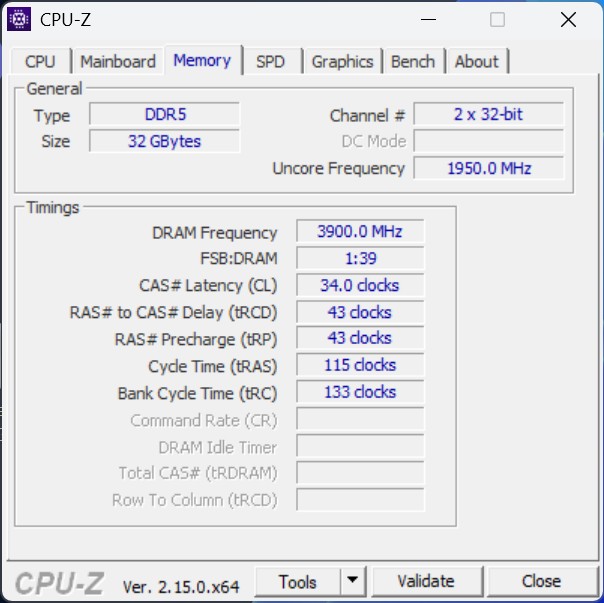 G Skill Trident Z5 NEO RGB 32GB DDR5 6000 CPU z OCED (Image © PCMasters.de)
G.Skill Trident Z5 NEO RGB 32 GB Overclocking
The chips in DDR5 memory modules often have more potential than the manufacturer specifies. G.Skill is also known for its overclocking-friendly memory. We didn’t open the modules, but the series typically uses SK Hynix chips. Beyond the specified 6,000, you should still be able to push the clock speed further, even if the latencies need to be loosened slightly.
With our sample, we were able to go up to a maximum of 7,800 MT/s, because the memory became unstable beyond that point (30-minute stress test). We didn’t need to increase the voltage, so we were able to stay at 1.450 volts. The benchmarks show the memory’s performance at the higher frequencies.
Synthetic Benchmarks
3D Mark
PCMark 10
GeekBench 6
7-Zip
Cinebench R20
AIDA64 v7.00
Lower latencies are better.
Gaming Benchmarks
Shadow of the Tomb Raider
Final Fantasy XV Benchmark
DDR5 RAM Comparison with Rating
The performance of the G.Skill Trident Z5 NEO RGB memory is average out of the box with the EXPO profile at DDR5-6000, but improves overall with higher clock speeds on the AM5 system. We were unable to lower the timings to a stable level, which is why the trade-off is rather poor. We would recommend setting the RAM to the sweet spot of 6,400 MT/s without changing the timings.
Data throughput has nevertheless improved on average due to the higher clock speed, even though performance was worse in most benchmarks.
Cooling
The heat sinks are relatively large and dissipate heat well, as the aluminum heat spreaders on the sides do their job effectively. You should ensure good airflow inside the case, especially when overclocking, to keep the RAM stable. In our tests, the RAM remained stable out of the box with the EXPO profile.
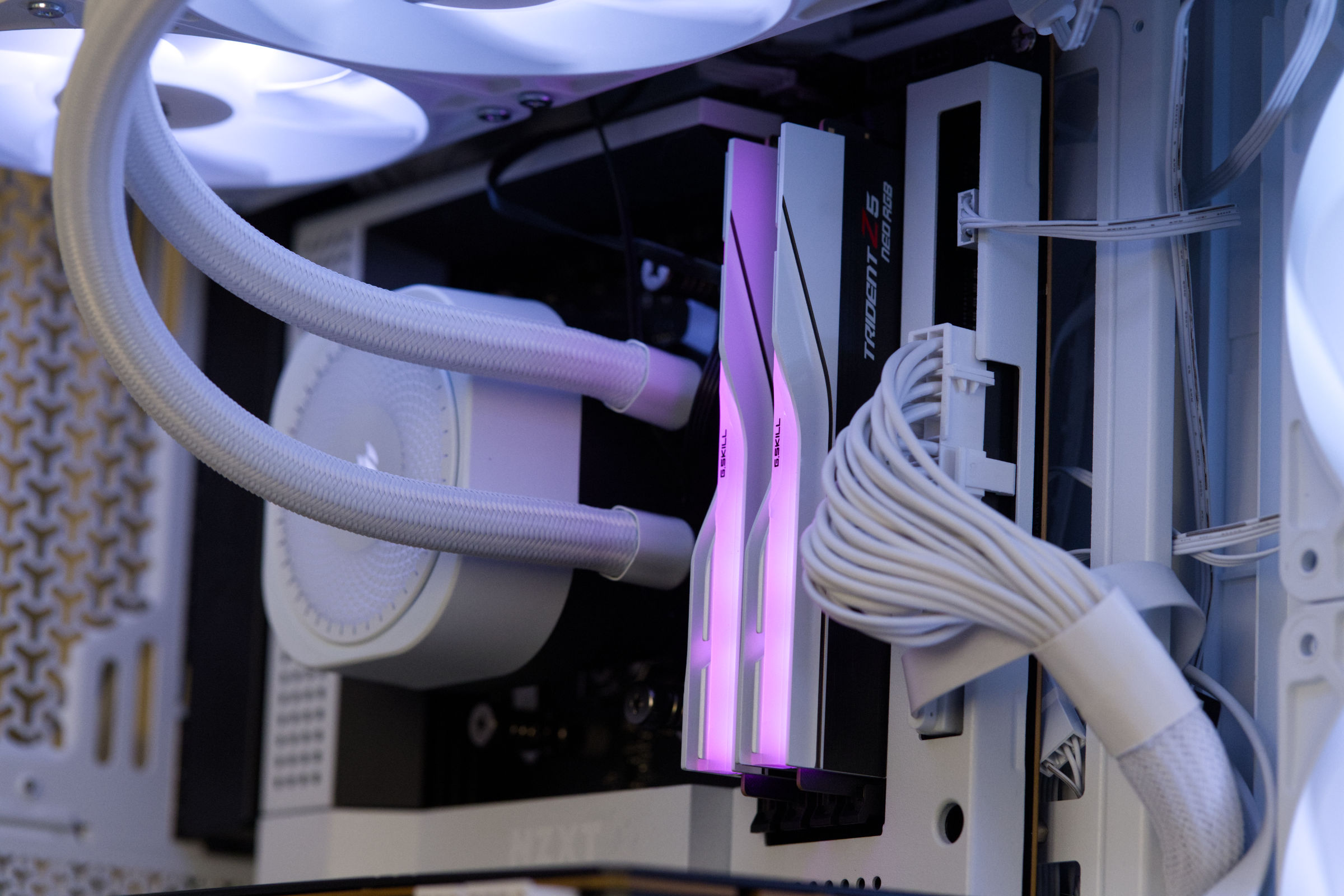 G Skill Trident Z5 NEO RGB 32 GB Kit DDR5 6000 CL26 Test (Image © PCMasters.de)
Conclusion on the G.Skill Trident Z5 NEO RGB

G.Skill delivers with the Trident Z5 NEO RGB, and the performance of the 32-GB kit tested here with CL26 timings shows that the memory performs best in the sweet spot for DDR5 memory on AM5 systems with Ryzen 7000 and Ryzen 9000 CPUs, as AMD considers 6,000 to 6,400 MT/s to be the most efficient range for this memory. Even though there are kits with 8,000 MT/s on the market, they are simply overpriced—especially given the current precarious situation in the memory market—and it’s advisable to stick to the basics. In our testing, we were able to significantly increase the clock speed, but the effect was anything but positive, which is why it’s much more worthwhile to use the EXPO profile with DDR5-6000 for this RAM.
In terms of design, G.Skill isn’t breaking any new ground—which isn’t necessary anyway—because the white memory looks incredibly sleek and becomes even more beautiful when the ARGB lighting is turned on. The lighting accentuates the wavy lines and details of the aluminum heatsink and blends in very harmoniously with the system. The heatsinks do their job well, though it’s always recommended to ensure sufficient airflow inside the case.
The limited lifetime warranty is great and commendable. The only downside right now, however, is the price, which is astronomically high due to shortages. 32-GB kits from this series, which cost €240 a year ago, are suddenly selling for €1,200 to €1,400. At the same time, larger kits are suddenly cheaper, and on Geizhals, more than half of the models are out of stock. This is a frustrating and unfortunate development, one for which G.Skill itself can’t do much, as the company’s spokesperson explained to Gamersnexus a few months ago.
This leaves us with a sobering conclusion: while we’re very impressed with the performance and design of the Trident Z5 NEO RGB 32 GB, at these prices, the memory is only recommended for die-hard enthusiasts who have deep pockets or are willing to wait for wider availability.
Pros
- Sleek design
- Aluminum heatsink
- AMD EXPO-OC profile, but also works on Intel systems
- Well-implemented ARGB lighting
- Overclocking possible (active cooling recommended)
- Modular design with removable ARGB modules
- Limited lifetime warranty
Cons
- Prices are chaotic and unpredictably high