 Computer Forum
 MSI GeForce RTX 5090 Test Review (Image © PCMasters.de)
GeForce RTX 5090 in detail
The new GeForce RTX 50 graphics cards have finally reached the market, albeit in very small quantities. We bought the sample of the MSI GeForce RTX 5090 32G Gaming Trio OC for this test, as there were hardly any samples available at the time of testing. NVIDIA has pulled off a paper launch here, as the quantities that went on sale were sold out within a few minutes and there are hardly any replenishments of the cards.
 Blackwell GB202 GPU Vollausbau (Image © NVIDIA)
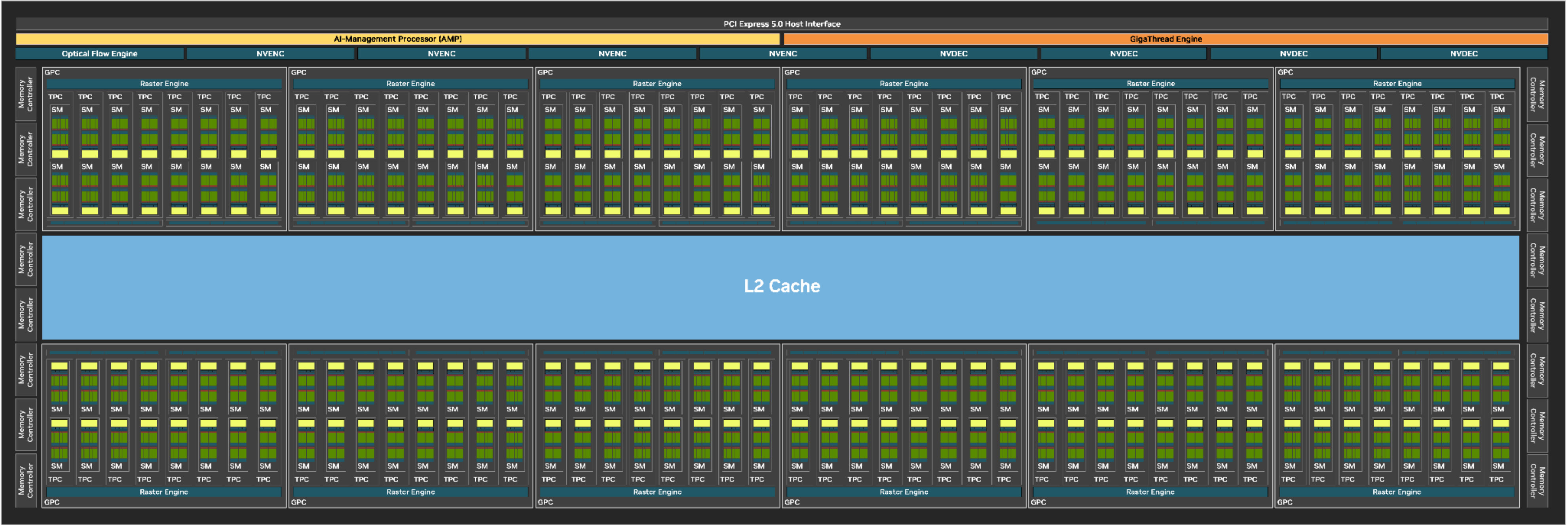
Despite the poor availability and high prices, we would still like to take an objective look at the card in a generational comparison and highlight the new features. A fundamental difference in the new Blackwell generation can be found directly in the GPU, as the chip with an area of 750 mm² has been manufactured using the 4 nm process at TSMC and comprises a whopping 92.2 billion transistors. The Ada Lovelace generation in the form of the GeForce RTX 4090 had a chip with an area of 608 mm² and contained 76.3 billion transistors. So here you can see an increase of 20% more transistors on approx. 23% more surface area.
 Ada Lovelace SM vs Blackwell (Image © NVIDIA)
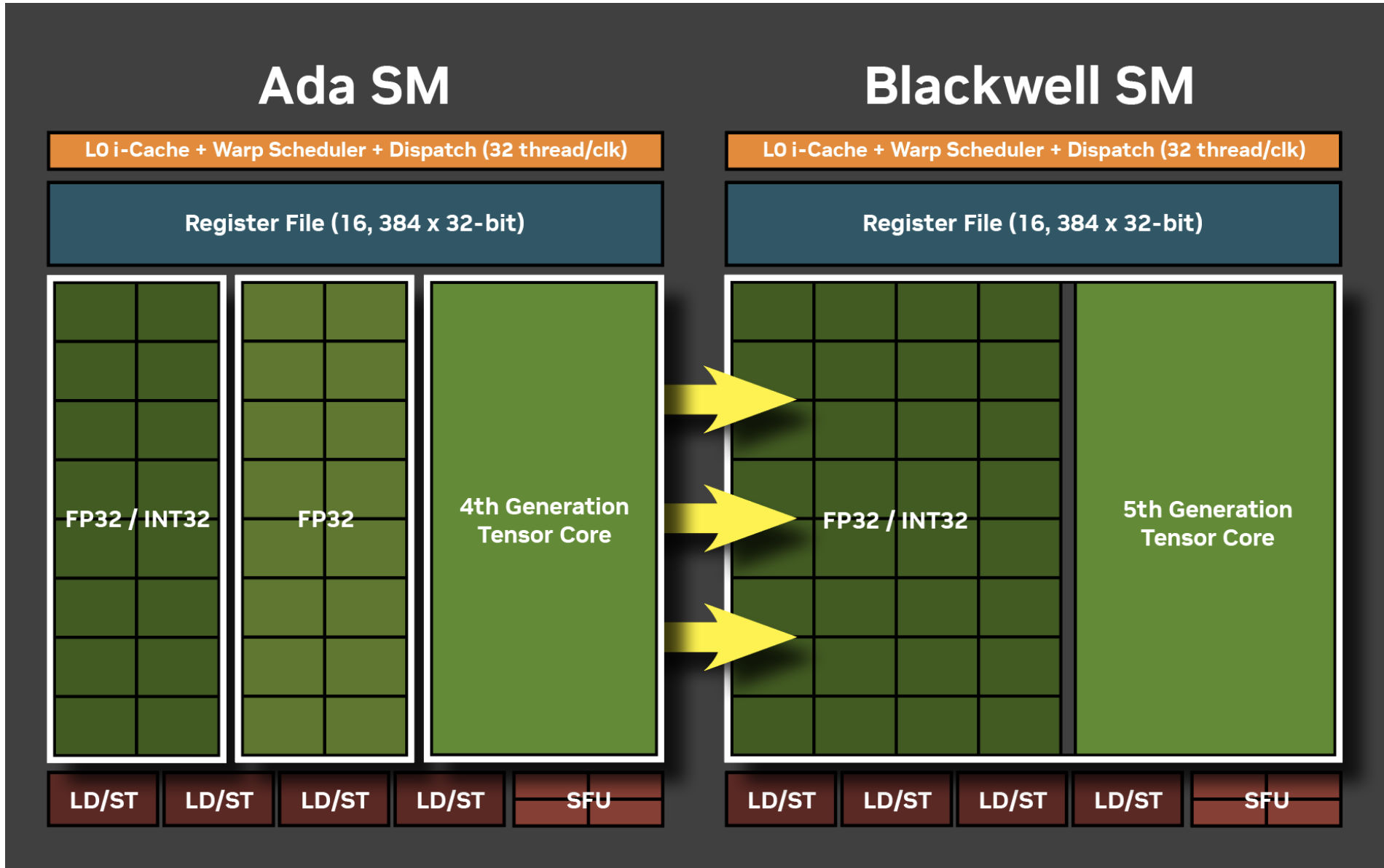
In the white paper on the new generation, NVIDIA highlighted some changes in the general structure of the streaming multiprocessors (SM). For example, a GB202 GPU comprises 384 FP64 cores (two per SM). In total, there are 12 GPCs with a raster engine, 8 TPCs, 16 SMs and 16 ROPs. No longer 16 separate "FP32 / INT 32" units with 16 separate ‘FP32’ units, but a total of 32 "FP32 / INT 32" units. This means that either 32 FP32 (floating point) or INT32 (integer) operations can now be carried out. The fifth-generation tensor cores are located next to these. The registers and the cache have been retained per SM.
.jpg "Blackwell Streaming Multiprocessor (SM)") Blackwell Streaming Multiprocessor (SM) (Image © NVIDIA)
Blackwell Streaming Multiprocessor (SM) (Image © NVIDIA)
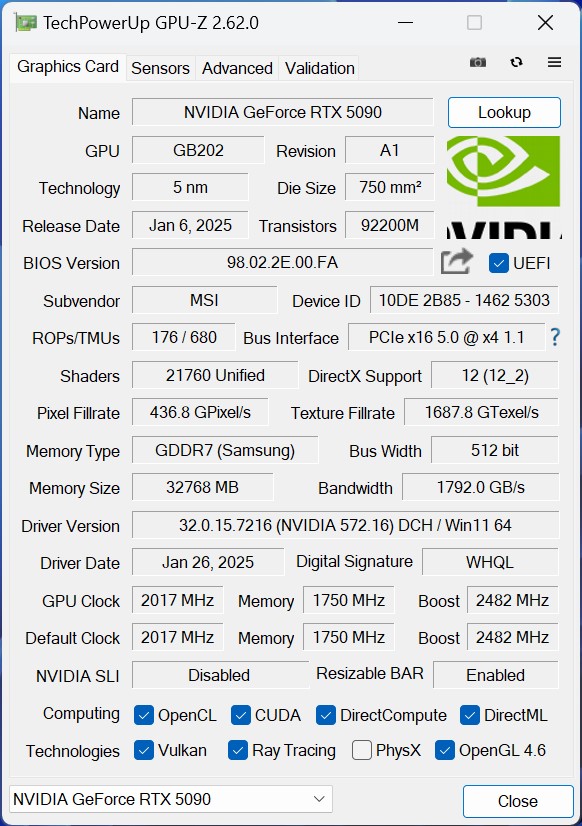 MSI GeForce RTX 5090 Gaming Trio GPU z (Image © PCMasters)
The monolithic GB202-300-A1 chip is probably the full version and the binned versions are used for the GeForce RTX 5080 and RTX 5070 Ti. In total, the GeForce RTX 5090 Die has an impressive 21,760 streaming processors or Cuda cores, 680 TMU and 192 ROP. For NVIDIA's DLSS hobbyhorse, there are also 170 raytracing cores and 680 tensor cores. The latter are used to drive AI models that also generate super resolution sampling and AI frames. It is interesting to note that purely in terms of the number of streaming processors or Cuda cores, an increase of 32.8 % can be seen. At 88 MB, the L2 cache is also larger than the 82 MB L2 cache of the GeForce RTX 4090, which means that in terms of raw performance alone, the generation leap should be between 20 and 32 %.
Another upgrade of the new generation is the PCI Express interface, which is now used in version 5.0. This increases the bandwidth from maximum 31.5 GB/s to 63 GB/s. In our sample, we always had the information that the GeForce RTX 5090 was only connected with 4 instead of 16 lanes, even if the graphics card supports it. The maximum bandwidth with PCie 5.0 x4 would theoretically be 15.7 GB/s. However, the GeForce RTX 4090 worked with PCIe 4.0 x 16 in the tests. We will clarify the extent to which this had an impact on performance afterwards on a different motherboard, but our current test system had to be retained for the comparison. We had previously only experienced this problem with one other graphics card.
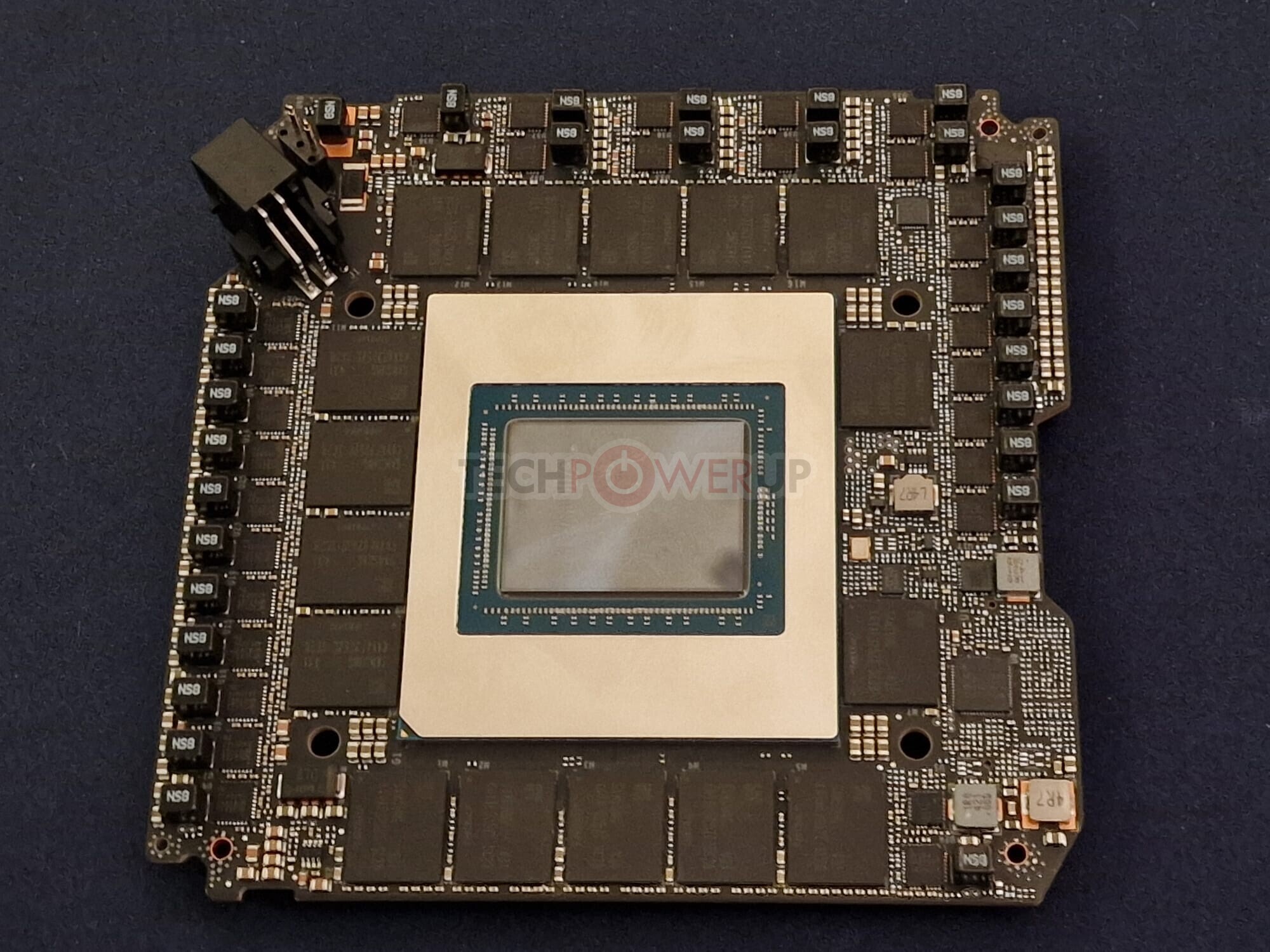 GeForce RTX 5090 Founders Edition GPU und GDDR7 (Image © Techpowerup)
Latest GDDR7 graphics memory
Another highlight of the new GeForce RTX 50 series is the latest GDDR7 graphics memory. The MSI GeForce RTX 5090 32G Gaming Trio OC is equipped with a total of 32 GB of the new memory chips. The bandwidth of the new memory is 28 Gb/s chips, which means that up to 1,792 TB/sec can be achieved. The GDDR6X memory of the previous generation "only" reached 23 Gb/s.
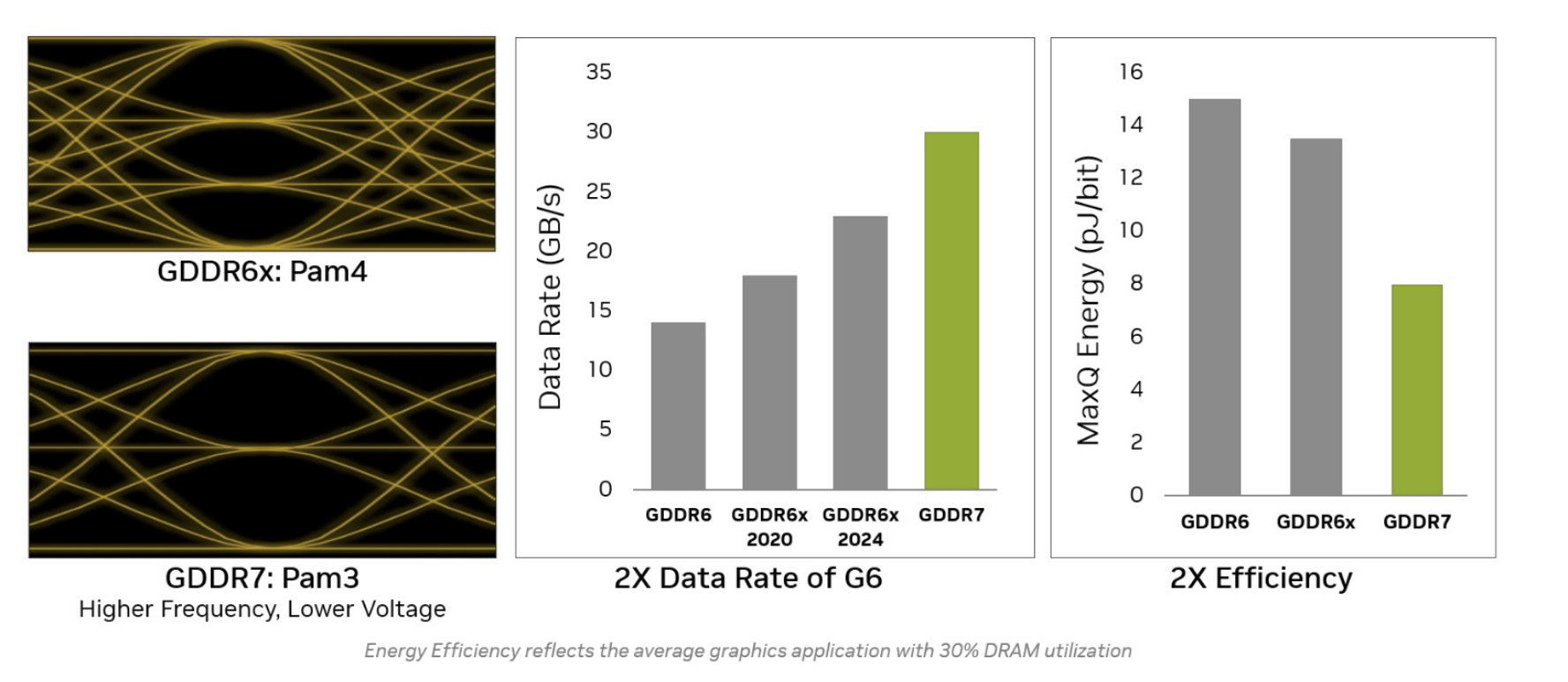 GDDR7 Generationsvergleich mit GDDR6 und GDDR6x (Image © PCMasters.de)
With the new GDDR7 generation, there is also a switch from PAM4 (2 bits per cycle) to PAM3 signaling (1.5 bits per cycle). An innovative pin encoding scheme significantly improves the signal-to-noise ratio and doubles the independent channels without additional input/output density. Improved equalization, revised clock architecture and enhanced I/O training further increase bandwidth. These advances provide better power efficiency and extend battery life in power-constrained systems.
GeForce RTX 5090 Technical Specifications
Below we have compiled all the important specifications of the GeForce RTX 5090 from MSI and Nvidia in a table and used the GeForce RTX 5080, RTX 5070 Ti, RTX 5070 and GeForce RTX 4090 as comparative values.
| MSI GeForce RTX 5090 Gaming Trio OC | GeForce RTX 5090 FE | GeForce RTX 5080 | GeForce RTX 5070 Ti | GeForce RTX 5070 | GeForce RTX 4090 | |
|---|---|---|---|---|---|---|
| Architecture | Blackwell | Blackwell | Blackwell | Blackwell | Blackwell | Ada Lovelace |
| Chip | GB202 | GB202 | GB203 | GB203 | GB205 | AD102 |
| AI TOPS | 3,352 | 3,352 | 1,801 | 1,406 | 988 | 1,321 |
| Tensor cores | 680 | 680 | 336 | 280 | 192 | 512 |
| Raytracing cores | 170 | 170 | 84 | 70 | 48 | 128 |
| Base (MHz) | 2.017 | 2,017 | 2,295 | 2,300 | 2,165 | 2,235 |
| Boost (MHz) | 2,482 (GAMING & SILENT Mode) | 2,407 | 2,617 | 2,475 | 2,510 | 2,520 |
| Memory configuration | 32 GB GDDR7 | 32 GB GDDR7 | 16 GB GDDR7 | 16 GB GDDR7 | 12 GB GDDR7 | 24 GB GDDR6X |
| Memory clock (MHz) | 1,750 | 1,750 | 1,875 | 1,750 | 2,209 | 1,313 |
| Memory connection | 512 bit | 512 bit | 256 bit | 256 bit | 192 bit | 384 bit |
| Texture units | 680 | 680 | 336 | 280 | 192 | 512 |
| ALUs/CUDA cores | 21,760 | 21,760 | 10,752 | 8,960 | 6,144 | 16,384 |
| Memory bandwidth | 1.792 GB/sec | 1,792 GB/sec | 960 GB/sec | 896 GB/sec | 672 GB/sec | 1,008 GB/sec |
| TDP/TGP | 575 W (MSI) | 575 W (NVIDIA) | 360 W | 300 W | 250 W | 450 W |
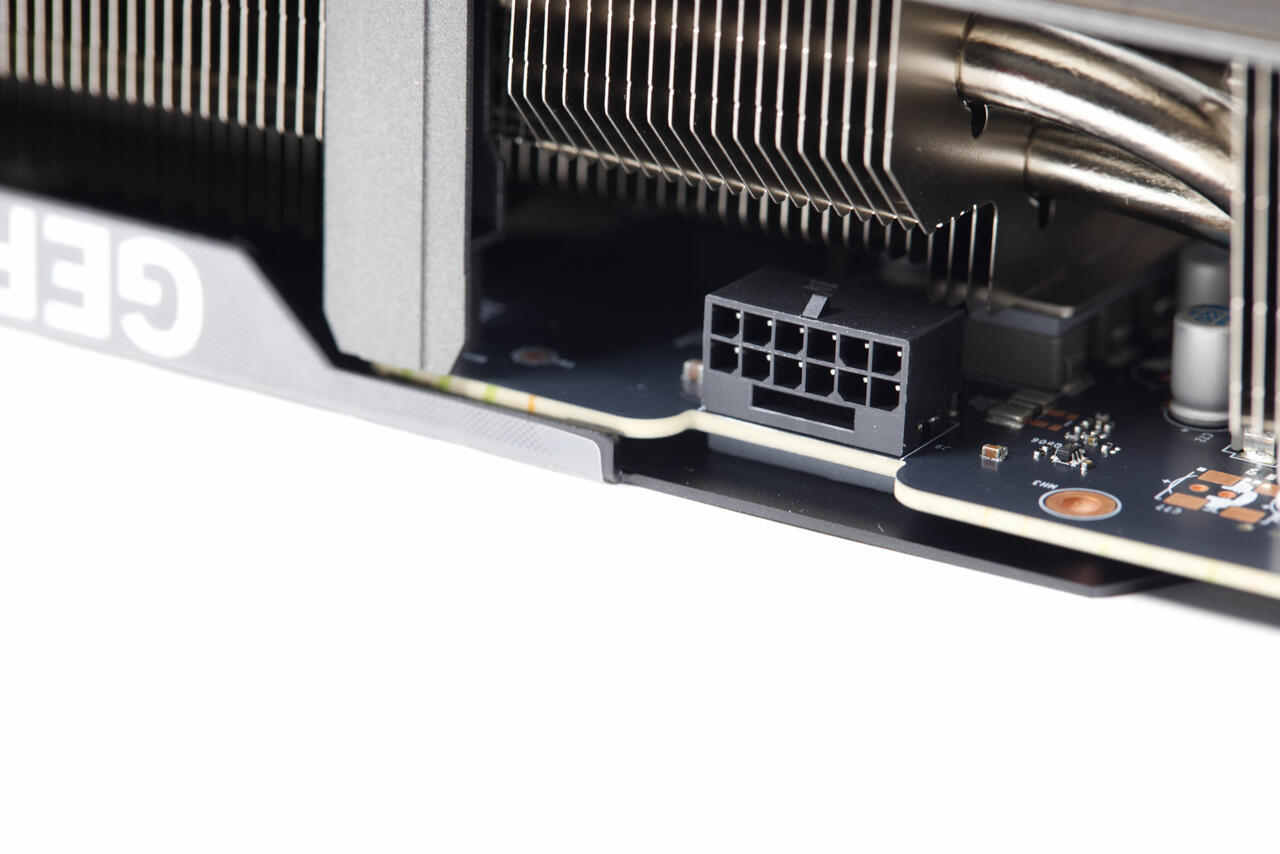
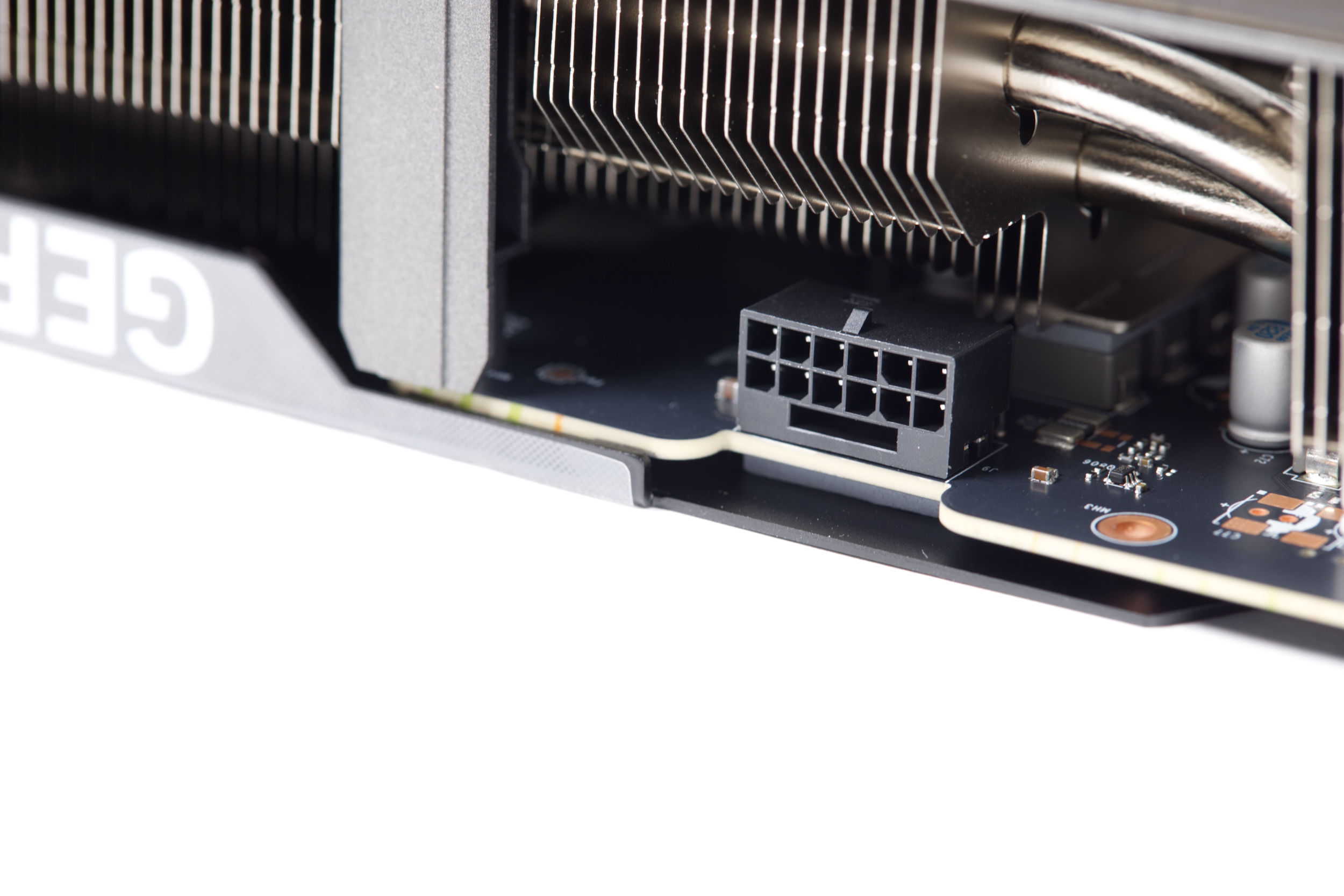 MSI GeForce RTX 5090 32G Gaming Trio OC 12VHPW Anschluss (Image © PCMasters.de)
New 12VHPWR plug and adapter
12V-2x6 connector and adapter For the new generation, NVIDIA and its partners, such as ASUS and MSI, are relying on an improved version of the 12V-2x6 power connector (formerly 12VHPWR connector). The GeForce RTX 5090 has a corresponding socket, which has been slightly adapted and should offer more safety. However, the latest reports from forums show that everything is not yet optimal.
With a Total Graphics Power (TGP) of 575 watts and power peaks far above this, it must be ensured that the adapters and cables can cope with this. The sensor cable communicates with the power supply unit to ensure that sufficient power can be provided.
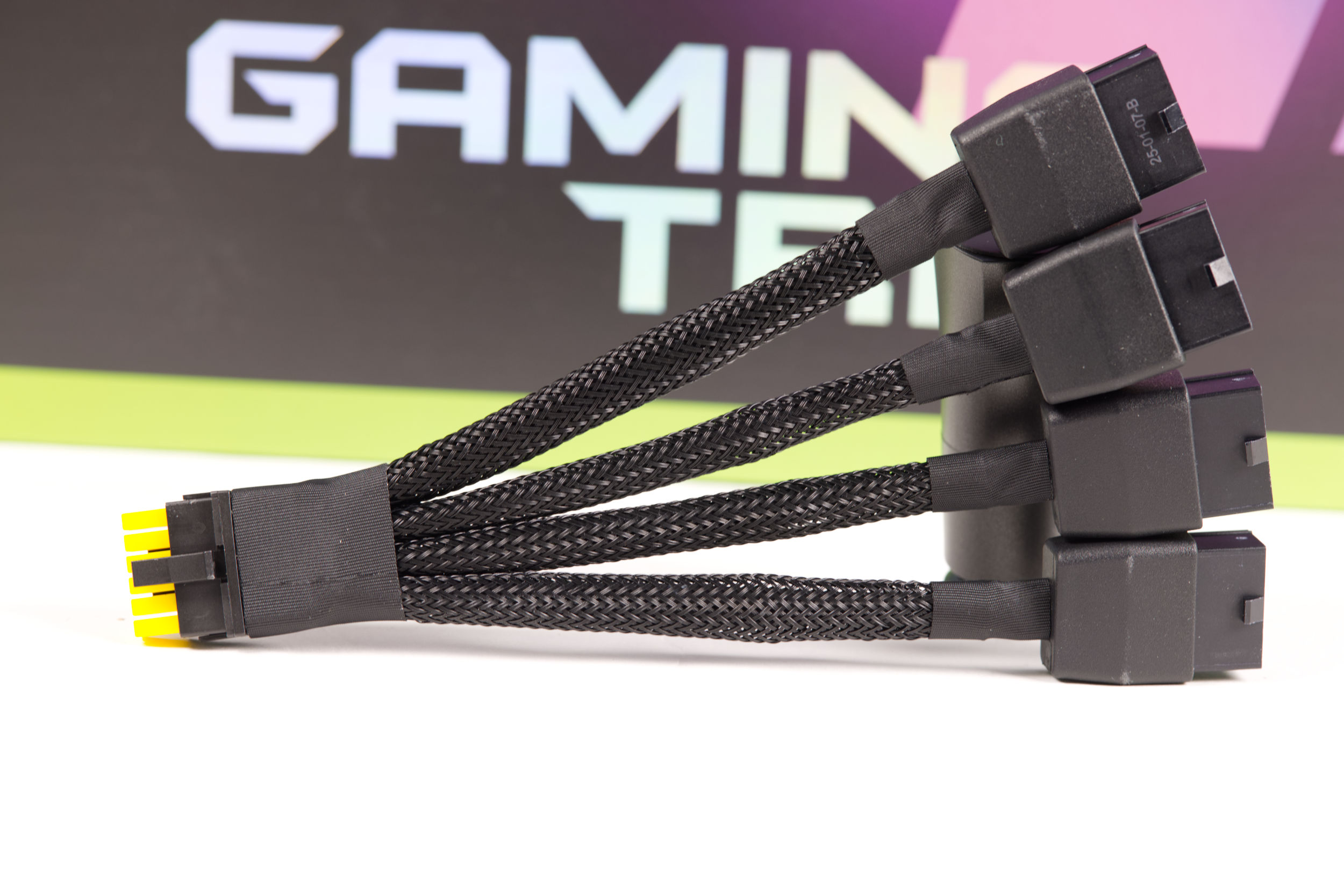 MSI GeForce RTX 5090 32G Gaming Trio OC 12VHPWR Adapter (Image © PCMasters.de)
MSI supplies a 12V 2x6 adapter that is yellow on one side. This color trick shows whether the plug is fully inserted or not. This was not the case with earlier generations and you had to look closely. The adapter has a total of four 8-pin power connectors on the other side, which can be connected to non-ATX 31 power supplies. However, both the adapter and the power supply cables have a plug-in service life that can vary. However, most users are unlikely to plug and unplug this cable more than three times, which is why this is not considered wild.
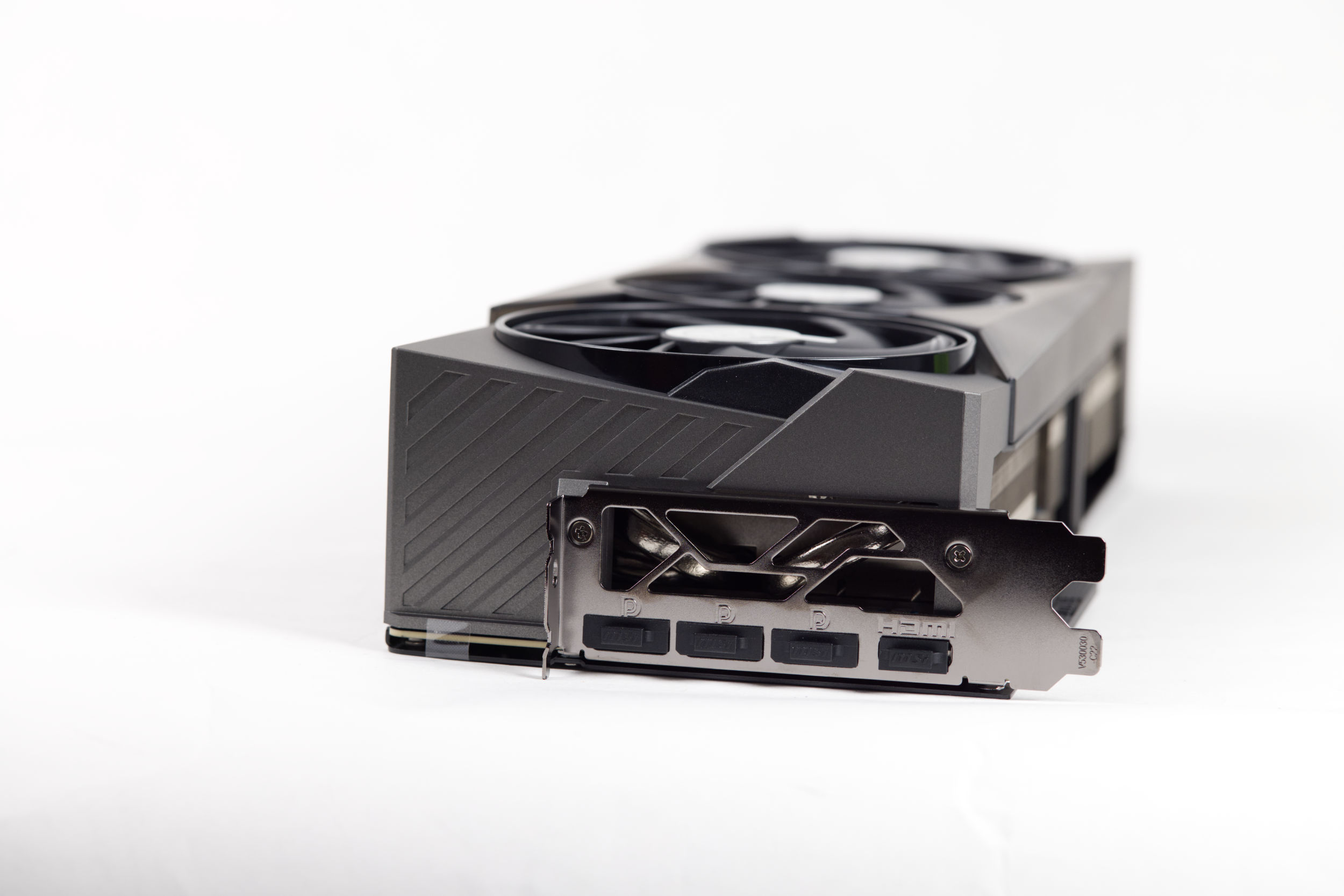 MSI GeForce RTX 5090 32G Gaming Trio OC Anschlüsse (Image © PCMasters.de)
Four display connectors
The MSI GeForce RTX 5090 32G Gaming Trio OC has four display ports and should therefore supply all current monitors with a video signal. These include three DisplayPort connectors that support the DisplayPort 2.1b standard and provide improved data transfer capabilities and support for ultra-high resolutions and refresh rates, which is essential for gamers, designers and multimedia professionals who want to push the limits of visual performance.
The graphics card also has an HDMI connection that complies with the latest HDMI 2.1b standard. This means that thanks to advanced Display Stream Compression (DSC), the port is capable of delivering 4K resolution at a frequency of 480 Hz, or for those who prefer even more visual clarity, 8K at 120 Hz. In addition to the Gaming Variable Refresh Rate (VRR) and High Dynamic Range (HDR), the HDMI connection is the ideal solution for high-performance gaming and rich multimedia experiences.
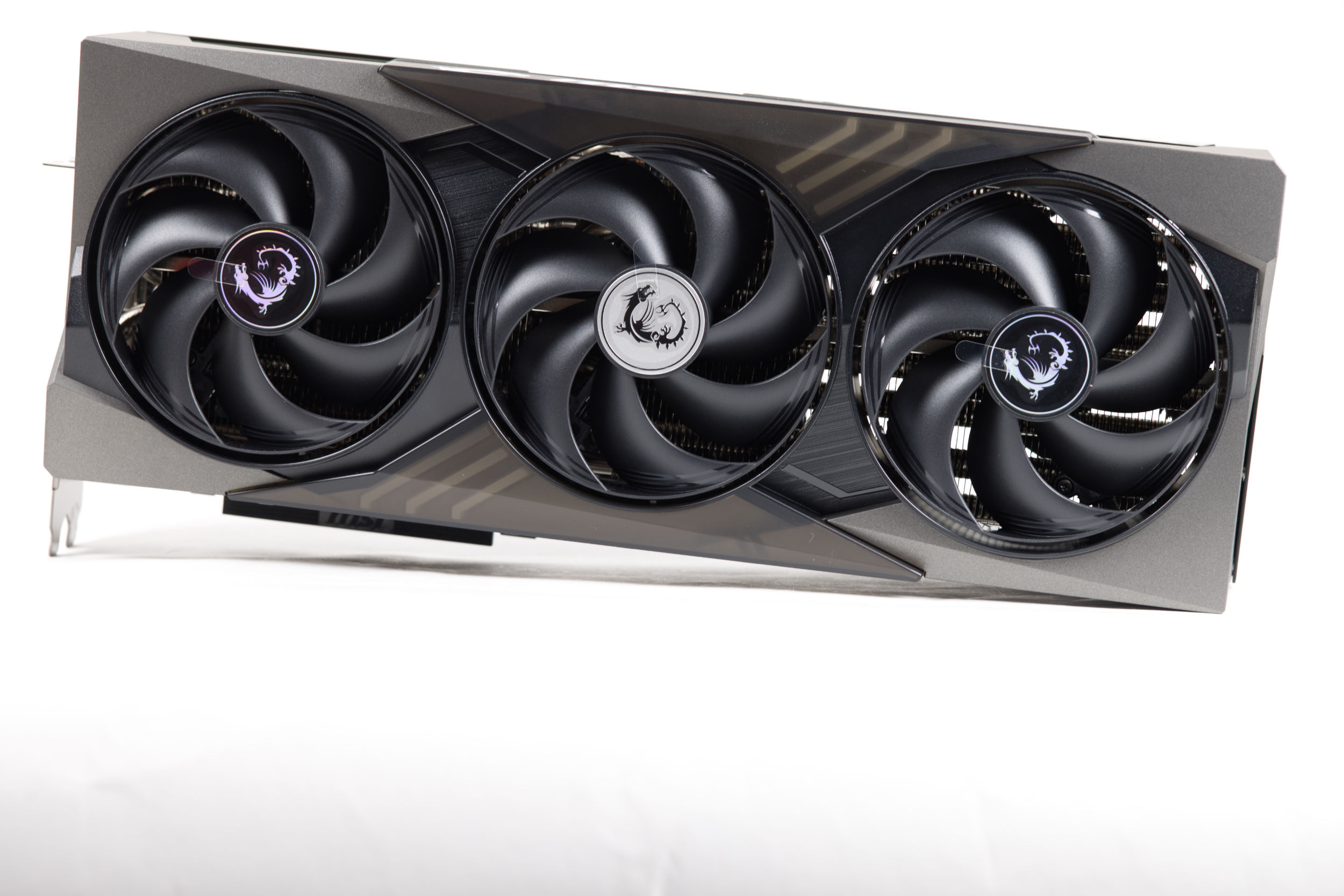 MSI GeForce RTX 5090 32G Gaming Trio OC Design (Image © PCMasters.de)
Design and construction of the new Gaming Trio OC generation
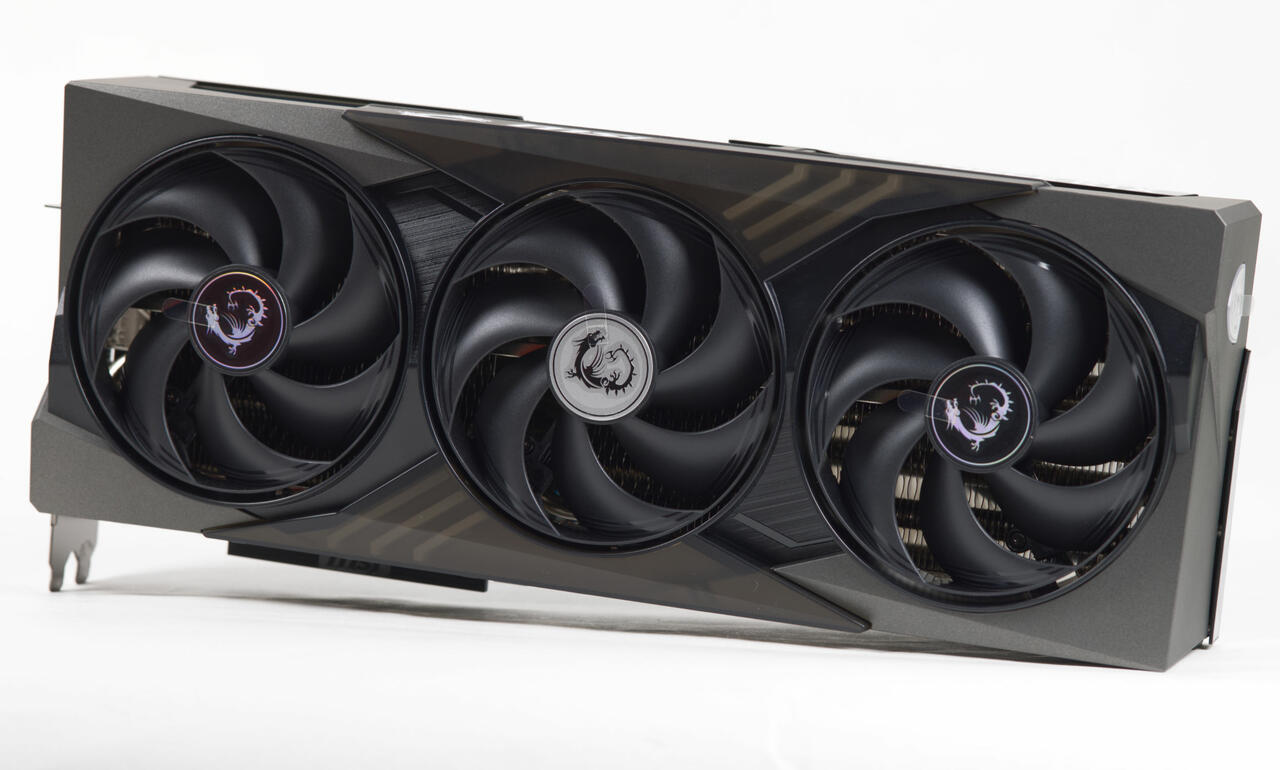
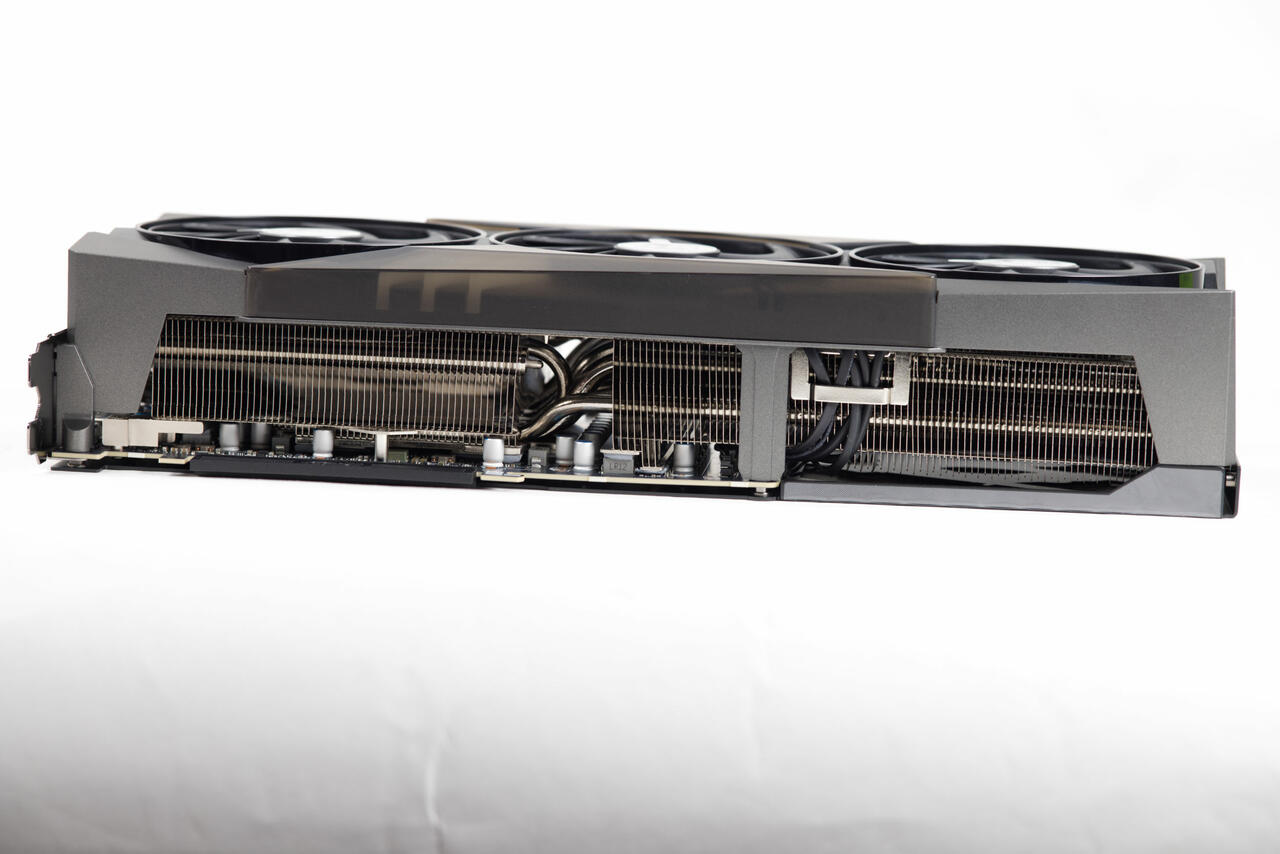
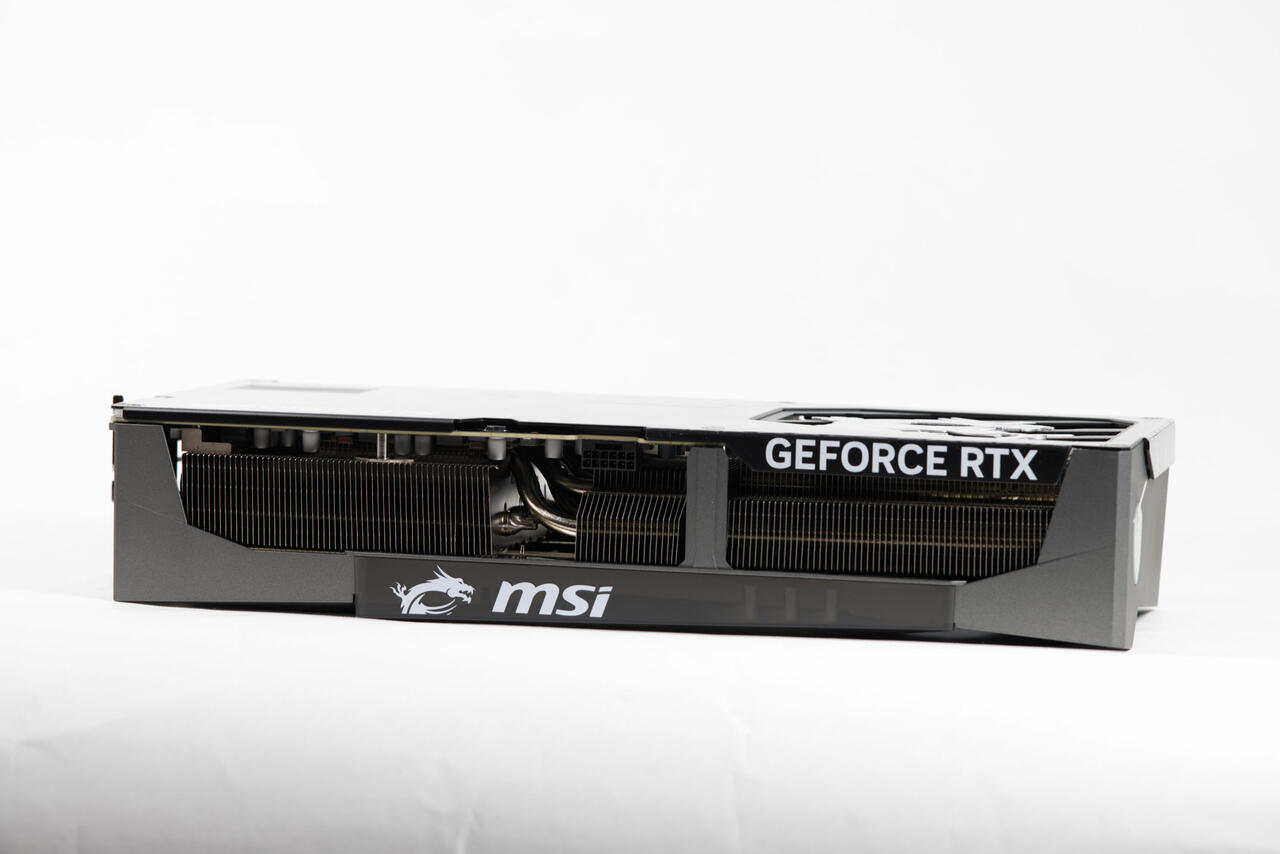
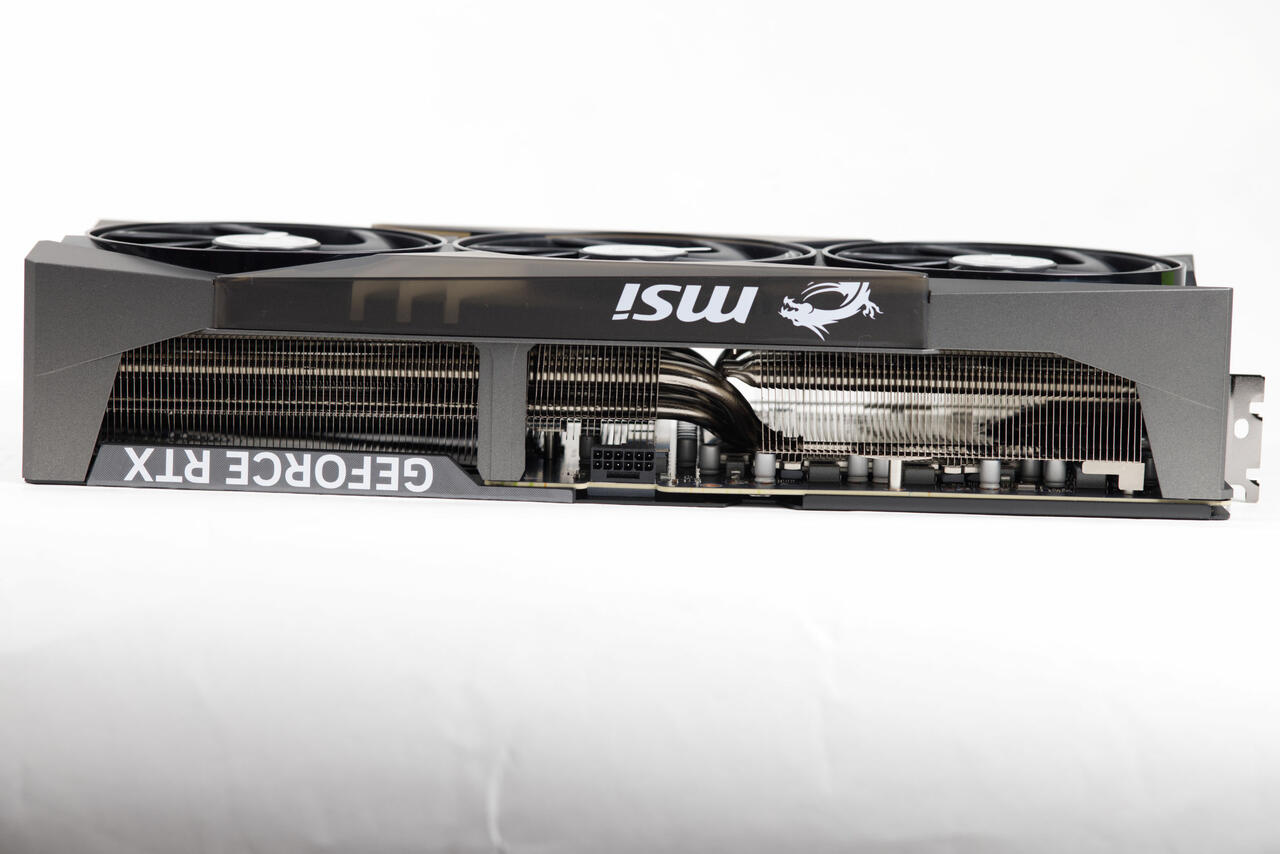
The MSI GeForce RTX 5090 32G Gaming Trio OC is based on the TRI FROZR design and uses some design elements from the previous generation. The front is covered by a black plastic front. Here we see a mix of dark black with gray elements and partially milky-transparent plastic. In addition to the three large Stormforce fans with a diameter of 110 mm, the three bright ARGB-illuminated strips are particularly striking. Measuring 359 x 149 x 70 mm, this card is anything but compact.
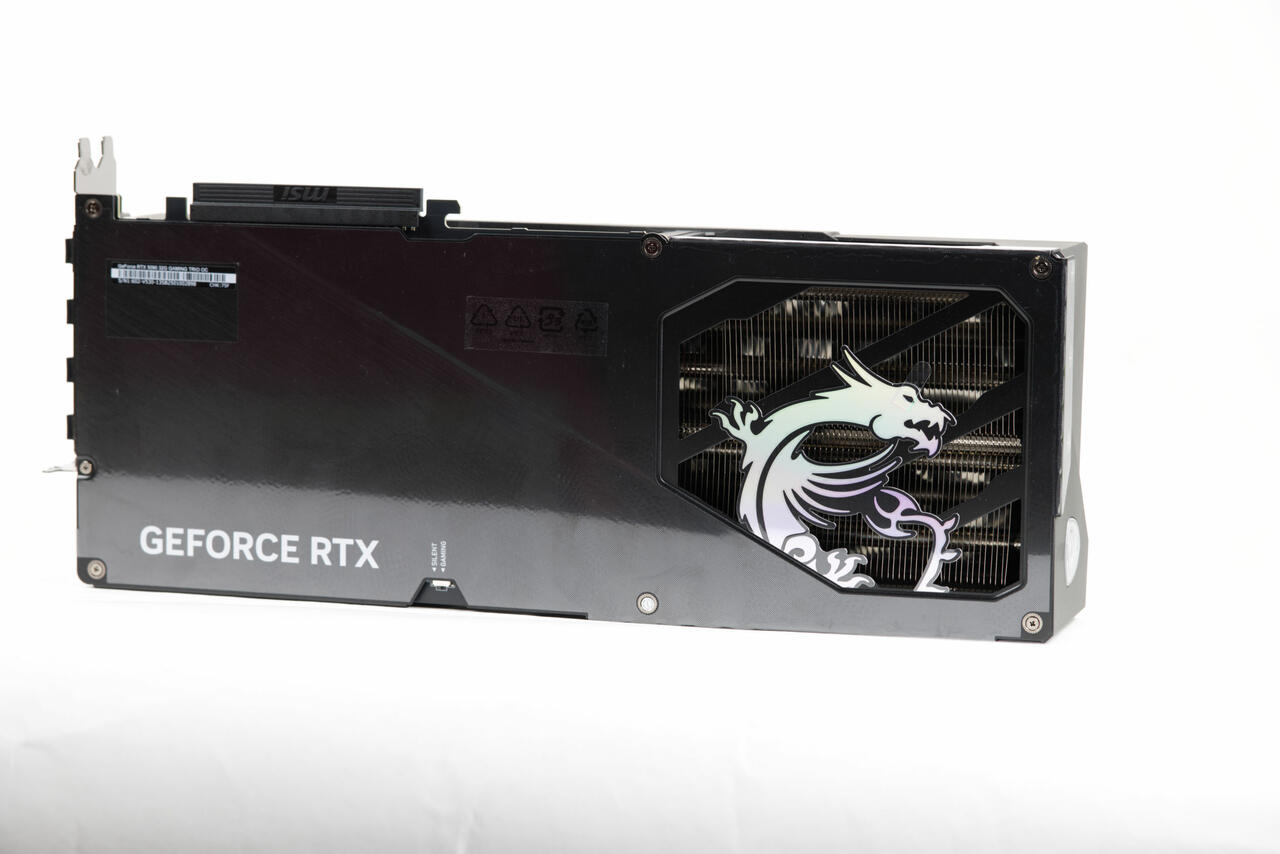
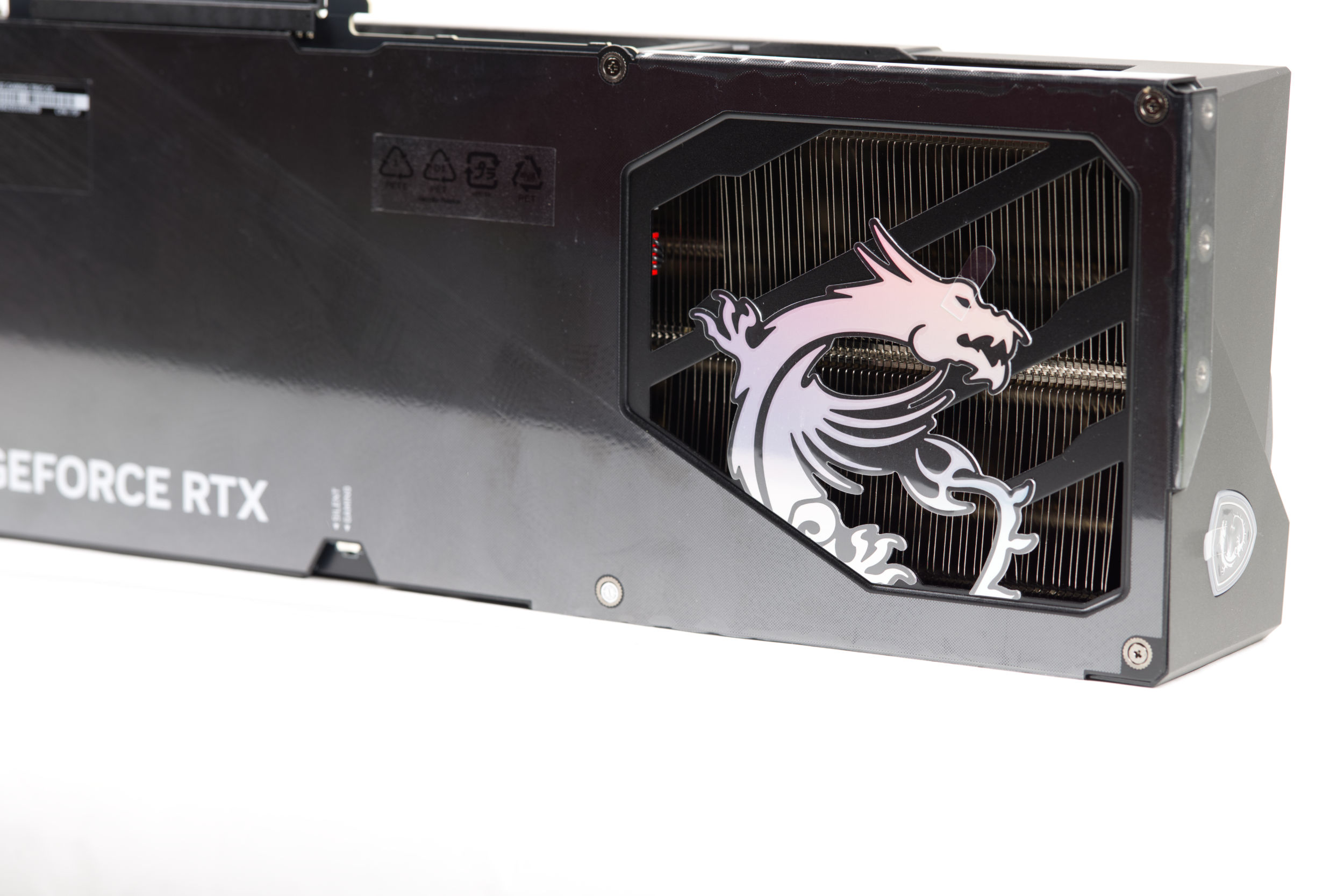 MSI GeForce RTX 5090 32G Gaming Trio OC Kühler auf Rückseite (Image © PCMasters.de)
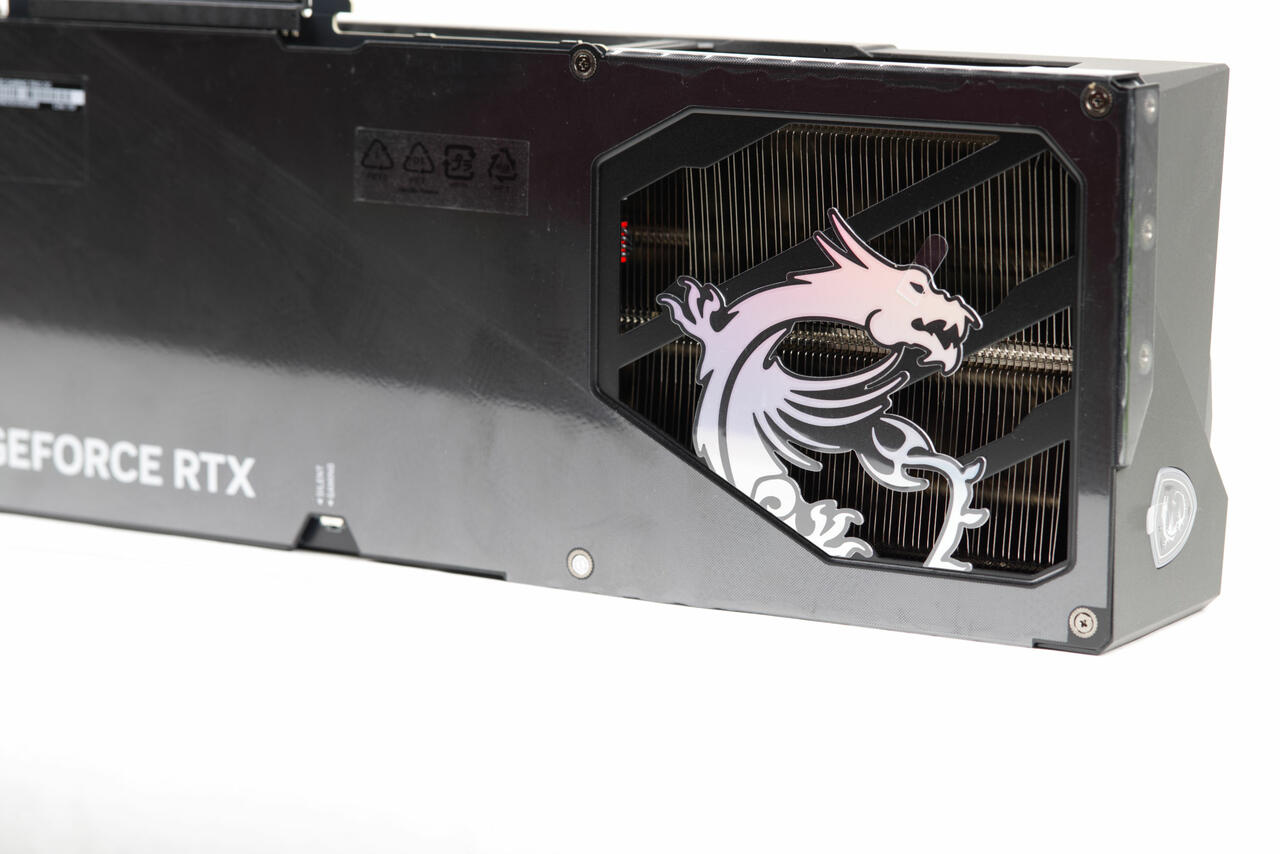
The rear is covered by a black backplate with a large cut-out at the end of the card. For decoration, the MSI dragon has been placed in this opening, which is covered in a reflective, shimmering paint.
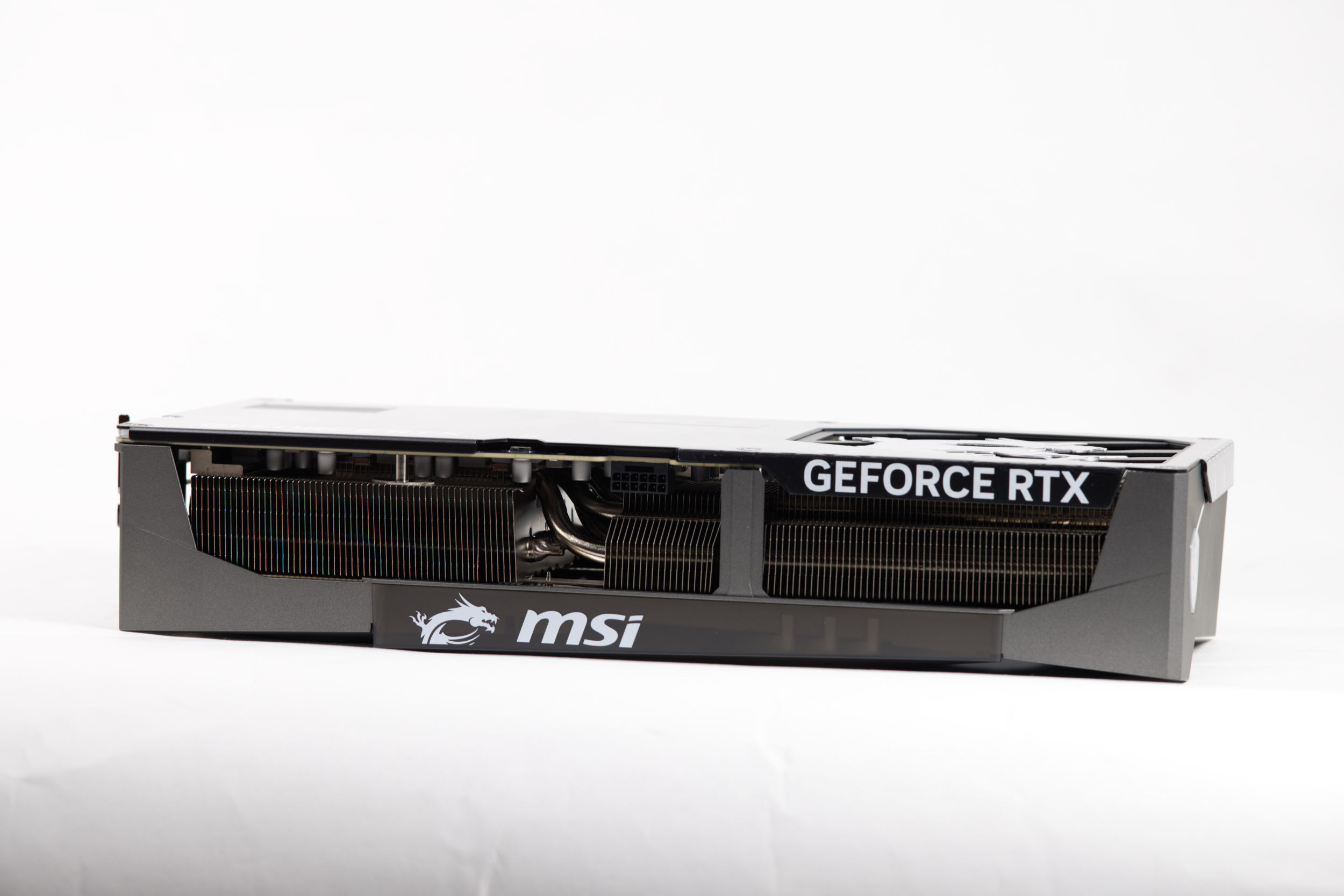 MSI GeForce RTX 5090 32G Gaming Trio OC Seitenansicht (Image © PCMasters.de)
The effect is stylish and breaks up the otherwise very dark design. There is also a BIOS switch that toggles between gaming and silence. Both have the same performance and should only affect the cooling or fan curve.
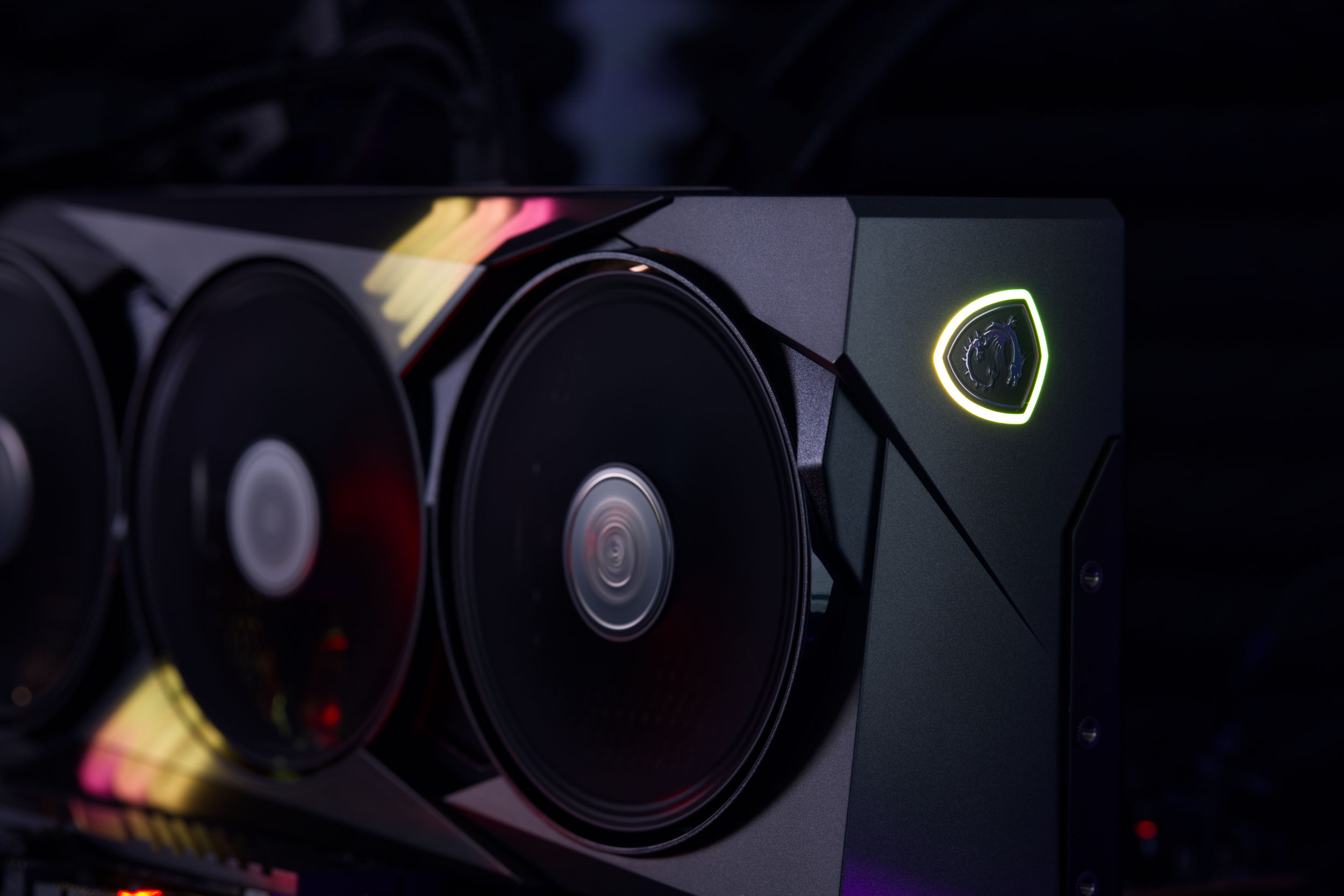 MSI GeForce RTX 5090 32G Gaming Trio OC ARGB Beleuchtung 2 (Image © PCMasters.de)
In addition to the white paintwork of the MSI logo and the "GeForce RTX" lettering, the only other striking feature is the ARGB-illuminated MSI logo on the side, which is synchronized with the rest of the lighting.
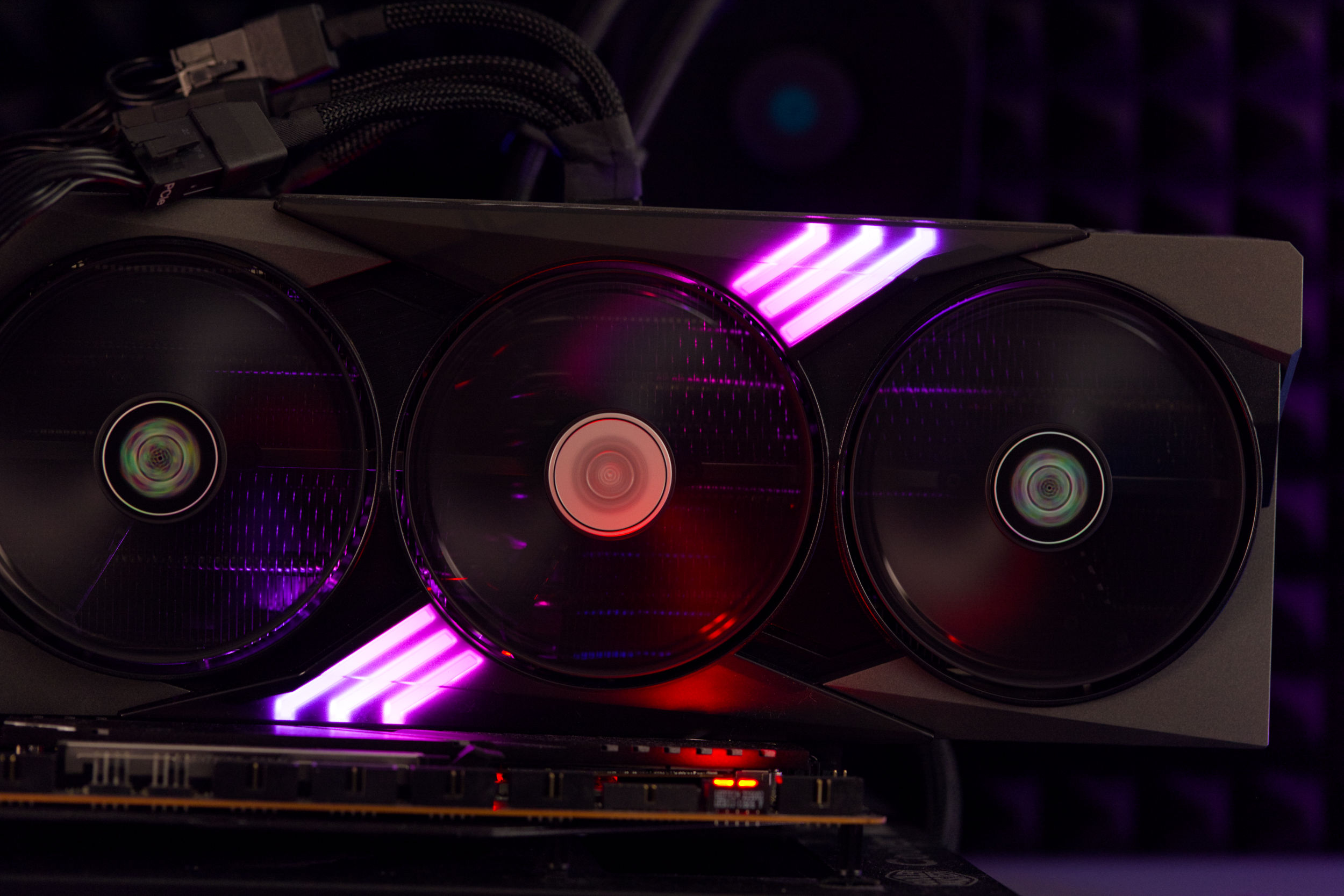 MSI GeForce RTX 5090 32G Gaming Trio OC ARGB Beleuchtung (Image © PCMasters.de)
Overall, however, the ARGB lighting is restrained and not particularly bright. The card is therefore dark and blends into the background except for its brute size.
MSI GeForce RTX 5090 photos
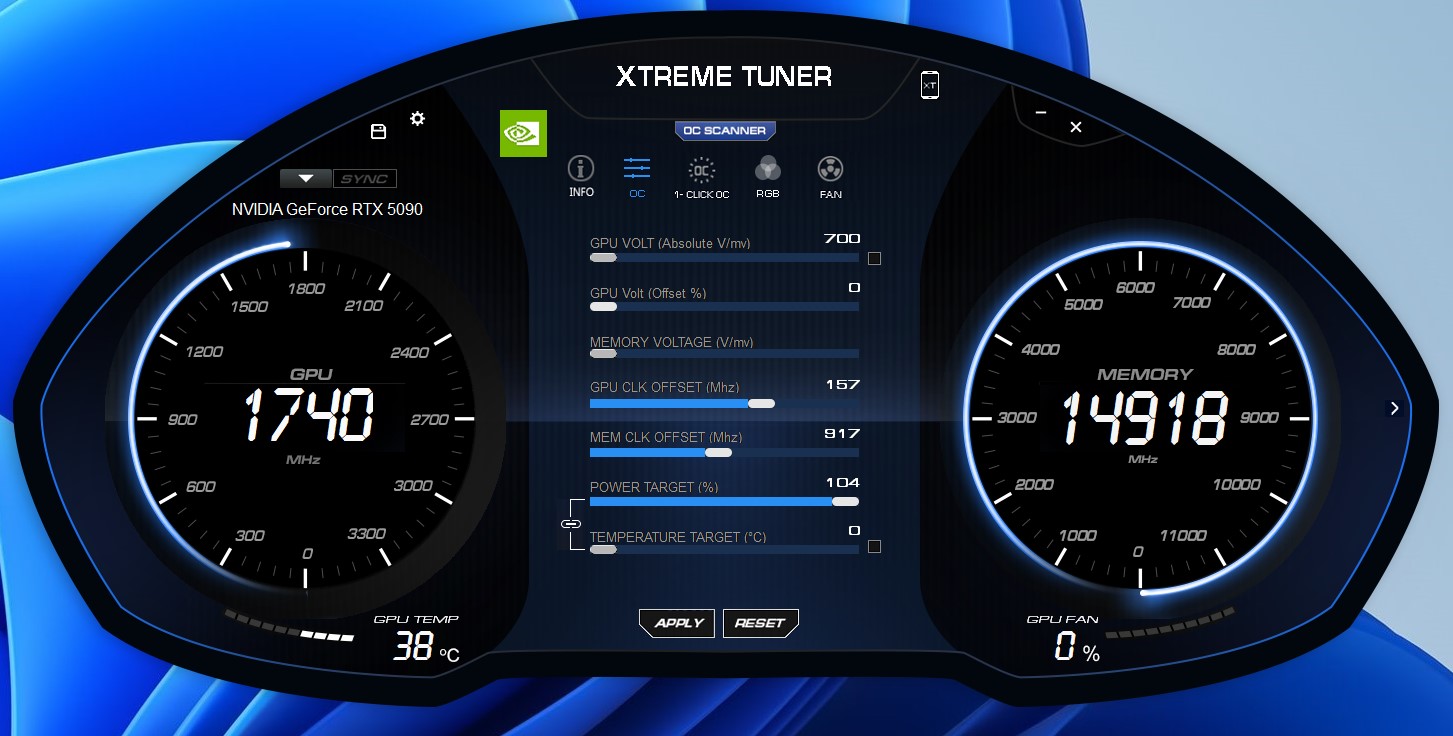 MSI GeForce RTX 5090 Gaming Trio Übertaktung (Image © PCMasters)
GeFoerce RTX 5090 overclocking
Even though MSI has its own Afterburner OC tool, which supposedly also offers directly overclocked profiles, we couldn't use it because it didn't work with the graphics card. Instead, we used our tried and tested XtremeTuner tool from KFA2, which was able to increase the clock rates and the power target without any problems. The tool is also offered free of charge on the company's website and can apparently be used for pretty much all NVIDIA graphics cards that we have had on the test system so far. However, the application has a companion app that is available for iPhone and Android. However, we did not use it to overclock the RTX 5090, but rather directly via the Windows GUI, as can be seen in the screenshot above.
The GPU clock was raised from around 2,070 MHz under Furmark load to 2,130 MHz. In the tool it was a plus of 157 MHz and measured it is about + 3% (60 MHz), but the boost clock always jumps up and down.
We were also able to boost the GDDR7 memory. The effective clock was 917 MHz to the standard clock of 1,750.1 MHz to 1,864.8 MHz. The TGP could be increased from 100 % to 104 %. However, no higher GPUz consumption was detected here, but we were able to measure approx. 35 watts more at the socket. However, the cooling was not overloaded and it would have been possible to go much higher, but the performance collapsed, which we attribute to the TGP limit.
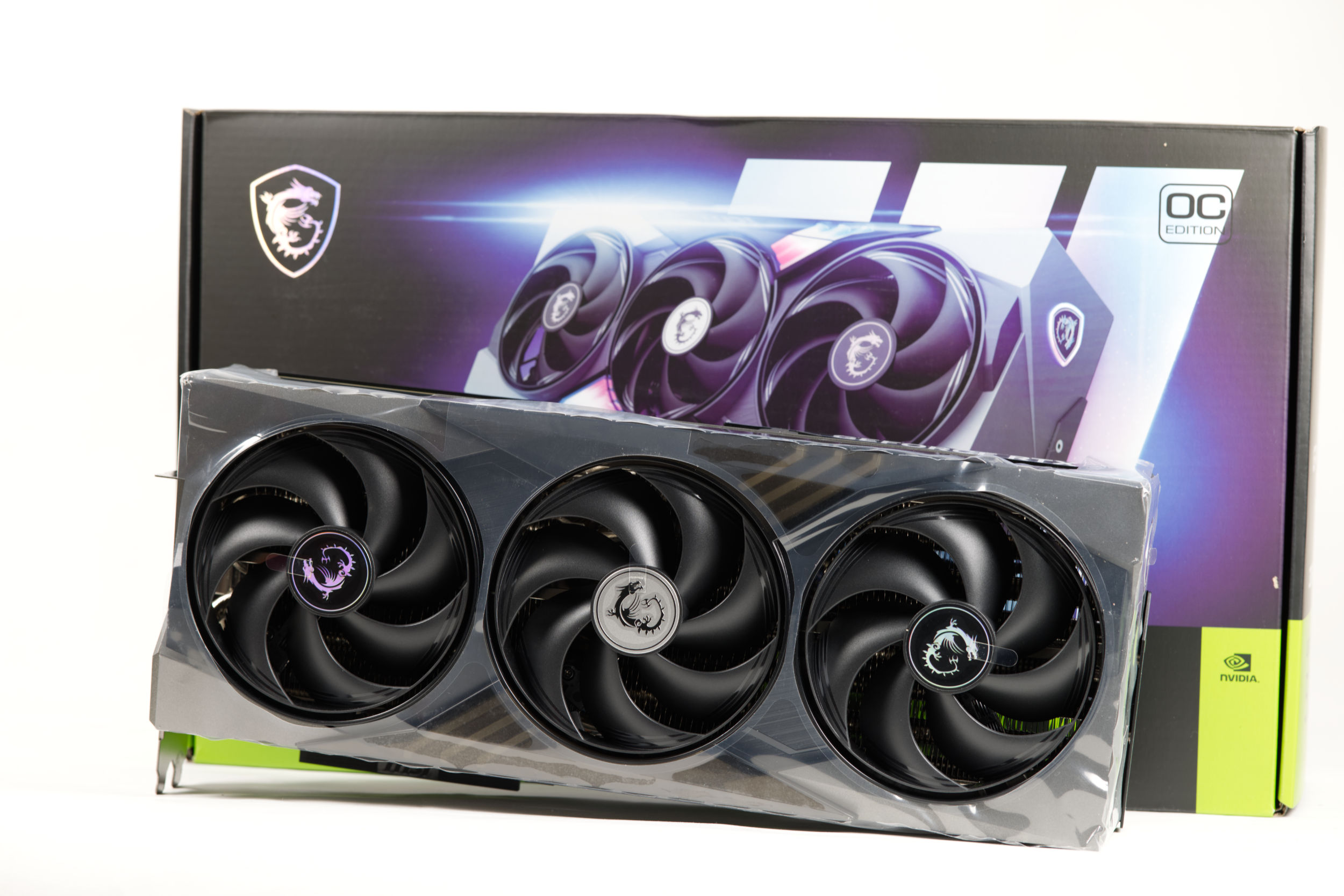 MSI GeForce RTX 5090 32G Gaming Trio OC Grafikkarte (Image © PCMasters.de)
Scope of delivery
As a buyer, you get a very well-packaged graphics card. The MSI packaging was rather compact, as the previous generations were significantly larger.
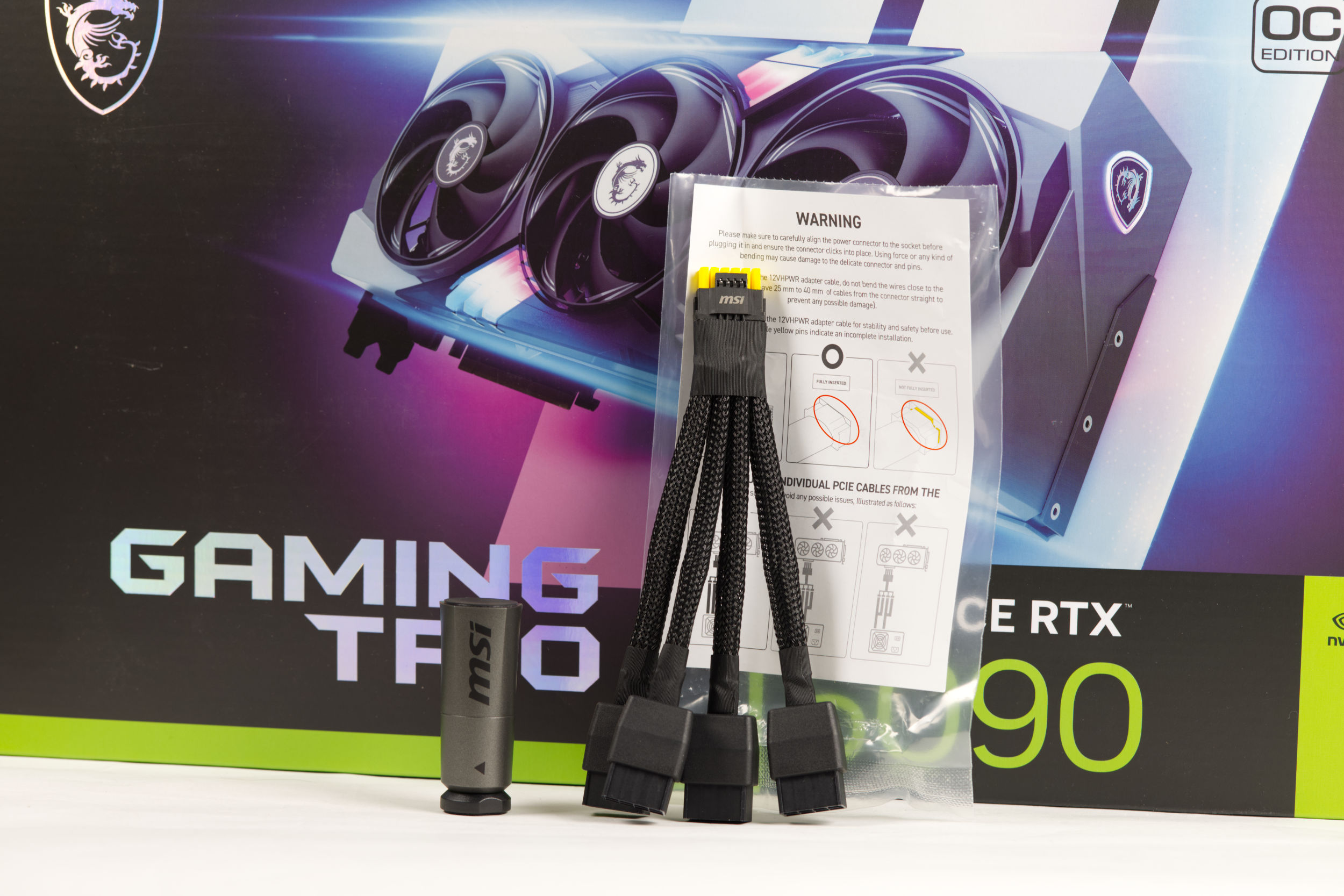 MSI GeForce RTX 5090 32G Gaming Trio OC Lieferumfang (Image © PCMasters.de)
Inside, another black box was revealed, the contents of which were lined with soft polystyrene to protect the card during transportation.
System requirements
The following system requirements can be found on the manufacturer's website: - PCI Express-compatible mainboard with one x16 graphics slot - Blocks 4 slots - 1x 12V-2x6 (12VHPWR) connector, or four PCIe 8-pin power connectors via 12V-2x6 adapter - Recommended**: Power supply unit with 1,000 W or more
Test setup
The Ryzen 9 7950X, which works with faster DDR5-6000 RAM, serves as the basis. The 2024 benchmarks do without Battlefield 4 and instead introduce Cyberpunk 2077 and Saints Row, we have further reduced 1080p tests and rather tested in 4k and also activated ray tracing where it made sense. The first 8k benchmarks have also been added.
Another new feature is that we are no longer testing in the case, but are once again relying on an open test setup. The graphics cards are getting too big and bulky, which is why we have opted for the Open Testbench.
The driver comes from Nvidia and has the number 572.16.
The test system
- CPU**: AMD Ryzen 9 7950X
- Mainboard: Biostar X670E Valkyrie
- SSD**: Samsung SSD 840 PRO 256 GB, Samsung 850 EVO 500 GB
- m.2 SSD: Samsung 970 Evo MZ-V7E250BW 250 GB
- RAM**: Sabrent ROCKET DDR5-4800 @ DDR5-6000 (44,44,44,44,86,130,1.2v)
- CPU cooler**: DeepCool LS720
- Power supply**: BeQuiet! Pure Power 11 FM 1000W
- Fan: 1 x Scythe Kaze FLex 120 mm PWM fan
- Case**: CoolerMaster Benchtable (open)
GeForce RTX 5090 ray tracing synthetic benchmarks
We only use 3DMark Port Royal for the synthetic benchmarks with ray tracing support. The remaining tests are based on games that implement the technology in one way or another.
3DMark PORT ROYAL 1.2
Synthetic benchmarks
The synthetic benchmarks are quite nice for an initial comparison of performance, but do not reflect the gaming performance of the cards, as they include other factors that are not directly visible.
3DMark Benchmark
Geekbench 6 Benchmark
Unigine Superposition Benchmark
8k Benchmarks
We use the Unigine Superposition run with 8k optioning as the first 8k test in the benchmark course. This can also be run on non-8k monitors.
Virtual Reality Benchmarks (VRMark)
GeForce RTX 5090 ray tracing games benchmarks
With new game titles and the conversion of the test station, more ray tracing titles have been added. The segment now provides a decent data basis. The results are not commented on individually. Our comments are summarized in the rankings below.
ResidentEvil Village with ray tracing
Cyberpunk 2077 with Ray Tracing with/without DLSS/FSR
Fortnite with ray tracing
Shadow of The Tomb Raider with Ray Tracing
Metro Exodus Ehanced Edition Benchmarks
Game Benchmarks
The benchmark results shown here are without ray tracing and DLSS. We have moved away from 1080p to 4k tests in games.
Final Fantasy XV Benchmarks
Cyberpunk 2077
Saints Row
Overwatch 2 Benchmarks
Shadow of The Tomb Raider
MSI GeForce RTX 5090 32G Gaming Trio OC Kühler auf Rückseite (Image © PCMasters.de)
Gigantic cooler with three axial fans
The MSI GeForce RTX 5090 32G Gaming Trio OC is equipped with a cooler that is also familiar from the previous generation. However, according to MSI's website, some improvements have been made to the TRI FROZR 4.
For example, the manufacturer has opted for a design consisting of a large heat sink at the front and a backplate at the rear. The PCB is not completely continuous but still larger than the minimalist GeForce RTX 5090 Founders Edition. However, this has the advantage that the hot air can flow freely, especially at the end of the graphics card, and does not press on the PCB. There are generally thermal pads attached to the actual cooler, which thermally connect the voltage converters and the memory with the cooler.
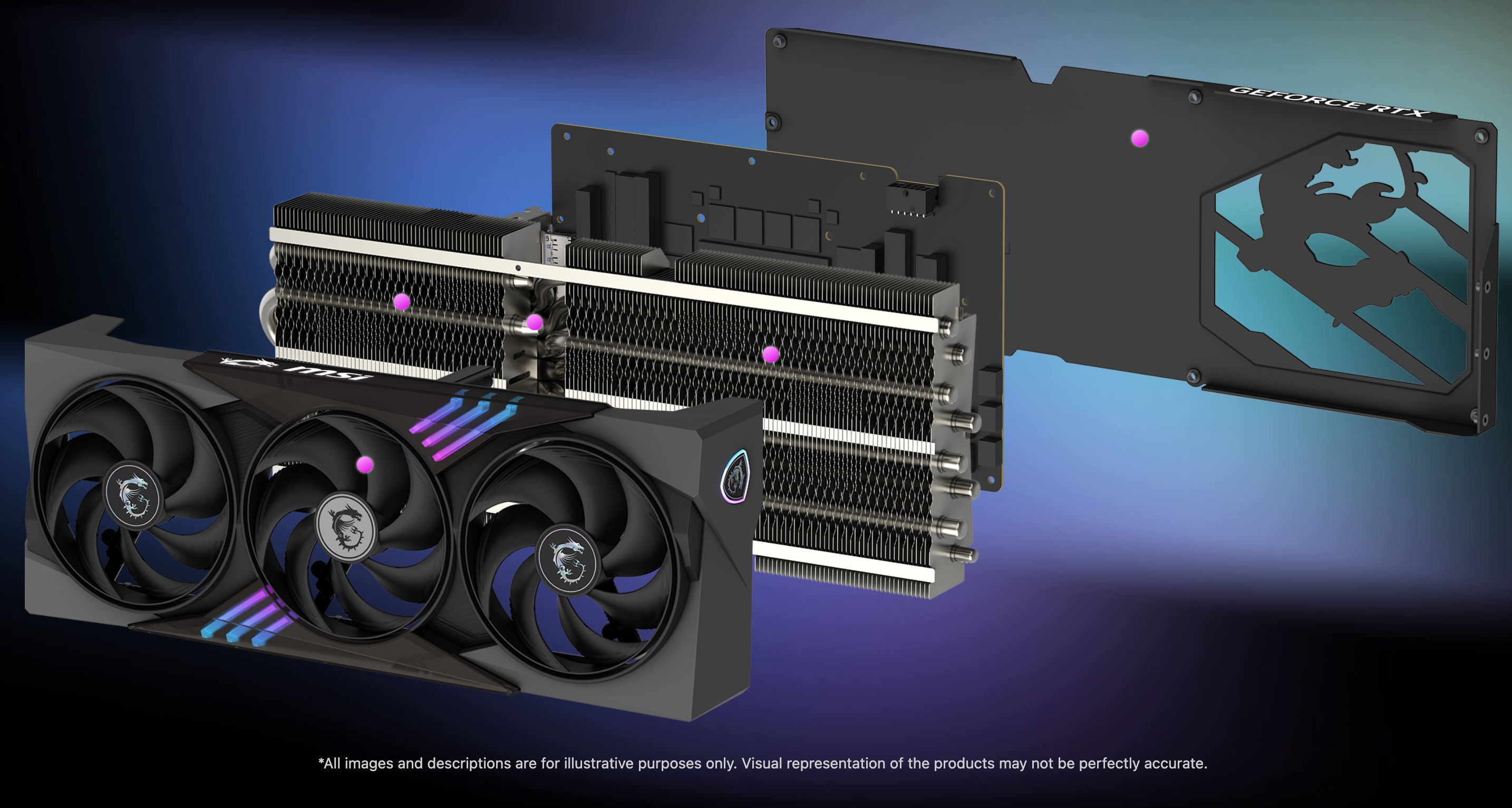 MSI GeForce RTX 5090 32G Gaming Trio OC Kühleraufbau (Image © PCMasters.de)
The main cooler is based on a familiar design: a copper base plate without a vapor chamber in the middle. Eight heatpipes lead from this to the two fin stacks on the outside. MSI calls the corrugated fins on the top "Wave Curve 4.0", which in turn are intended to minimize air turbulence. The waves are less pronounced at the points where the fan hubs are located.
The three axial fans with a diameter of 110 mm are located on a plastic cover. They mainly work quietly because the cooler is simply larger than the previous generation and can therefore dissipate a lot of waste heat.
Temperatures
The cooler is large overall and keeps the graphics card at an acceptable temperature under full load, but can turn faster if necessary. The temperature rose slightly after overclocking.
The measured values are delta values in which the room temperature has been deducted.
Volume of the GeForce RTX 5090 from MSI
We have introduced a volume measurement and measured the noise level of the GeForce RTX 4090 and compared it with other graphics cards. The open design lends itself well to such an evaluation. We measure at a distance of 20 cm. The PCE-332A measuring device is set to a measuring range of 30-80 dbA
Under full load with Furmark, the three fans of the MSI GeForce RTX 5090 rotate at approx. 1,300 rpm and reached a noise level of 39.9 dBA. The GIGABYTE RTX 4090 Windforce V2 16G was comparatively much louder here at 46.7 dB(A). After overclocking, the noise level of the MSI GeForce RTX 5090 hardly increased and the speed was mostly below 1,300 rpm. We would describe the card as quiet under load. Under idle conditions and low load, the fans don't rotate at all.
In games with very high fps, we could clearly hear a coil beeping.
Power consumption
In terms of power consumption, the MSI GeForce RTX 5090 sets new standards with 575 watts - in a negative sense! This measurement comes from GPUz and reflects the TGP from NVIDIA. After overclocking at 104% TGP, the MSI card achieved the same 575 watts, but we were able to measure a higher consumption at the socket.
Even though the MSI GeForce RTX 5090 only consumes slightly more power in idle compared to the GeForce RTX 4090, it is significantly hungrier under full GPU load with Furmark. We measured just under 792 watts** at 100% TGP, which is a new record. After overclocking, the consumption even went up to 827 watts. So it's no wonder that a 1 kW power supply such as the **Corsair RM1000x Shift is recommended for operation.
Apart from the performance, we have an increase in consumption from RTX 4090 to RTX 5090 of a remarkable 38%. This value is close to the increase of the Cuda cores. After overclocking, however, 45% more power is required for the new generation.
Graphics card ranking 2025
After we have retested all graphics cards and included them in the comparison, we look at the performance of the model from this test in relation to the rest and the previous generations.
GeForce RTX 5090 gaming benchmarks at 1920x1080 (1080p)
In 1080p benchmarks, the MSI GeForce RTX 5090 can build up a large gap to all cards, including the GIGABYTE RTX 4090 Windforce V2 16G. Without overclocking, we see approx. 31% more performance and after overclocking as much as 38% more fps compared to the RTX 4090. This is in line with the amount of power it consumes more.
GeForce RTX 5090 gaming benchmarks at 4k or 3840x2160 without ray tracing
If we increase the resolution to 4k/UHD, the MSI GeForce RTX 5090 is approx. 47 % ahead of the GeForce RTX 4090 and approx. 97 % ahead of the water-cooled Radeon RX 7900 XTX from PowerColor! After overclocking, however, the performance drops here because in some games the clock rate no longer goes as high as under standard conditions.
GeForce RTX 5090 gaming benchmarks at 4k or 3840x2160 with ray tracing
If ray tracing is activated at 4k/UHD, the MSI GeForce RTX 5090 delivers around 33% more fps on average than the GIGABYTE RTX 4090 Windforce V2 16G. The water-cooled Radeon RX 7900 XTX is left behind here and is 77% behind the GeForce RTX 5090.
GeForce RTX 5090 gaming benchmarks at 8k
In the 8k benchmark, the GeForce RTX 5090 performs very similarly, delivering 51.6% more performance compared to the previous generation. Overclocking gives the MSI GeForce RTX 5090 an even greater advantage of approx. 57%.
GeForce RTX 5090 synthetic benchmarks
With synthetic benchmarks, you usually get a very balanced ratio, as a lot of static and feature-specific test runs are carried out here. In these scenarios, the MSI GeForce RTX 5090 achieves an average of 20.8% more performance than the GeForce RTX 4090. After overclocking the GeForce RTX 5090, the advantage increases to 23%.
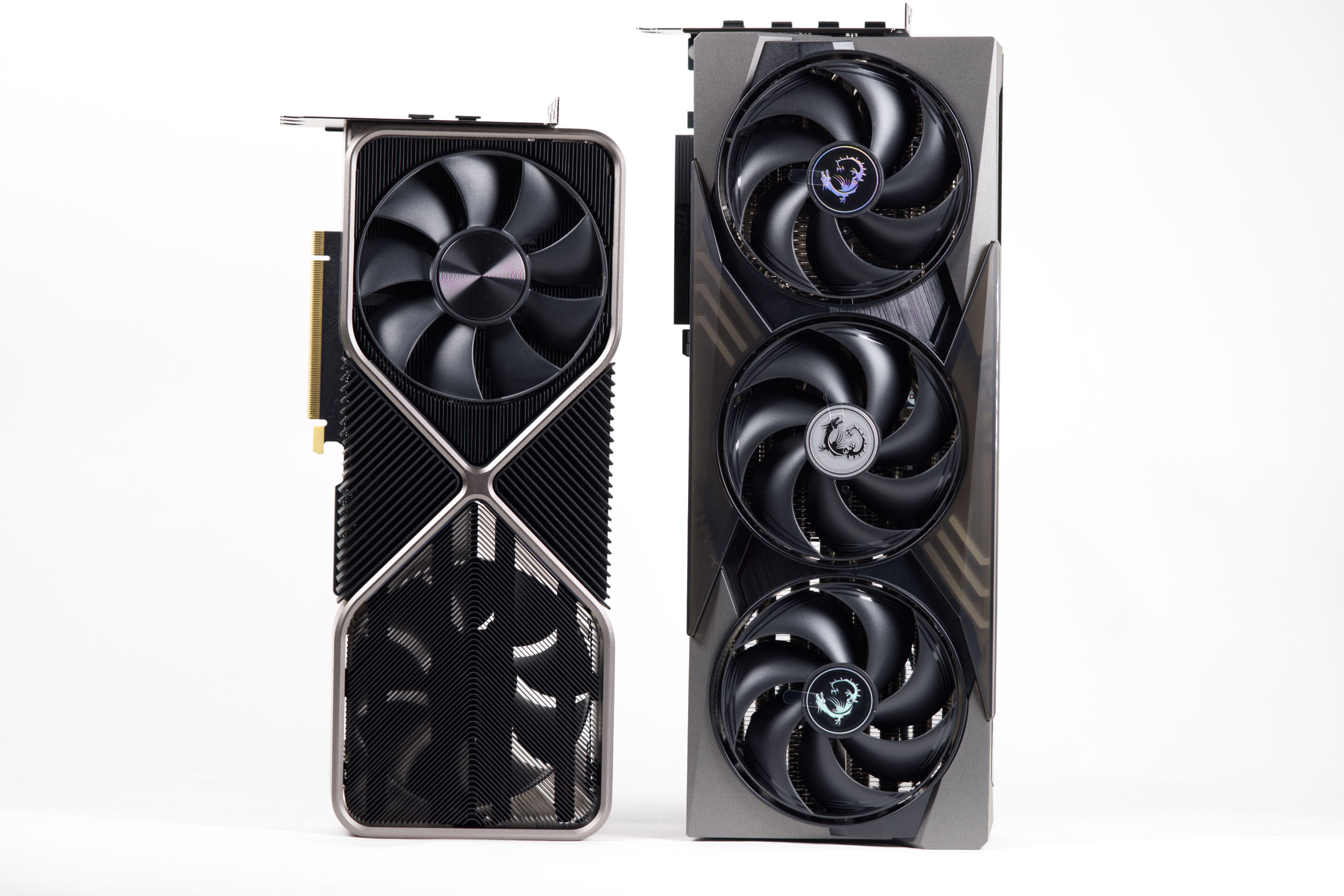 MSI GeForce RTX 5090 32G Gaming Trio OC vs RTX 3090 FE (Image © PCMasters.de)
Conclusion on the GeForce RTX 5090
NVIDIA wanted to set new standards with the GeForce RTX 5090 and has achieved this on several levels. As the MSI GeForce RTX 5090 32G Gaming Trio OC is a graphics card that is close to NVIDIA's specified limits, we were able to put the new generation to the test in a direct comparison with the GeForce RTX 4090.
In purely technical terms, NVIDIA has packed more raw performance into the new Blackwell chip and tweaked many of the screws. With an increase of 20% more transistors on around 23% more surface area, a whopping 21,760 streaming processors are accommodated, which represents an increase of 32.8%. In addition, the latest GDDR7 graphics memory is used here, which is even connected with a 512 bit wide memory bus and even provides 32 GB memory capacity compared to the 24 GB of the GeForce RTX 4090. But it's not just on paper that performance has increased: In 1080p games we see 31% more performance, in 4k or 3840x2160 without ray tracing it's 47% more performance and with ray tracing it's still 33%. In synthetic benchmarks, we see an average of 20.8% more performance.
However, this performance boost also comes at a price: the 575 watt TGP results in significantly higher consumption. The graphics card is mostly quiet and the cooling is not yet at its limit. Coil beeping can be heard in scenarios with very high frame rates.
If you decide to buy one, you will have a hard time finding a card. The GeForce RTX 5090 is not yet in stock and is only available if you pay significantly more than the €2,829 (RRP).
Pro
- Very high performance
- 32 GB GDDR7 memory
- Large and quiet cooler
- Simple design with ARGB lighting
- Overclocking possible
Contra
- Slight coil beeping at high FPS
- High consumption
- Price of
- Availability