
 Computer Forum
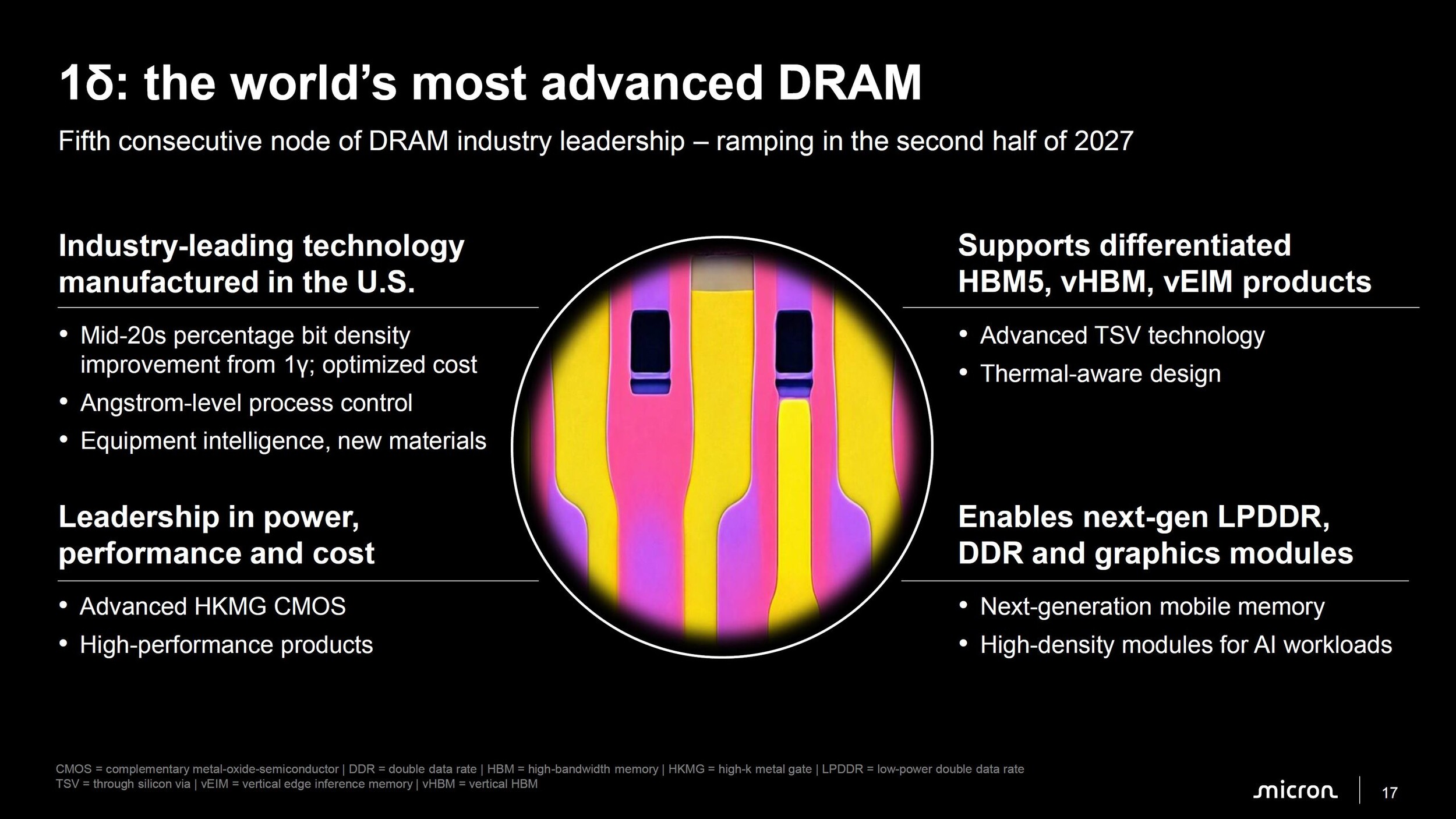 DDR6 DRAM 1delta (Image © Wccftech,Micron)
The upcoming 1-Delta node is the successor to 1-Gamma technology. This node is characterized by process control in the angstrom range and the integration of advanced HKMG-CMOS technology. Key technical aspects of the 1-Delta node include:
- Bit density: A percentage improvement in bit density in the mid-20s range compared to the 1-Gamma node.
- Manufacturing: Production will be concentrated in the United States, with the technology currently in the yield ramp-up phase.
- Scaling Path: Micron is focusing on 6F2 DRAM scaling, as the company has determined that the 4F2 path is no longer feasible due to complexity and cost.
- Future Integration: This node forms the foundation for HBM5, vHBM, vEIM, DDR6, and LPDDR6.
Looking further into the future, the roadmap includes the transition to 1-Epsilon using wafer bonding, followed by the Zeta-A node utilizing high-NA EUV, and the Eta-A node. The ultimate goal is to realize 3D DRAM, in which cells are stacked vertically, as planar cells are reaching atomic limits.
DDR6, LPDDR6, and High-Capacity RDIMMs
Micron’s next-generation memory products are designed to deliver a significant increase in bandwidth and energy efficiency, primarily to support AI inference and data center workloads.
DDR6 and LPDDR6
- DDR6: This standard is designed for highly reliable server applications and offers more than twice the bandwidth of DDR5.
- LPDDR6: LPDDR6 is aimed at both mobile devices and data centers and offers an improvement in energy efficiency of over 35% compared to LPDDR5. Micron is currently collaborating with Meta to integrate LPDDR6 into future data center architectures.
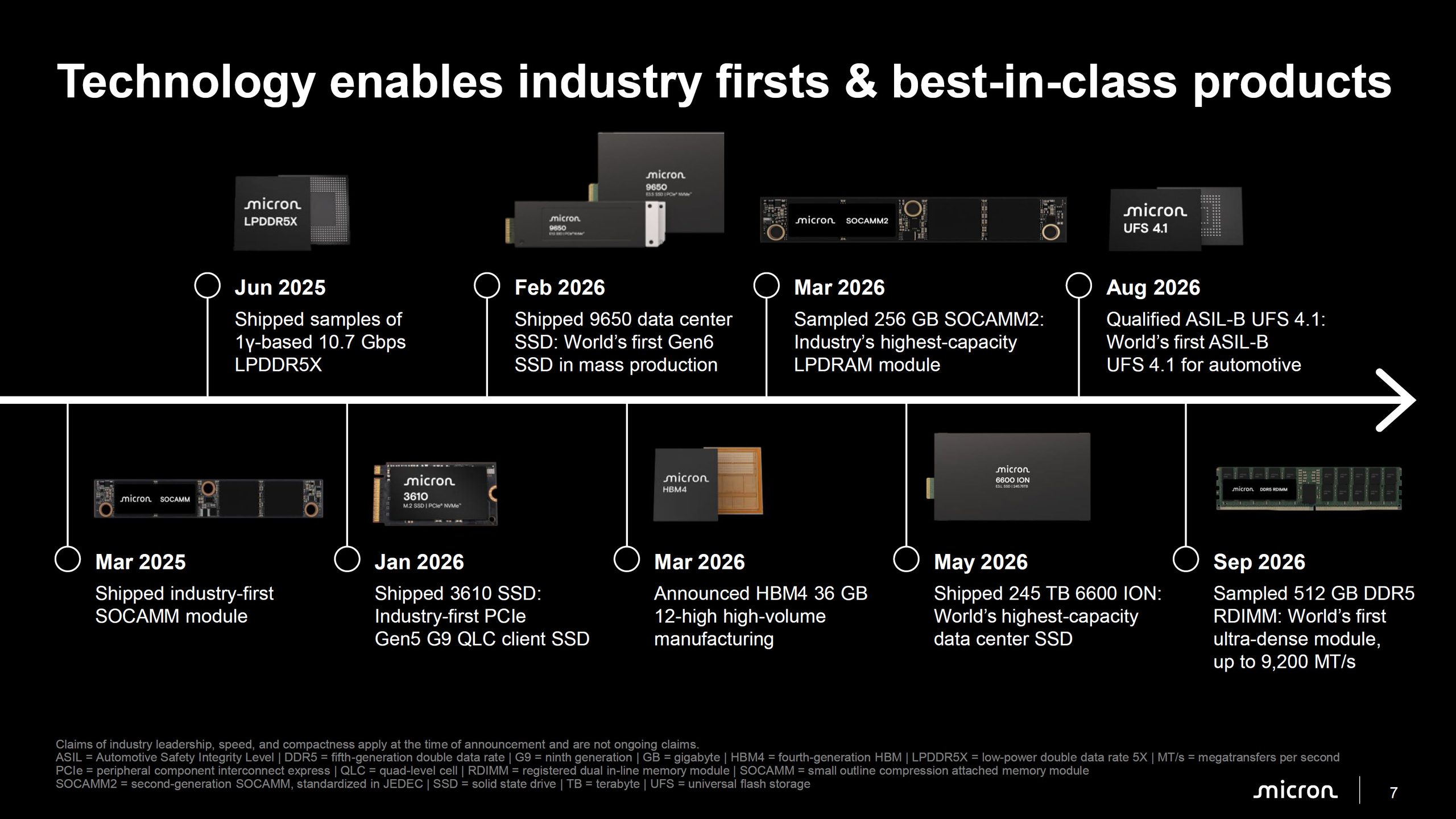 Micron DRAM Roadmap NAND RAM (Image © Wccftech,Micron)
High-Capacity RDIMMs
To support large AI datasets, Micron is currently developing modules with extremely high memory density, moving from the previously announced capacities of 512 GB to 1 TB RDIMM memory modules. That would be staggering, considering that 32 or 64 GB per module is currently the norm. How much these modules will cost is another story entirely, and we expect prices on par with those of a small car.
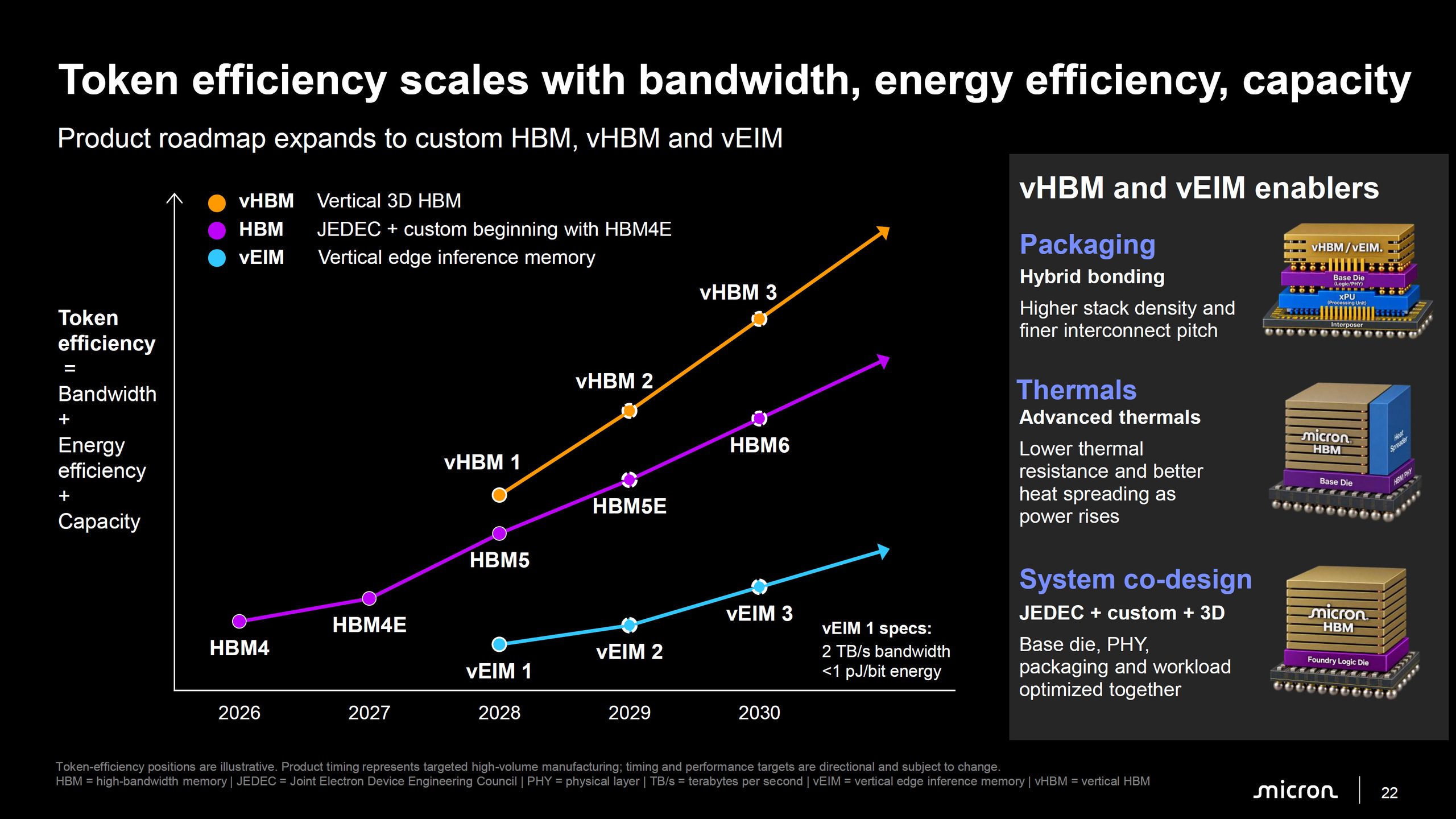 Micron HBM Roadmap (Image © Wccftech,Micron)
High Bandwidth Memory (HBM) and Vertical Architectures
Of course, the HBM roadmap was also a key part of the presentation. The following developments were highlighted:
Standard and Custom HBM
Micron is moving from HBM3E (8H and 12H) toward HBM4. HBM4 is expected to hit the market in 2026, with mass production of 36-GB stacks set to begin. HBM4 will offer a bandwidth of approximately 2.8 TB/s per stack. Custom base-die options enable the integration of computing logic and core memory logic.
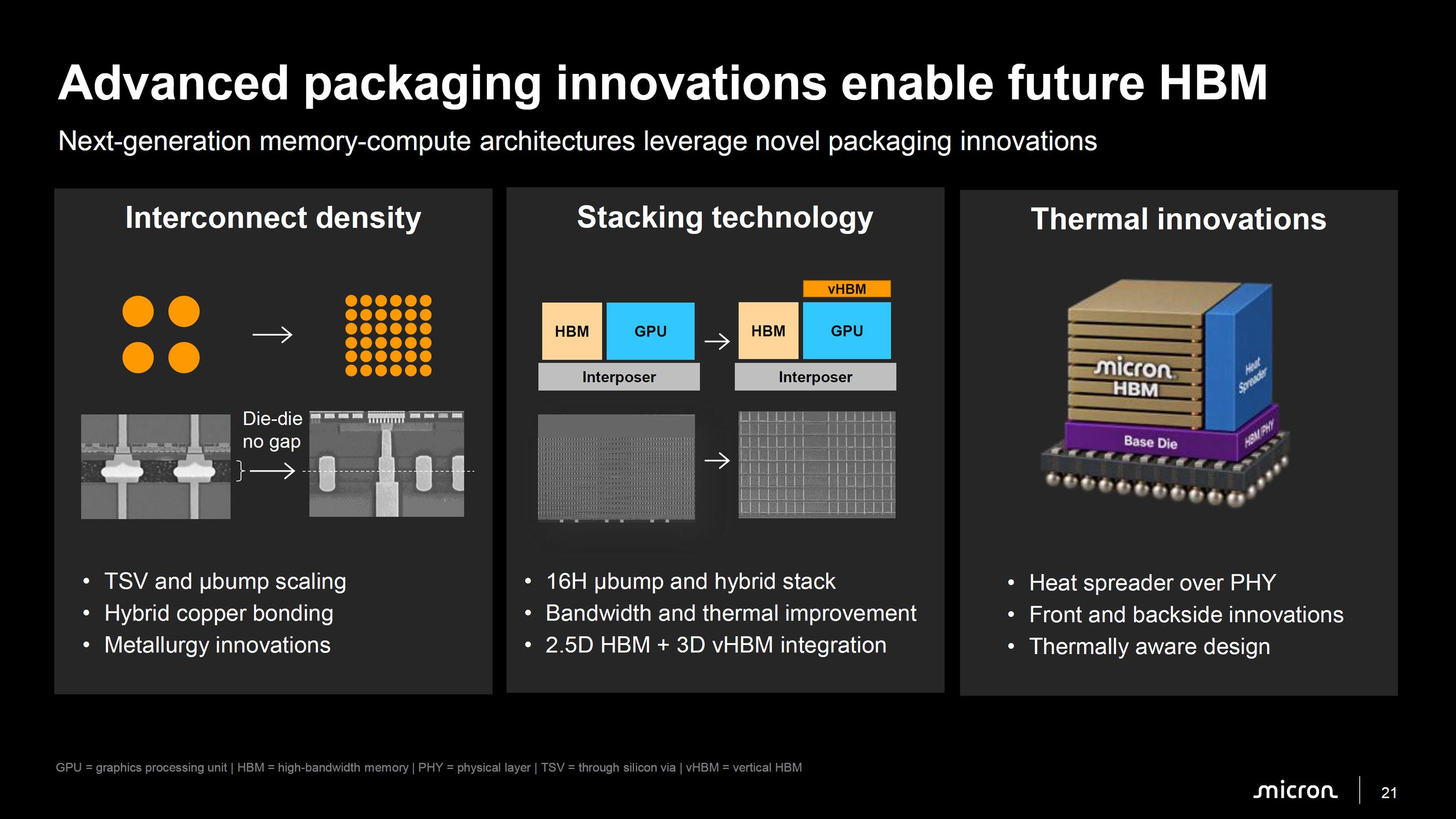 Micron HBM Features (Image © Wccftech,Micron)
Vertical HBM (vHBM) and vEIM
One innovation is vHBM (Vertical 3D HBM), in which memory is stacked directly on top of the compute chip, as is also the case with AMD’s 3D-V-Cache. This minimizes the path from memory to the compute chip and increases tokens per watt as well as overall bandwidth efficiency.
In parallel, Micron is developing vEIM (Vertical Edge Inference Memory) with the goal of achieving a bandwidth of 2 TB/s per module while consuming less than 1 pJ/bit. These vertical solutions will utilize hybrid copper bonding and thermally optimized designs to control heat distribution across the PHY.
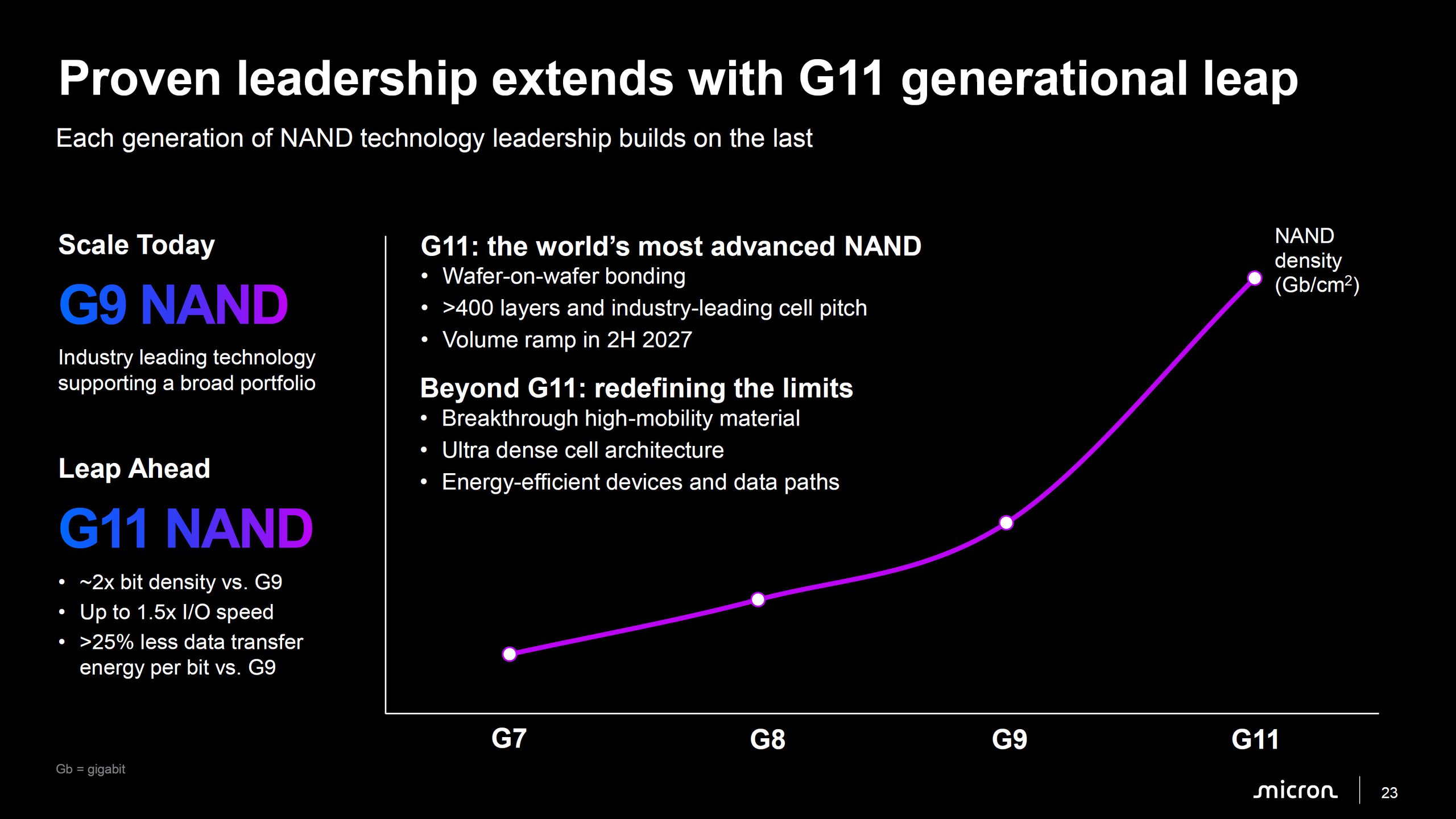 Micron G11 NAND (Image © Wccftech,Micron)
G11 NAND Flash and 400-Layer Scaling
NAND is also Micron’s core business, and the company is moving beyond the G9 generation to the G11 generation. Mass production of G11 NAND is scheduled to begin in the second half of 2027. The technical specifications of G11 NAND include:
- Number of layers: More than 400 layers.
- Bonding technology: Uses wafer-on-wafer bonding.
- Density and Speed: Offers approximately twice the bit density of G9 NAND and a 1.5-fold increase in I/O speeds.
- Energy Efficiency: Reduces energy consumption per data transfer by more than 25%.
Development beyond G11 will focus on high-mobility materials and extremely dense cell architectures to further improve energy-efficient data paths.
These are just the key takeaways from the roadmap; as usual, individual announcements regarding the respective technologies will be released in due course—for example, once mass production is achieved or during earnings calls for shareholders. Even though the innovations seem very promising and positive, the intense focus on data centers continues to push consumers into the background, meaning we shouldn’t expect lower prices for RAM and NAND. It’s a truly unfortunate situation that should actually concern companies as well.