
 Computer Forum
 OpenAI GPT 5 6 (Image © OpenAI)
The new architecture emphasizes performance per token. On the “Agents’ Last Exam,” a test of professional workflows across 55 fields, GPT-5.6 Sol scored 53.6. This puts it well ahead of Claude Fable 5. Even at medium settings for reasoning performance, Sol outperforms its competitor while costing only about a quarter as much to run. Terra and Luna follow a similar trend, outperforming Fable 5 at about one-sixteenth of the cost.
For particularly demanding projects, the models offer an “Ultra” setting. This mode coordinates four agents in parallel to complete complex tasks faster. In doing so, higher token consumption is traded for better results and lower latency. Developers can now use these multi-agent configurations via a beta version of the Responses API.
 OpenAI GPT 5 6 RSI Index (Image © OpenAI)
Programming capabilities have taken a measurable leap forward. Sol set a new benchmark in the “Artificial Analysis Coding Agent Index” with a score of 80. It consumes less than half the output tokens and takes only half the time compared to previous top models. The model family also demonstrates strength in command-line workflows via Terminal-Bench 2.1 and DeepSWE.
 OpenAI GPT 5 6 GeneBench Pro (Image © OpenAI)
A new feature called “Programmatic Tool Calling” enables the model to write and execute lightweight programs. These programs coordinate tools and process data in memory. This means developers don’t have to script every single step or return every tool response to the model, which reduces the total number of tokens used.
The models now handle design decisions differently. GPT-5.6 can create ergonomic user interfaces and interactive visualizations based on general instructions. Since it can review the rendered result rather than just generating code, it detects visual errors even before delivery. This also extends to knowledge work, where it transforms fragmented data from Slack or Microsoft 365 into professional presentations and spreadsheets. It can even derive a specific design system from a reference presentation and apply those layout rules to new slides.
Performance in the area of cybersecurity has also improved. Sol scored 73.5% on ExploitBench, compared to 47.9% for GPT-5.5. To manage the risks associated with these features, OpenAI has launched the “Trusted Access for Cyber” program. Verified users of this program can perform tasks such as triaging security vulnerabilities and analyzing malware. Starting September 1, members must use hardware-backed passkeys to retain this access.
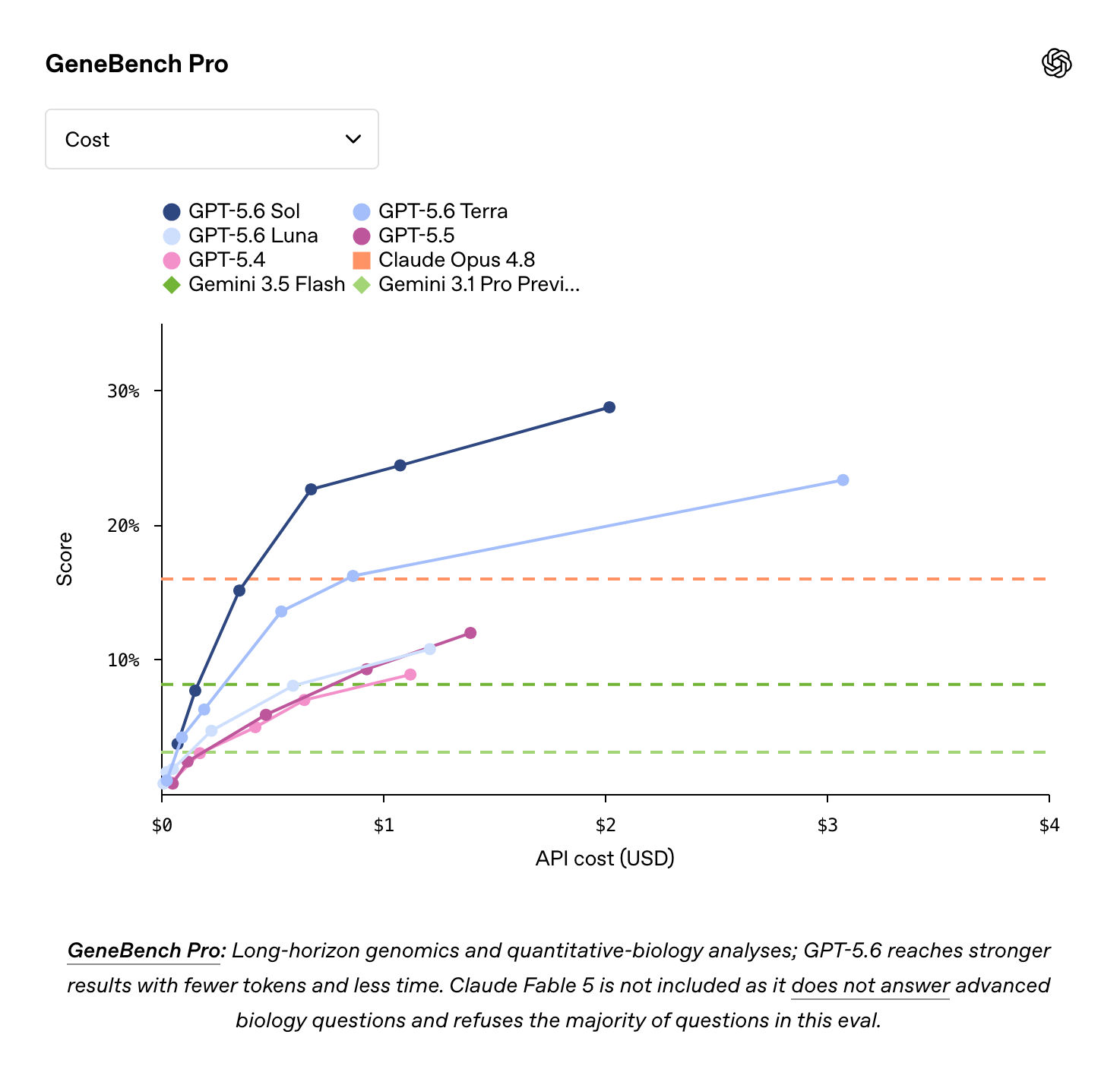
In the fields of biology and chemistry, Sol shows improvements on GeneBench Pro and LifeSciBench. These advancements are also reflected internally at OpenAI. Researchers are using the models to diagnose errors and optimize training kernels. Internal data shows that computational power for coding inference has increased 100-fold within six months.
Security is ensured by a multi-layered system. Instead of relying solely on classifiers, the system uses a “Reasoning Monitor” to check conversations for potential risks. Prior to launch, OpenAI spent 700,000 A100e GPU-hours on automated “red teaming” to find and fix security vulnerabilities.
The models are designed to help defenders find and close vulnerabilities before attackers can exploit them.
The rollout will take place worldwide within a 24-hour window for ChatGPT, Codex, and the API. Plus and Enterprise users will gain access to Sol through more involved settings. Pricing is tiered by model size: Sol costs $5 per million input tokens and $30 for output; Terra costs $2.50 and $15, respectively; Luna is the most affordable at $1 for input and $6 for output. Prompt caching has also been updated and now includes a minimum cache lifetime of 30 minutes.