
 Computer Forum
 Google Gemini 3 8 Flash und Gemini 3 8 Flash Cyber Release (Image © Google)
Gemini 3.8 Flash: Logical Reasoning and Software Development
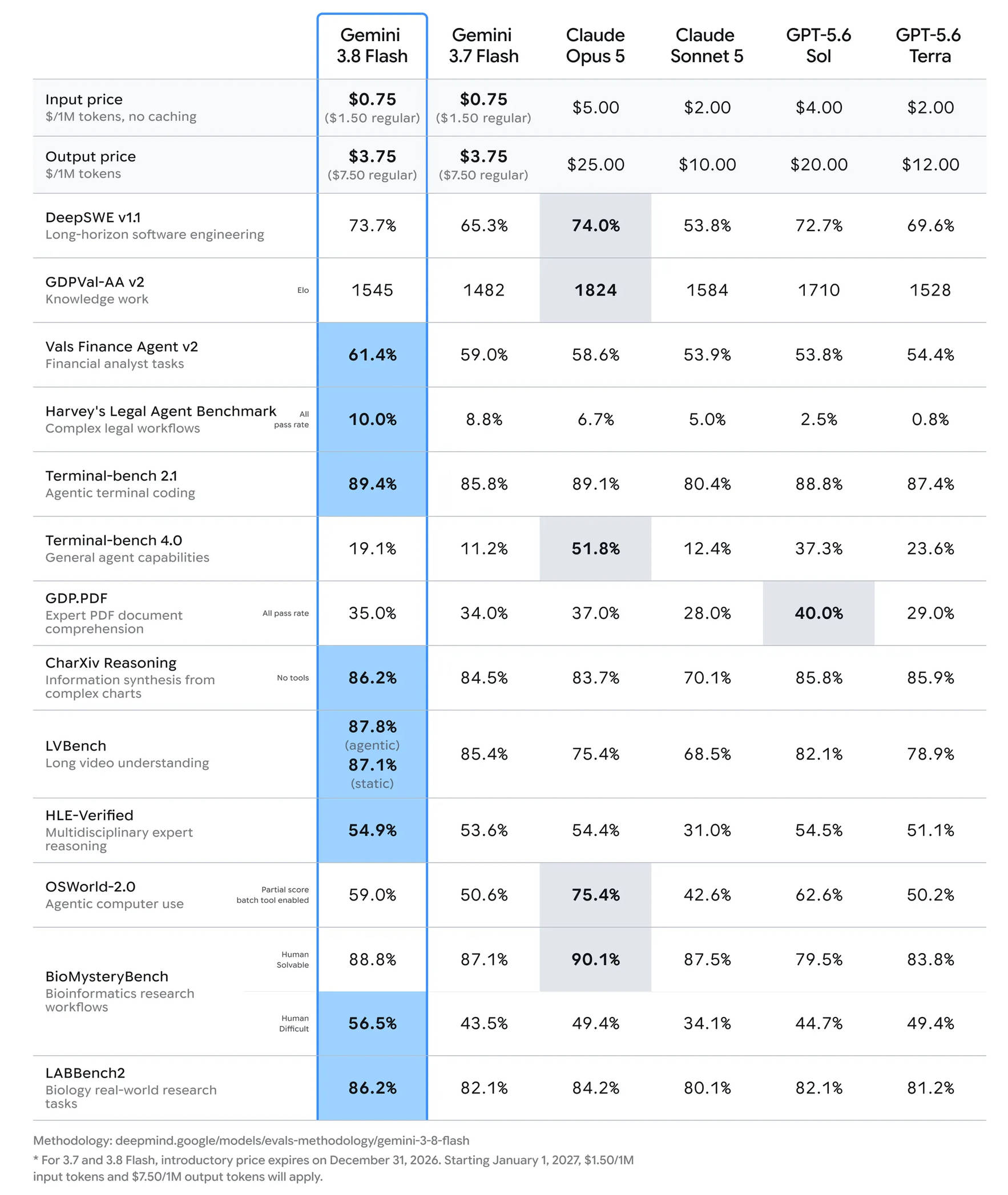
The “Gemini 3.8 Flash” standard model is designed for tasks in software development and the field of autonomous agents. It demonstrates improvements in multi-step reasoning within specialized domains, as evidenced by its score of 54.9% on the HLE Verified benchmark. In the field of software development with a long-term horizon, the model performs well on the DeepSWE v1.1 benchmark and solves complex problems autonomously.
The model’s performance is based on a design that allows for greater precision in complex tasks, enabling the model to perform additional inference steps and call upon tools iteratively. While this may result in increased token consumption due to the higher computational effort, developers can adjust these settings to optimize computational efficiency.
 Google Gemini 3 8 Flash und Gemini 3 8 Flash Cyber Leistung (Image © Google)
Practical applications of the model include the creation of immersive 3D environments, interactive topographic maps using data from the U.S. Geological Survey, and a hardware anatomy visualization tool that generates 3D renderings of device teardowns.
Gemini 3.8 Flash Cyber and the Fairwind Program
The “Gemini 3.8 Flash Cyber” variant specializes in cybersecurity tasks, particularly vulnerability detection and automated patching. Access to this model is restricted to trusted security professionals through the newly established Fairwind Program.
In terms of autonomous vulnerability detection, the model outperforms earlier versions and larger “Frontier” models in the CyberGym benchmark. Internal tests using 20 different programming languages show a success rate of over 70% in vulnerability detection.
In the area of automated patching, the model achieved a “pass@1” rate of 47.2% on the CWE-Bench, making it one of the top-performing models in this category while keeping costs lower. The model has already been put into practice at Google, where the Chrome security team reported that it generated 2.6 times more correct patches than other major commercial models. In addition, Google’s Cloud Vulnerability Research team used the model to identify a critical underlying vulnerability in less than two hours.
 Google Gemini 3 8 Flash Cyber Bench (Image © Google)
Security and System Resilience
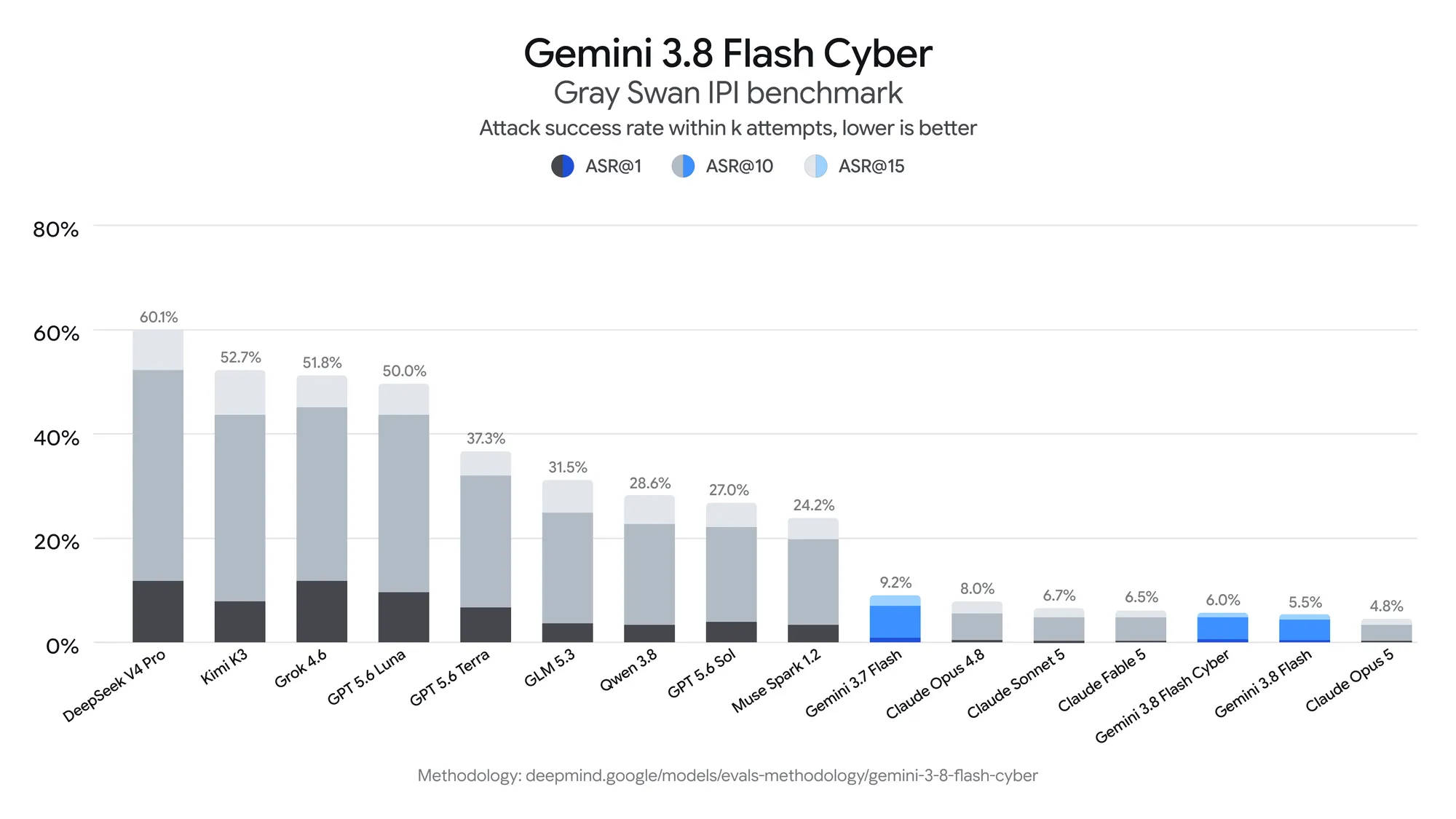
Both models include safeguards against misuse in the areas of chemical, biological, radiological, and nuclear (CBRN) risks as well as cyberattacks. The “Cyber” variant features a more comprehensive set of safeguards specifically tailored for defensive use cases. Additionally, the Gemini 3.8 series exhibits improved resilience against prompt injection attacks, as measured by the Gray Swan benchmark.
Pricing and Availability
Gemini 3.8 Flash costs $0.75 per million input tokens and $3.75 per million output tokens.
Access is available through the following channels:
- Developers: Available via the Gemini API in Google AI Studio, Android Studio, and Stitch.
- Enterprises: Accessible via Gemini Enterprise.
- Consumers: Available to Google AI Pro and Ultra subscribers via the Gemini app, Google Search’s AI mode, and Google Sheets.
- Cybersecurity professionals: Access to the “Cyber” variant is available to government agencies, critical infrastructure operators, and software maintenance professionals through the Fairwind program.