
 Computer Forum
 QNAP QSW M5218P 6F12T (Image © QNAP)
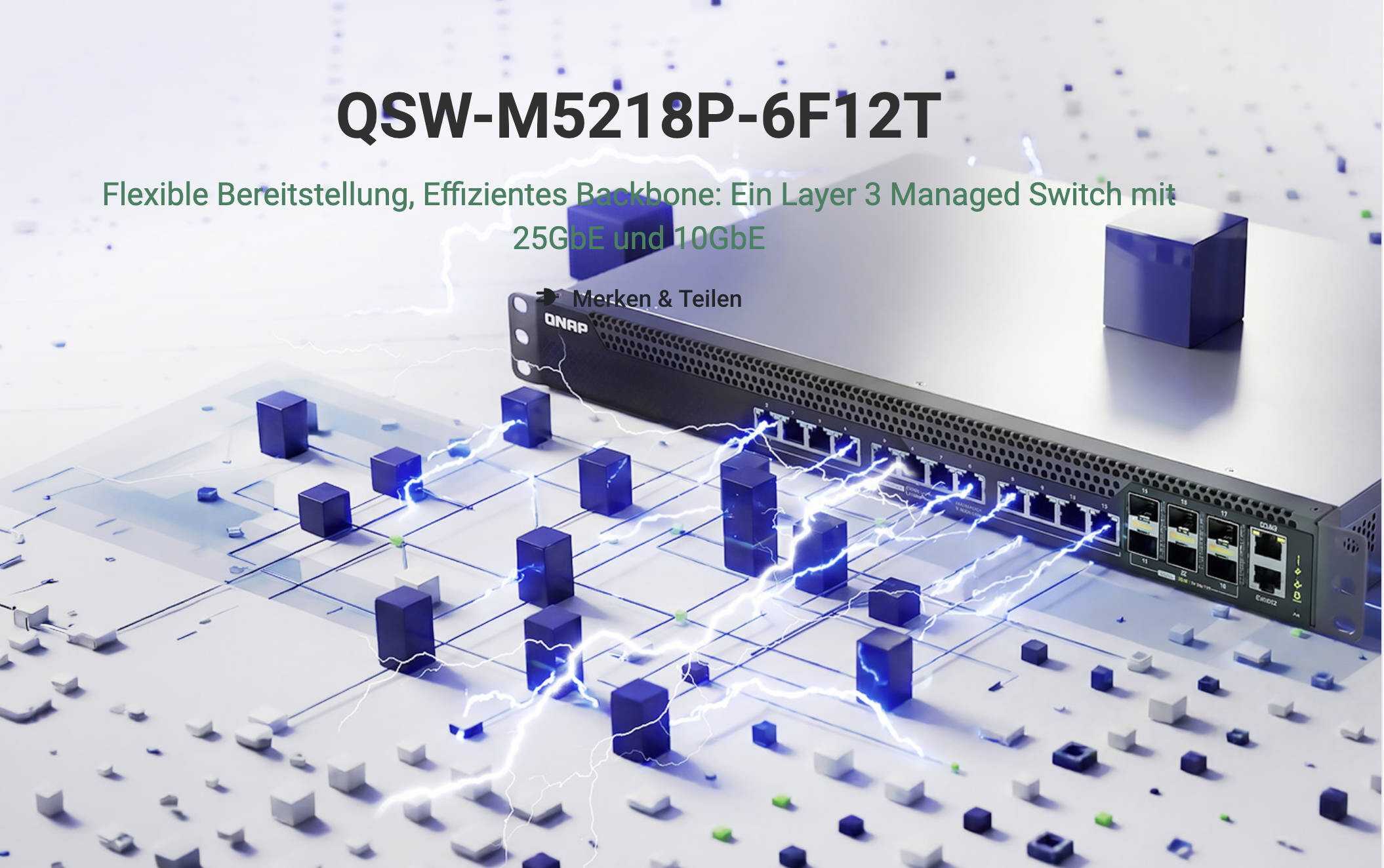
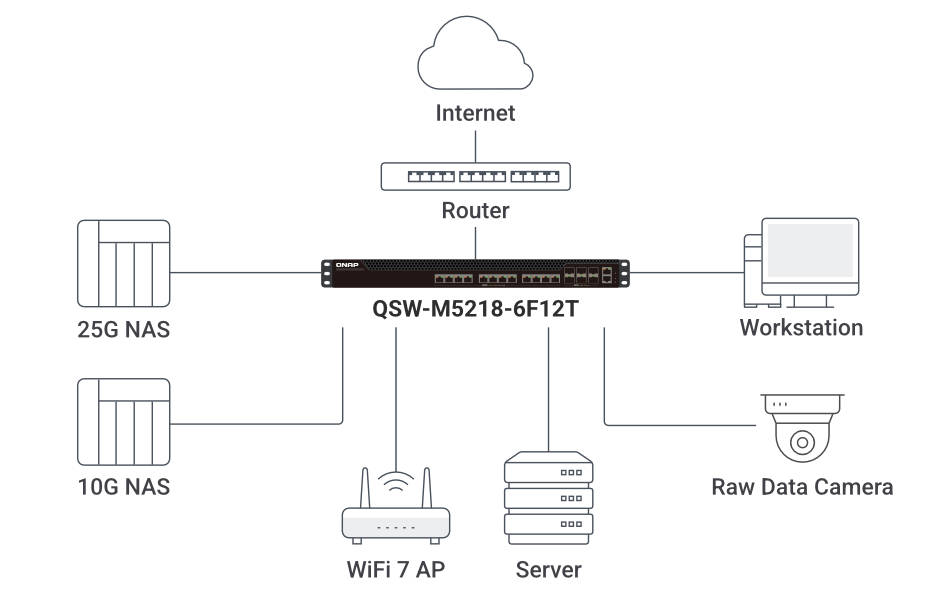
As enterprise hardware—including NAS devices, workstations, and servers—increasingly transitions to 10-GbE connectivity, traditional 1-GbE or 2.5-GbE ports and single 10-GbE uplinks often result in performance bottlenecks. The QSW-M5218 series solves this problem by providing a high density of 10-GbE interfaces for connecting high-performance end devices.
The 25-GbE SFP28 uplink ports serve as the network backbone and offer up to 2.5 times as much bandwidth per port as traditional 10G uplinks. This architecture enables enterprises to expand the capacity of their core network while continuing to use existing Cat-6a copper cabling for end-device connections, thereby reducing the need for extensive new fiber-optic installations.
 QSW M5218 6F12T (Image © QNAP)
L3-Lite Routing and Network Efficiency
To bridge the gap between simple Layer 2 switches and expensive, complex Layer 3 core switches, the QSW-M5218 series utilizes L3-Lite routing. While conventional managed Layer-2 switches are limited to VLAN and QoS functions, these models support static IPv4/IPv6 routing, inter-VLAN routing, and an integrated DHCP server. By processing routing tasks directly on the switch, the system offloads the central core router and reduces overall network latency. This approach offers a cost-effective alternative to full-featured Layer 3 models that use dynamic routing protocols such as OSPF or BGP, making it a practical choice for SMBs managing multiple network segments.
High Availability and Synchronization
Network stability is ensured by Multi-Chassis Link Aggregation (MC-LAG) and the Link Aggregation Control Protocol (LACP). MC-LAG allows multiple switches to be aggregated into a single logical link, ensuring that network operations continue without interruption even if a physical link fails. When combined with QNAP NAS high-availability (HA) configurations, this creates a redundant architecture that spans both the storage and network layers.
For professional audiovisual environments, the switches offer hardware-level support for the IEEE 1588v2 Precision Time Protocol (PTP) and Transparent Clock. This enables time synchronization with sub-microsecond accuracy, thereby compensating for switching latencies. Additionally, IGMP snooping is integrated to manage multicast streams. This prevents unnecessary traffic from consuming available bandwidth and ensures synchronized playback across video walls and media servers in AVoIP configurations.
PoE Capabilities and Power Supply
The QSW-M5218P-6F12T model supports PoE++ (IEEE 802.3bt) and delivers up to 90 W per port with a total power consumption of 470 W. With this capacity, the switch can power up to 12 PoE+ (30 W) devices, such as standard Wi-Fi access points or IP cameras. The higher output power of 90 W is specifically designed for high-performance hardware, including Wi-Fi 7 access points and PTZ cameras, eliminating the need for separate PoE injectors or additional power cables.
 QNAP QSW M5218 6F12T (Image © QNAP)
The series is designed for integration with the ADRA NDR X Network Detection and Response system on QNAP NAS to identify and isolate ransomware or anomalous traffic patterns. It also supports QNAP Airgap+ for isolated backup environments, reducing the risk of backups being compromised during a network-wide attack.
Administrative tasks are handled via QSS Pro (QNAP Switch System Pro), a web-based interface for managing L2 and L3-Lite settings. For enterprises with multiple locations, the AMIZcloud platform provides centralized cloud control, allowing IT administrators to remotely monitor and troubleshoot switches without the need for local hardware or software installations.
Technical Specifications and Prices
QSW-M5218-6F12T
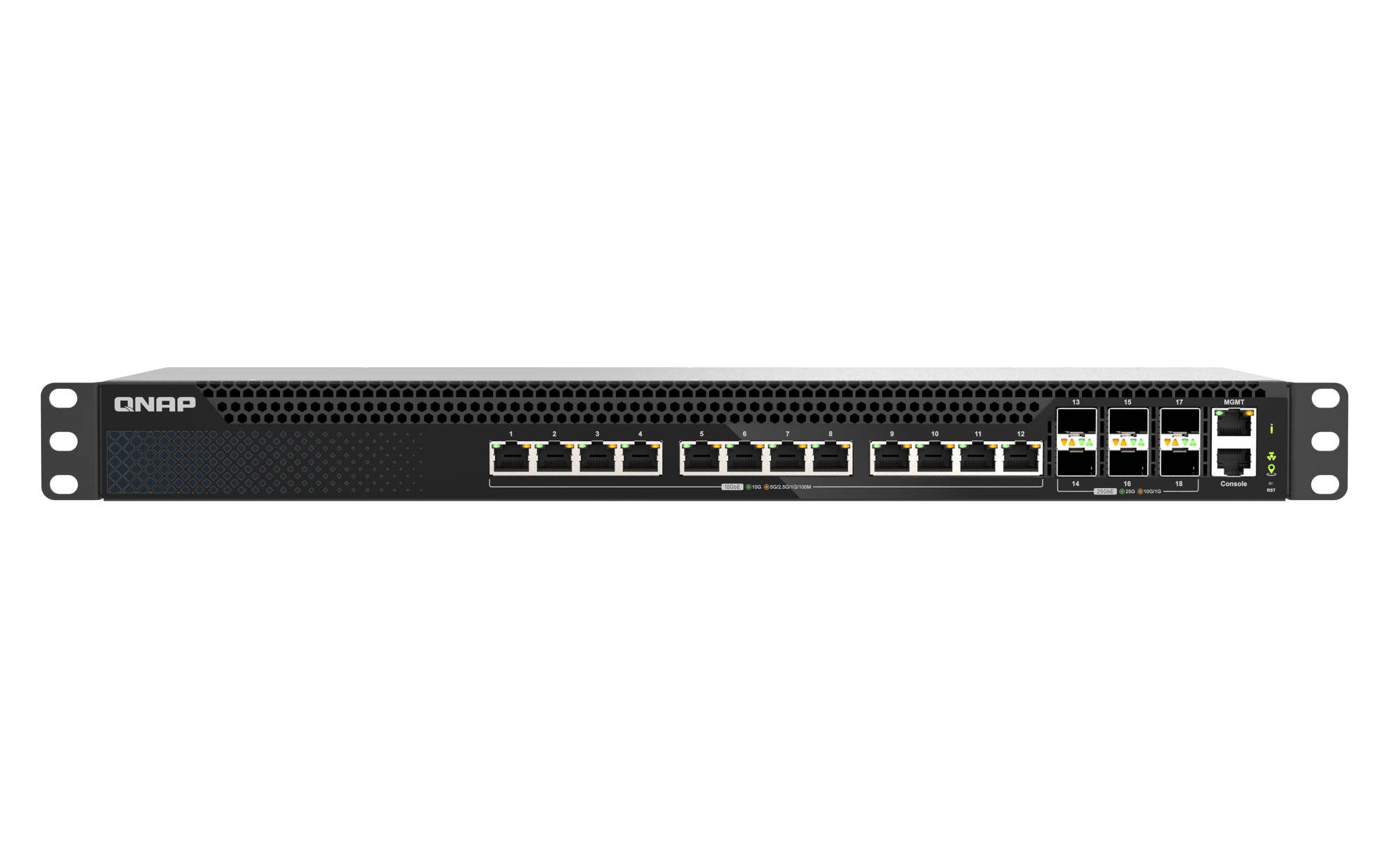
- Ports: 12x 10GbE RJ45, 6x 25GbE SFP28 uplinks
- Switching Capacity: 540 Gbit/s
- Management: L3 Lite Managed
- Price: €1,049
QSW-M5218P-6F12T
- Ports: 12x 10-GbE RJ45 PoE, 6x 25-GbE SFP28 uplinks
- Switching capacity: 540 Gbit/s
- PoE Standards: PoE++ (IEEE 802.3bt) up to 90 W per port
- Power Consumption: 470 W
- Management: L3 Lite Managed
- Price: €1,349