 Computer Forum
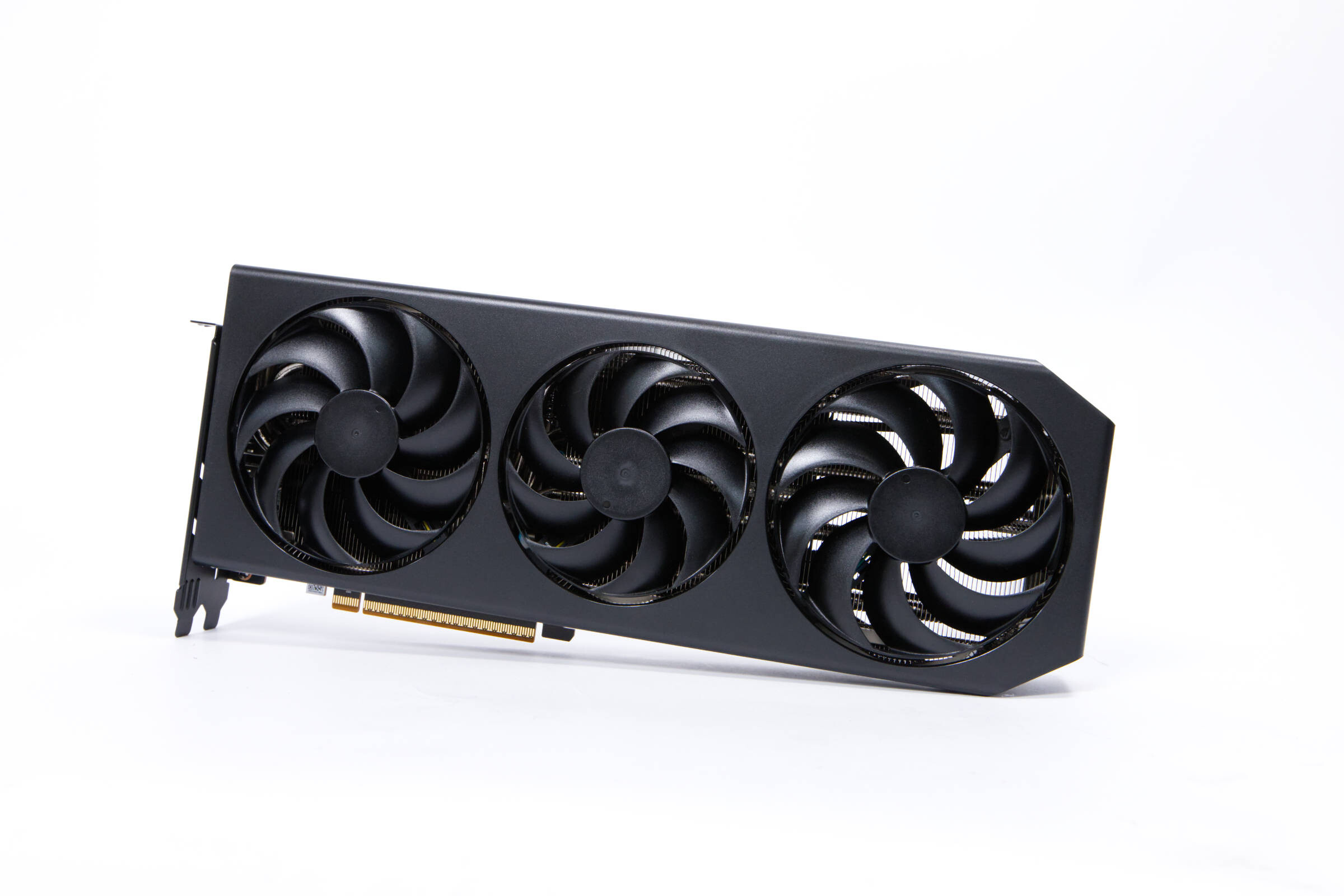 PowerColor Radeon RX 9070 Hellhound Test Review (Image © PCMasters.de)
PowerColor Radeon RX 9070 GRE Hellhound in detail
With the Radeon RX 9070 GRE, AMD offers a new option for gamers who are looking for inexpensive graphics cards but don't want to neglect performance. The GRE models were originally intended for the Chinese market, but have also found favor in Europe with the Radeon RX 7900 GRE (test). The Radeon RX 9070 GRE has been expected since the beginning of last year and has appeared repeatedly in leaks. AMD officially unveiled the card with its board partners at Computex 2026.
Disclaimer: We were provided with a copy by AMD and PowerColor and were allowed to test the graphics card in advance for the launch. The tests were carried out with the Adrenalin Edition 26.5.2 BETA driver provided by AMD. It is generally the case that the performance and stability of the drivers will improve again with a later driver version.
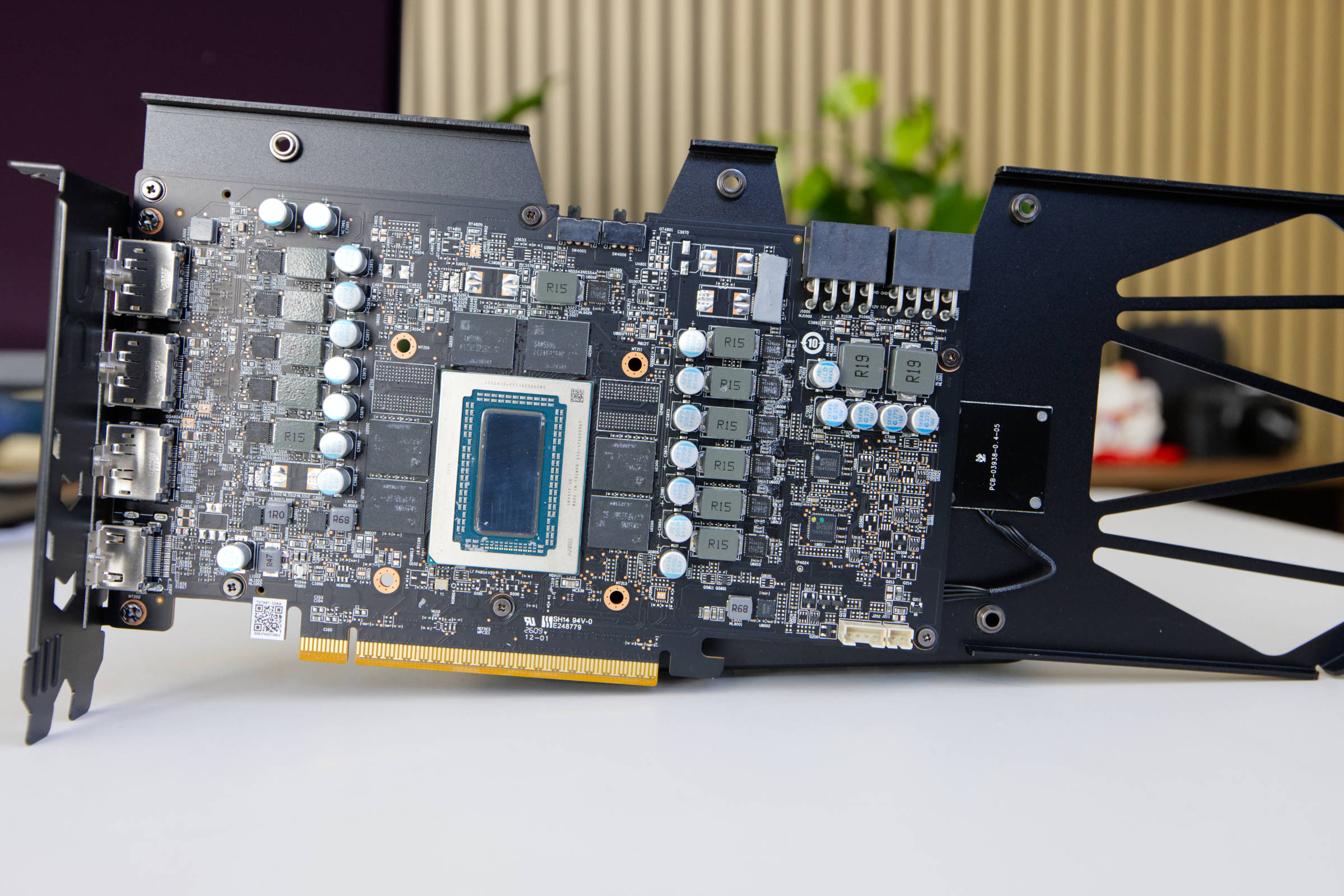 PowerColor Radeon RX 9070 Hellhound PCB (Image © PCMasters.de)
The actual technology on the PCB is hidden under the cooler: the NAVI 48 chip with RDNA4 architecture. The Radeon RX 9070 GRE shares this with its big siblings in the Radeon RX 9070 series, but some of it has been deactivated - as part of the binning process. It is therefore the same large chip with a 357 mm² surface area, but only 48 instead of the total of 64 compute units are active. This is why the Radeon RX 9070 GRE chip has a total of 3,072 ALUs.
For ray tracing calculations, the Radeon RX 9070 GRE has 48 ray accelerators (Gen. 3) and also has dedicated AI accelerators (Gen. 2), 96 of which are enabled. The base clock is said to remain at 1.33 GHz, whereas the boost clock can increase up to 2.79 GHz and even up to 2.86 GHz in the Hellhound Edition. The gaming clock is 2,220 MHz, but will vary greatly in games.
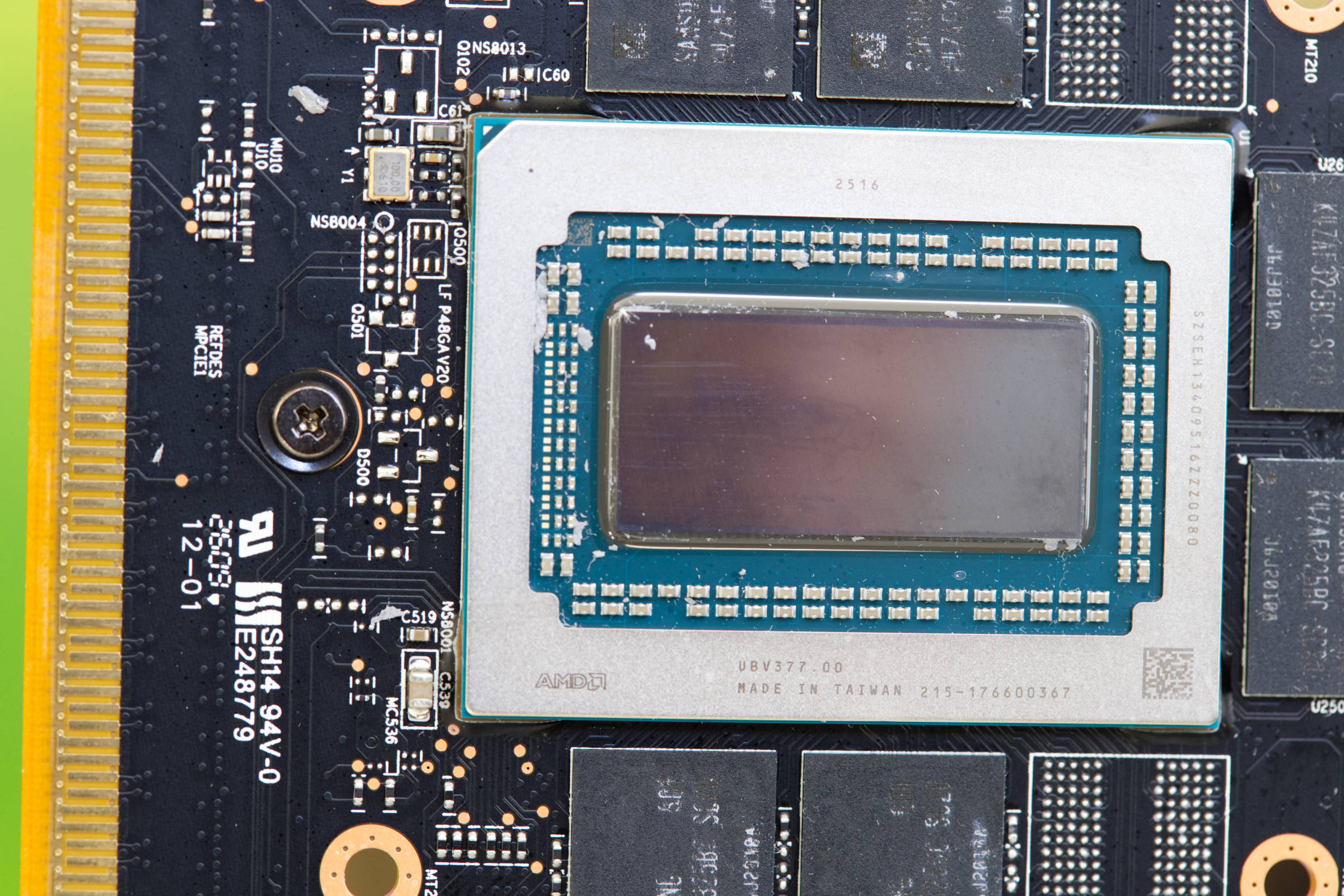 PowerColor Radeon RX 9070 Hellhound Navi48 (Image © PCMasters.de)
The chip continues to roll off the "assembly line" at TSMC using the 5nm N4P process. As a difference to the GeForce RTX 5060 Ti, AMD also emphasizes that the Radeon RX 9070 GRE uses 16 x PCI Gen5 lanes instead of the 8 lanes of the RTX 5060 Ti. It is also interesting that the RTX 5060 Ti with 16 GB VRAM is mentioned as a competitor, and not the weaker 8 GB variant. A look at the PCB also shows the very compact design, because even if the graphics card looks large, the actual PCB is rather small.
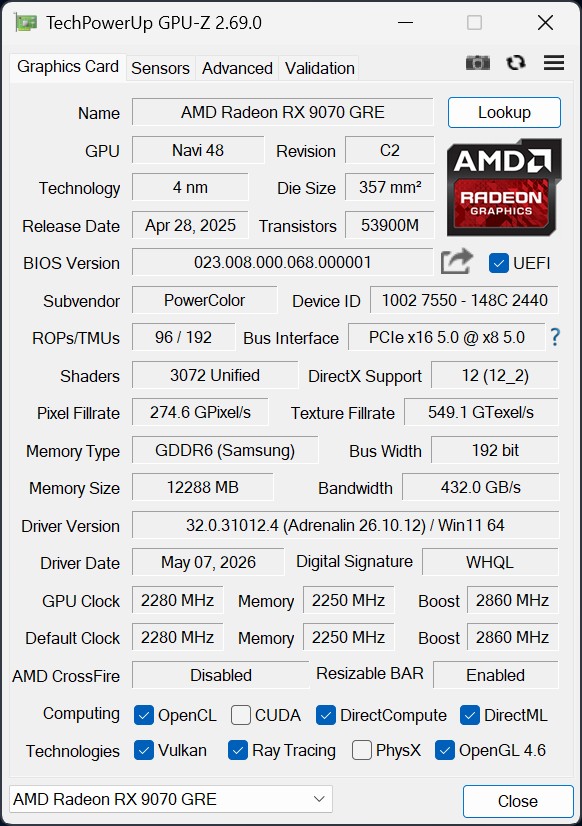 PowerColor Radeon RX 9070 GRE GPUz (Image © PCMasters.de)
Further details on these RDNA4 improvements are covered in a separate article.
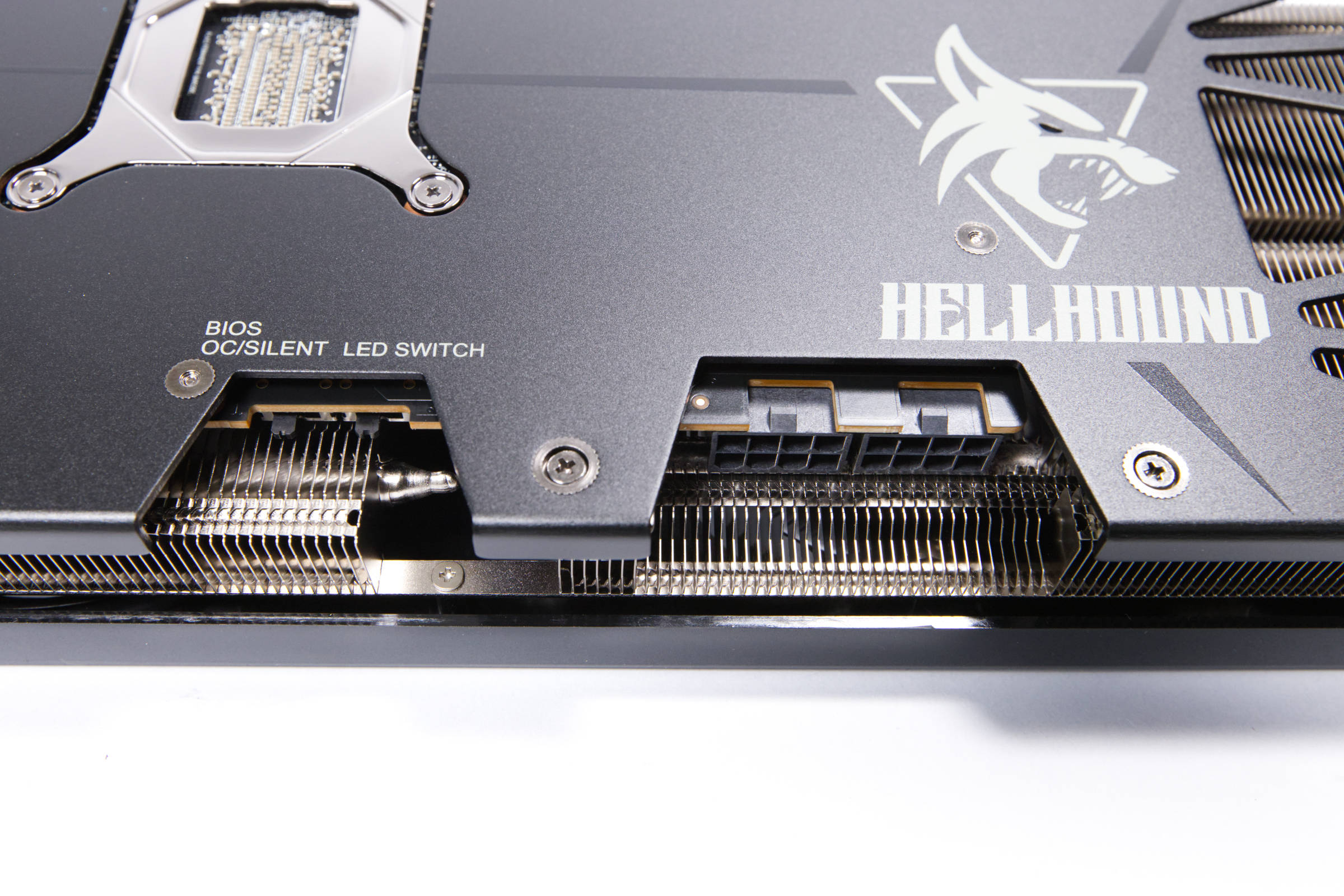 PowerColor Radeon RX 9070 Hellhound Switches PCIer Stomstecker (Image © PCMasters.de)
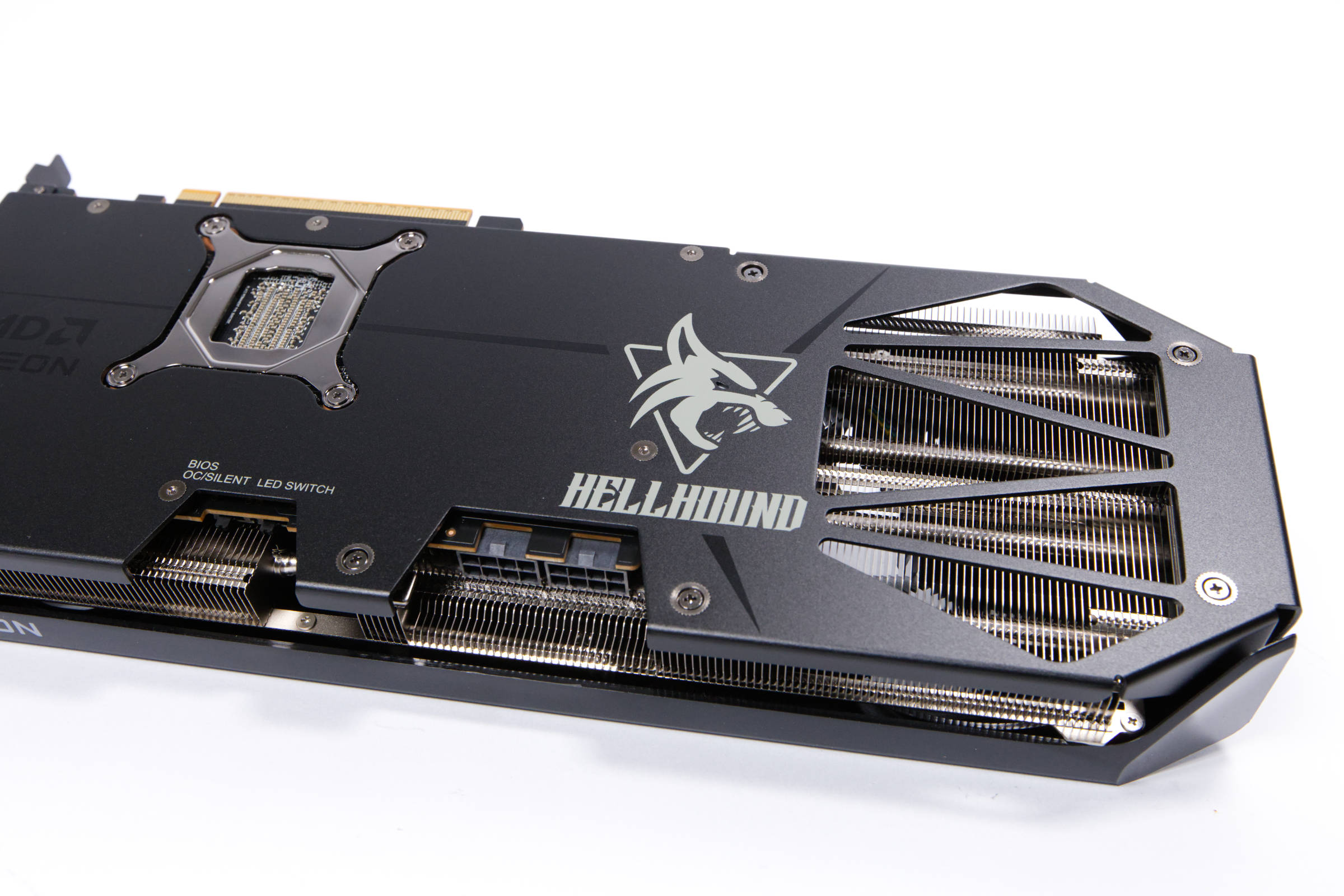
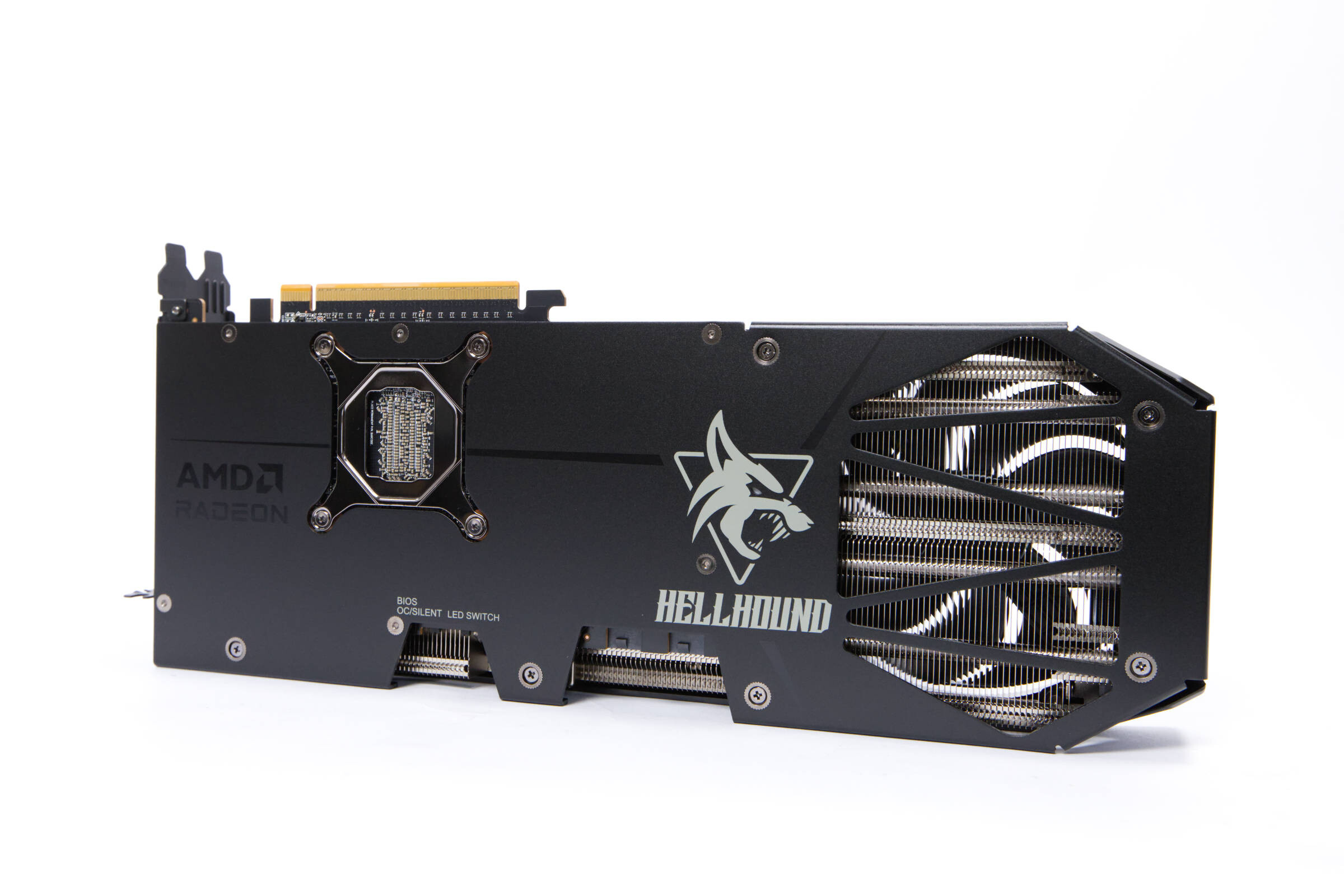
PowerColor once again relies on a dual BIOS with switch for the Hellhound edition of the Radeon RX 9070 GRE. This allows the card to run more quietly and economically when switching to silent mode. The TDP is often lowered in this mode, but we recommend leaving it in its original state, as the card is already extremely quiet. The LED lighting, which shines cold blue in this case, can also be switched off. However, the lighting is not exactly bright, which is why you can safely leave it on.
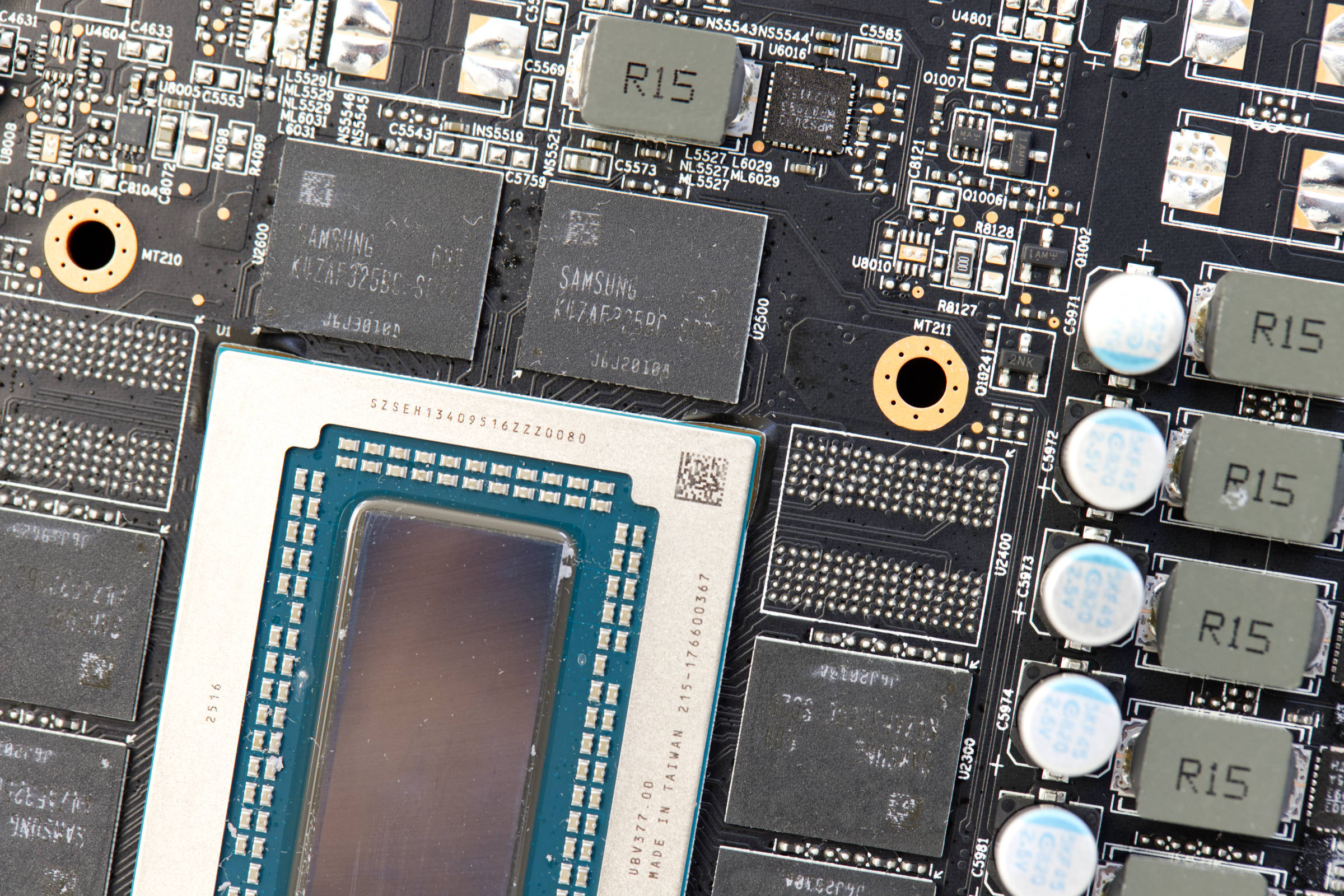 PowerColor Radeon RX 9070 Hellhound Samsung K4ZAF325BC SC20 (Image © PCMasters.de)
12 GB GDDR6 graphics memory
A further cut is made to reduce the cost of graphics memory. AMD spares itself the negative comments by installing 12 GB instead of 8 GB. Of course, 16 GB would be better, but the difference to the regular RX 9070 would be dwindling. However, GDDR6 memory from SAMSUNG is still used, which bears the identifier K4ZAF325BC SC20. On the PCB you can see that only 6 instead of 8 GDDR6 chips are soldered here. The PCB is prepared for two more chips with solder joints, but they are missing.
The most important memory specifications include 18 Gbit/s GDDR6 on a 192-bit bus. The memory clock is also lowered slightly to 2,250 MHz. The resulting bandwidth of the GDDR6 memory is 432 GB/s. To further increase the effective bandwidth and reduce the pressure on the main memory, the Radeon RX 9070 GRE also integrates 48 MB of third-generation Infinity Cache, which can reduce latency and stabilize frame pacing in texture-rich scenes.
PowerColor Radeon RX 9070 Hellhound Switches PCIer Stomstecker (Image © PCMasters.de)
Two tried and tested 8-pin PCie power connectors
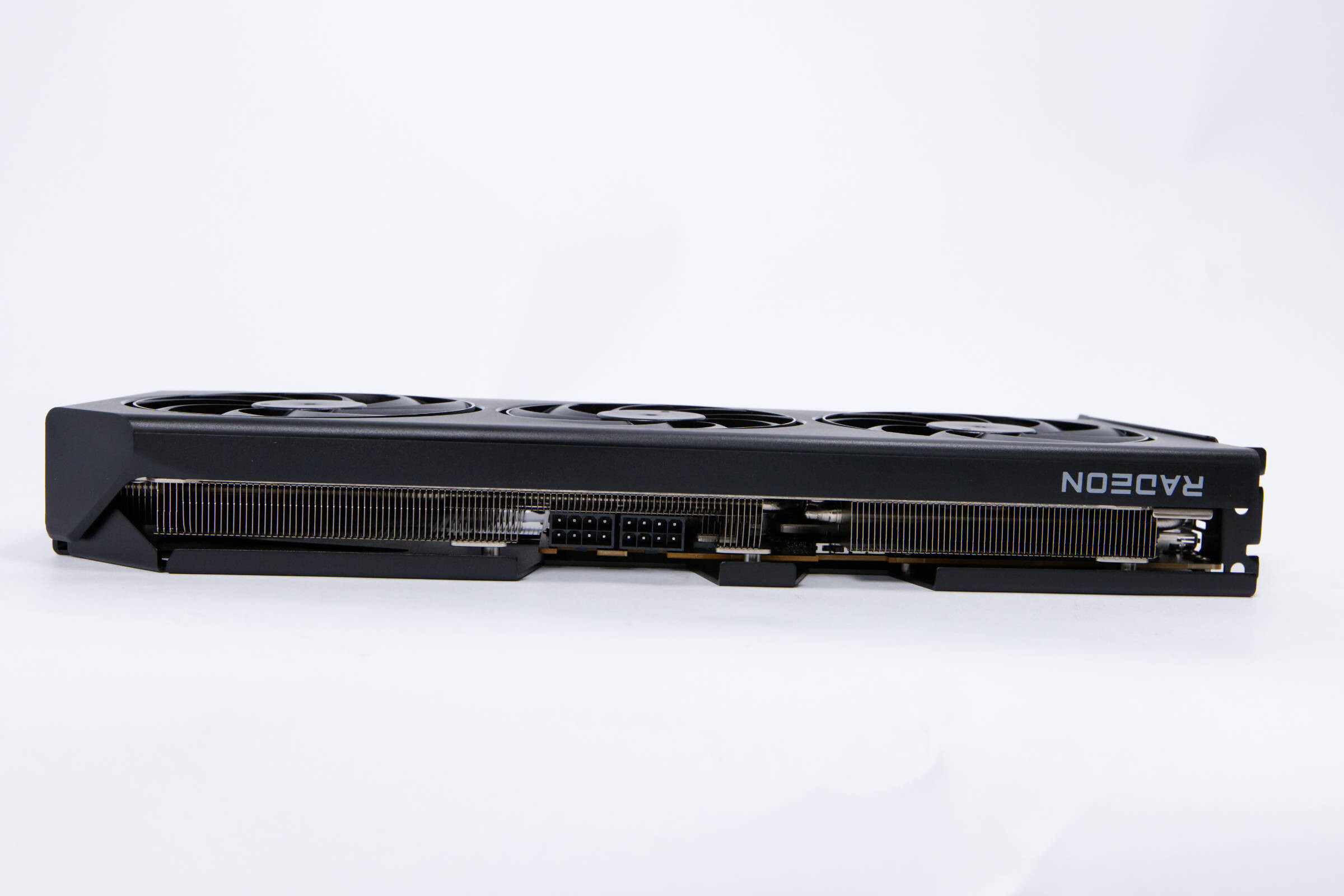
For the power supply, we once again see the usual two 8-pin connectors. These are also sufficient for this model and should provide a buffer. You can therefore rely on an ATX 2.2 or 3.0 power supply or even 3.1, as no 12x6-pin 12V power connection is required. The total graphics performance (TGP) of the Radeon RX 9070 GRE is a maximum of 220 watts, which is the same as the Radeon RX 9070. The PCIe x16 slot provides a maximum of 75 watts and the two 8-pin PCIe power connectors each supply up to 150 watts. So you still have a buffer if you want to overclock.
Radeon RX 9070 GRE Technical data
To better illustrate the differences between the two generations, we have listed the specifications in a table:
| Radeon RX 9070 XT | Radeon RX 9070 | PowerColor Radeon RX 9070 GRE Hellhound |
Radeon RX 9060 XT | Radeon RX 7900 XTX | Radeon RX 7900 GRE | |
|---|---|---|---|---|---|---|
| Architecture | RDNA4 | RDNA4 | RDNA4 | RDNA4 | RDNA3 | RDNA3 |
| Fabrication | 5nm,TSMC N4P |
5nm,TSMC N4P |
5nm,TSMC N4P |
5nm,TSMC N4P |
5nm | 5nm |
| Transistors | 53.9 billion | 53.9 billion | 53.9 billion | 29.7 billion | 57.7 billion | 57.7 billion |
| The size | 357 mm² | 357 mm² | 357 mm² | 199 mm² | 529 mm² | 529 mm² |
| Compute Units (CU) | 64 | 56 | 48 | 32 | 96 | 80 |
| ALUs | 4,096 | 3,584 | 3,072 | 2,048 | 6,144 | 5,120 |
| Raytracing Accelerators | 64 | 48 | 48 | 32 | 96 | 80 |
| AI Accelerators | 128 | 56 | 96 | 64 | 192 | 160 |
| ROPs | 128 | 128 | 128 | 64 | 192 | 192 |
| Boost clock | 2,970 MHz | 2.520 MHz | 2,860 MHz | 3,130 MHz | 2,500 MHz | 2,245 MHz |
| Base clock | 1,660 MHz | 1.330 MHz | 1,330 MHz | 2,220 MHz | 1,900 MHz | 1,270 MHz |
| Infinity Cache | 64 MB | 64 MB | 48 MB | 32 MB | 96 MB | 96 MB |
| Graphics memory | 16 Gb GDDR6 | 16 Gb GDDR6 | 12 Gb GDDR6 | 16 Gb GDDR6 | 16 Gb GDDR6 | 16 Gb GDDR6 |
| Memory bandwidth | 256 bit | 256 bit | 192 bits | 128 bit | 384 bit | 256 bits |
| Memory | 20 Gbit/s | 20 Gbit/s | 18 Gbit/s | 20 Gbit/s | 20 Gbit/s | 18 Gbit/s |
| Total board power | 304 W | 220 W | 220 W | 160 W | 355 W | 260 W |
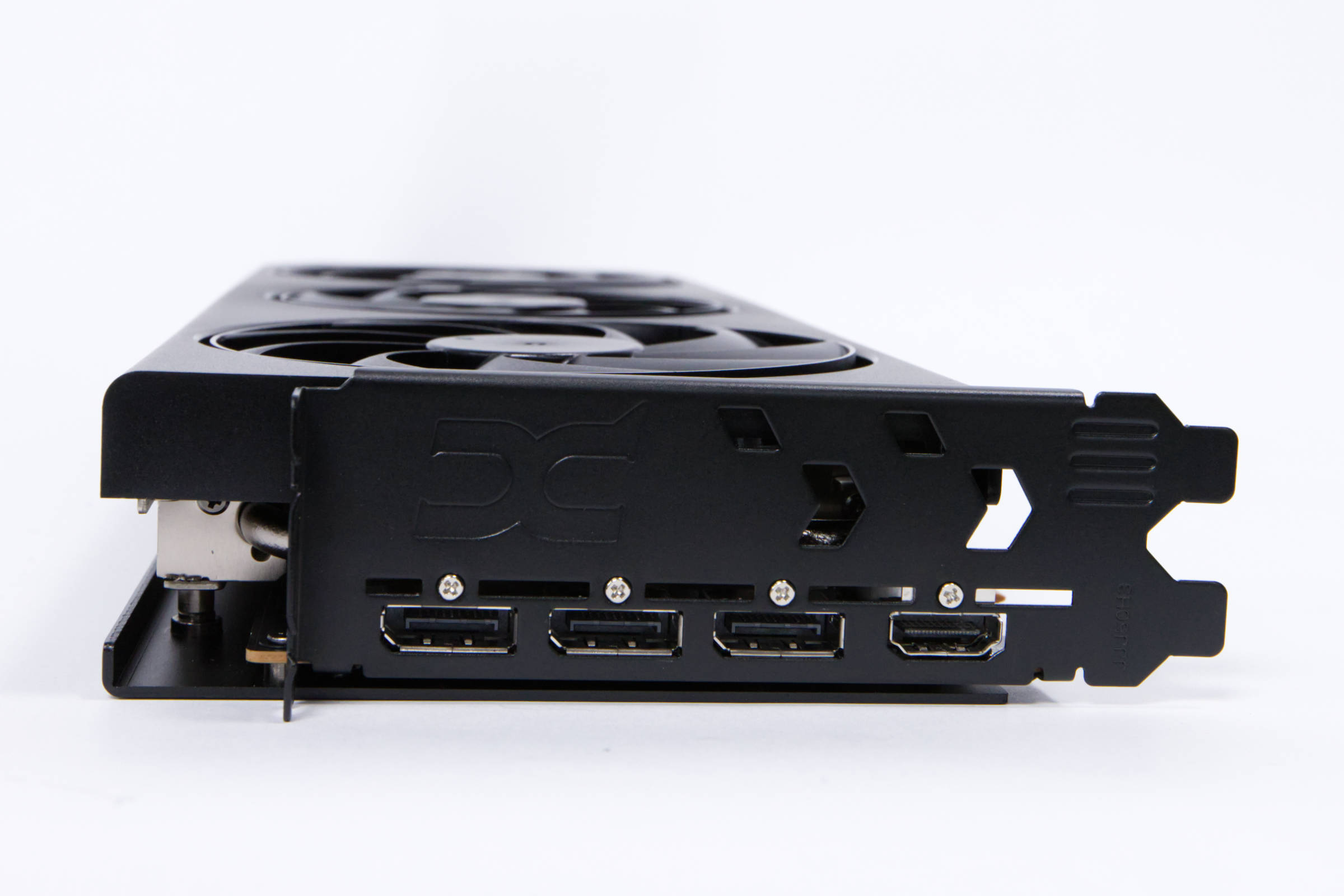 PowerColor Radeon RX 9070 Hellhound Anschlüsse (Image © PCMasters.de)
Four connectors for monitors
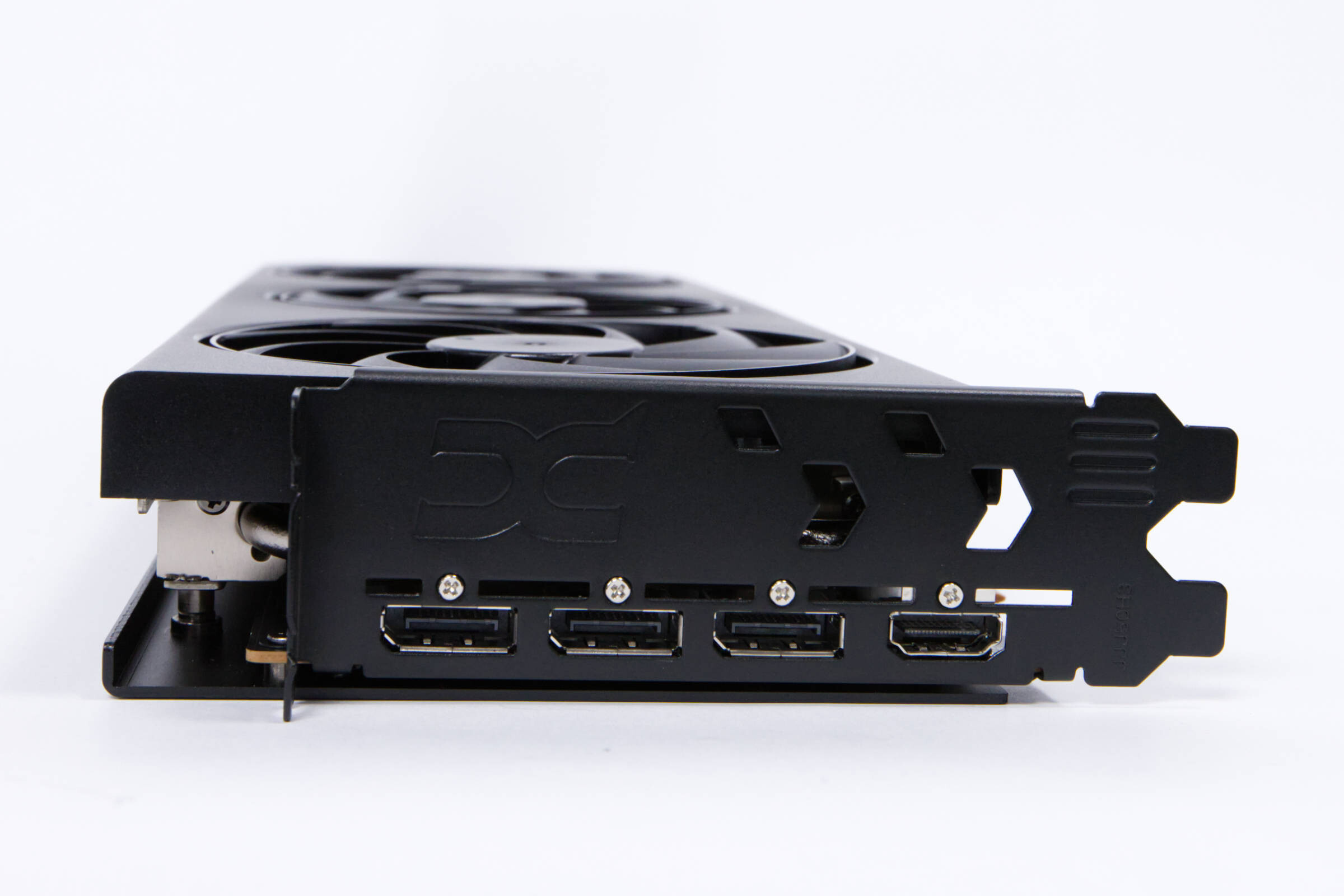
The Radeon RX 9070 GRE Hellhound is equipped with the usual four video outputs, which have been specially developed for high-resolution display environments. The card offers a total of four outputs, consisting of one HDMI 2.1b port and three DisplayPort 2.1a ports.
A key feature of this configuration is that all four ports support resolutions of up to 8K (7680 × 4320). The DisplayPort 2.1a implementation utilizes UHBR13.5 signal transmission. This technical standard was developed to provide a higher connection bandwidth and more precise timing margins, which is essential for driving displays with extremely high pixel density or those that require extended color formats.
Complementing the DisplayPort outputs, the HDMI 2.1b port offers native 8K support. This ensures seamless integration and direct connectivity with a wide range of modern hardware, including professional audiovisual panels and current generation TVs.
 PowerColor Radeon RX 9070 Hellhound Design 2 (Image © PCMasters.de)
Radeon RX 9070 Hellhound design and build
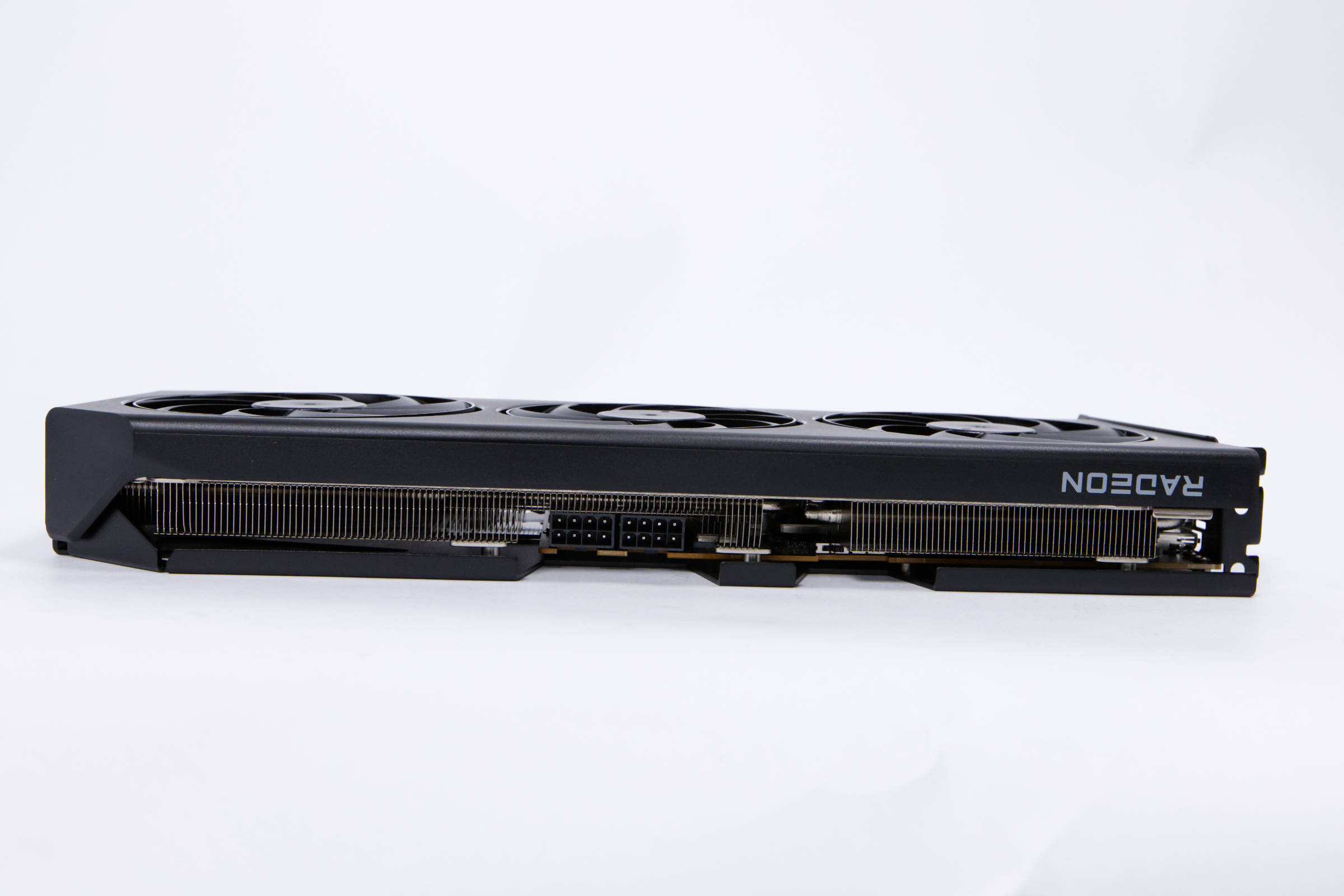
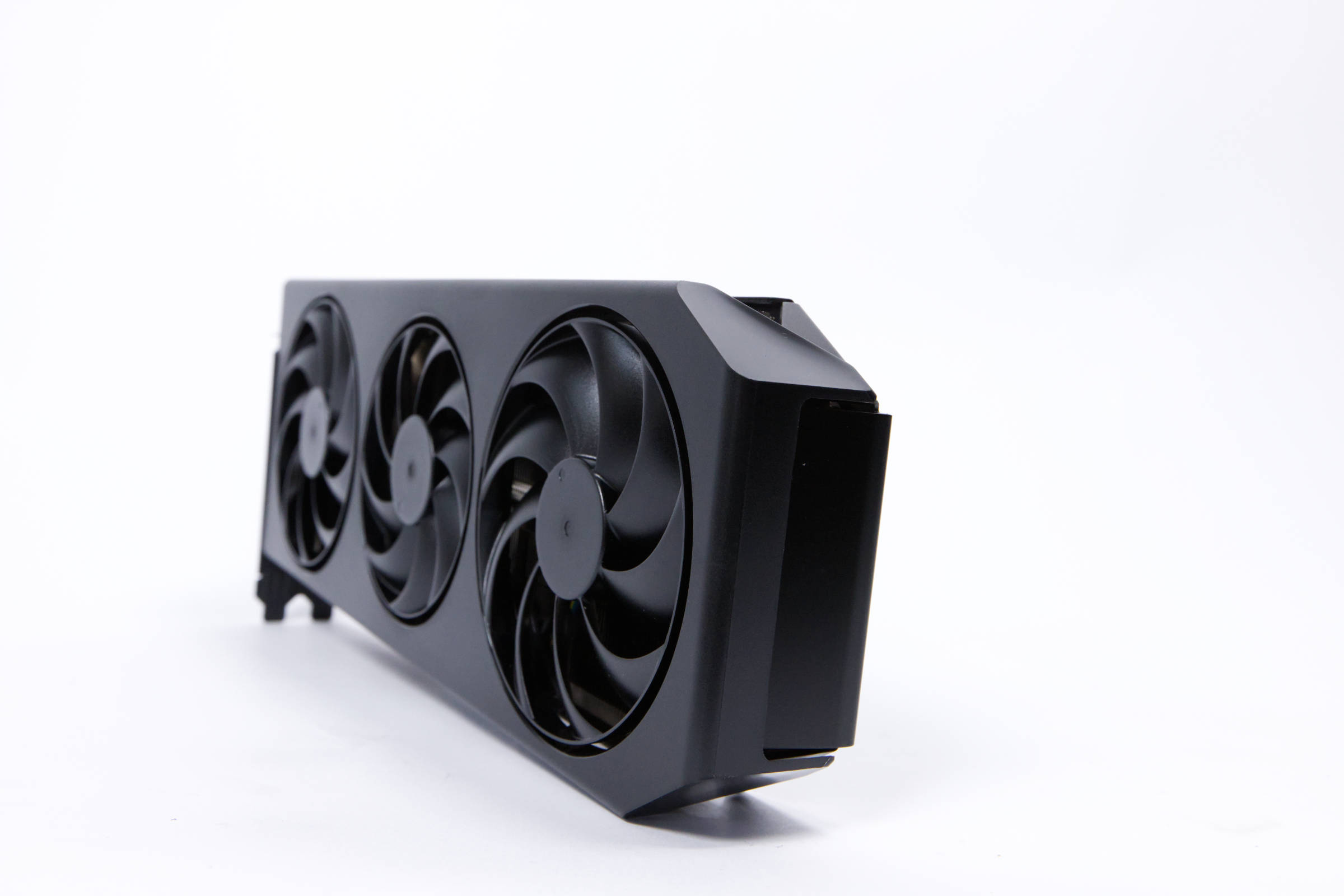
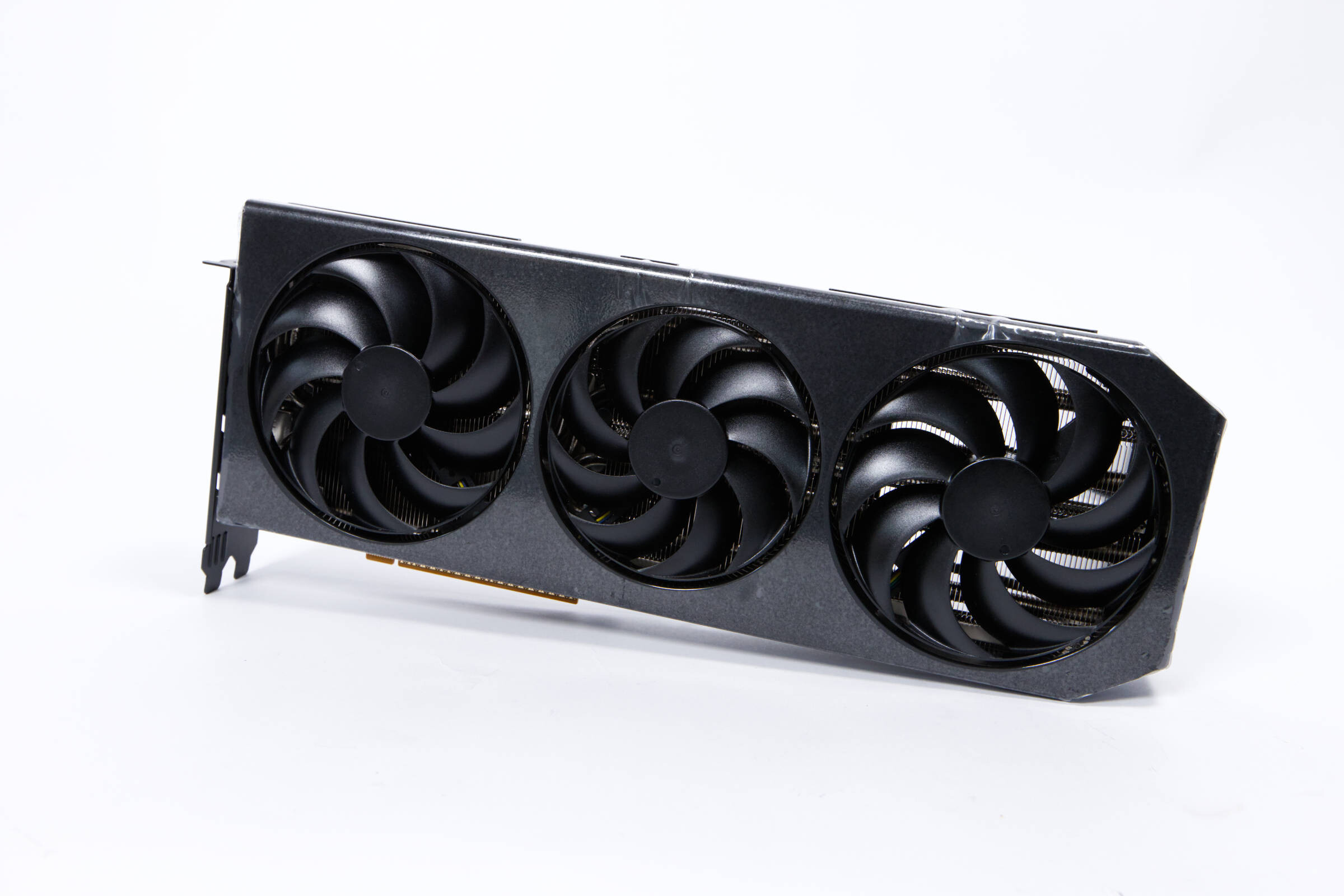
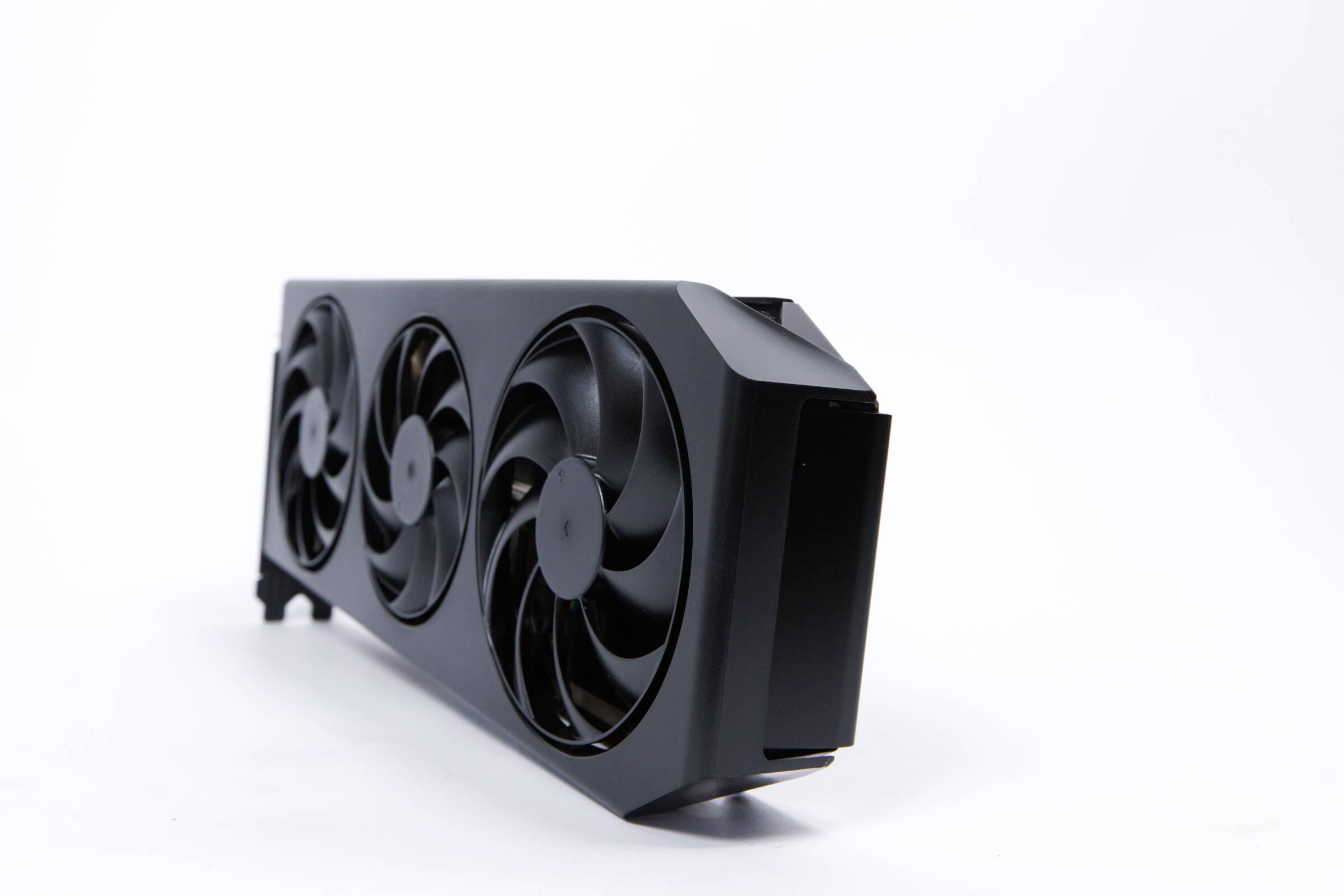
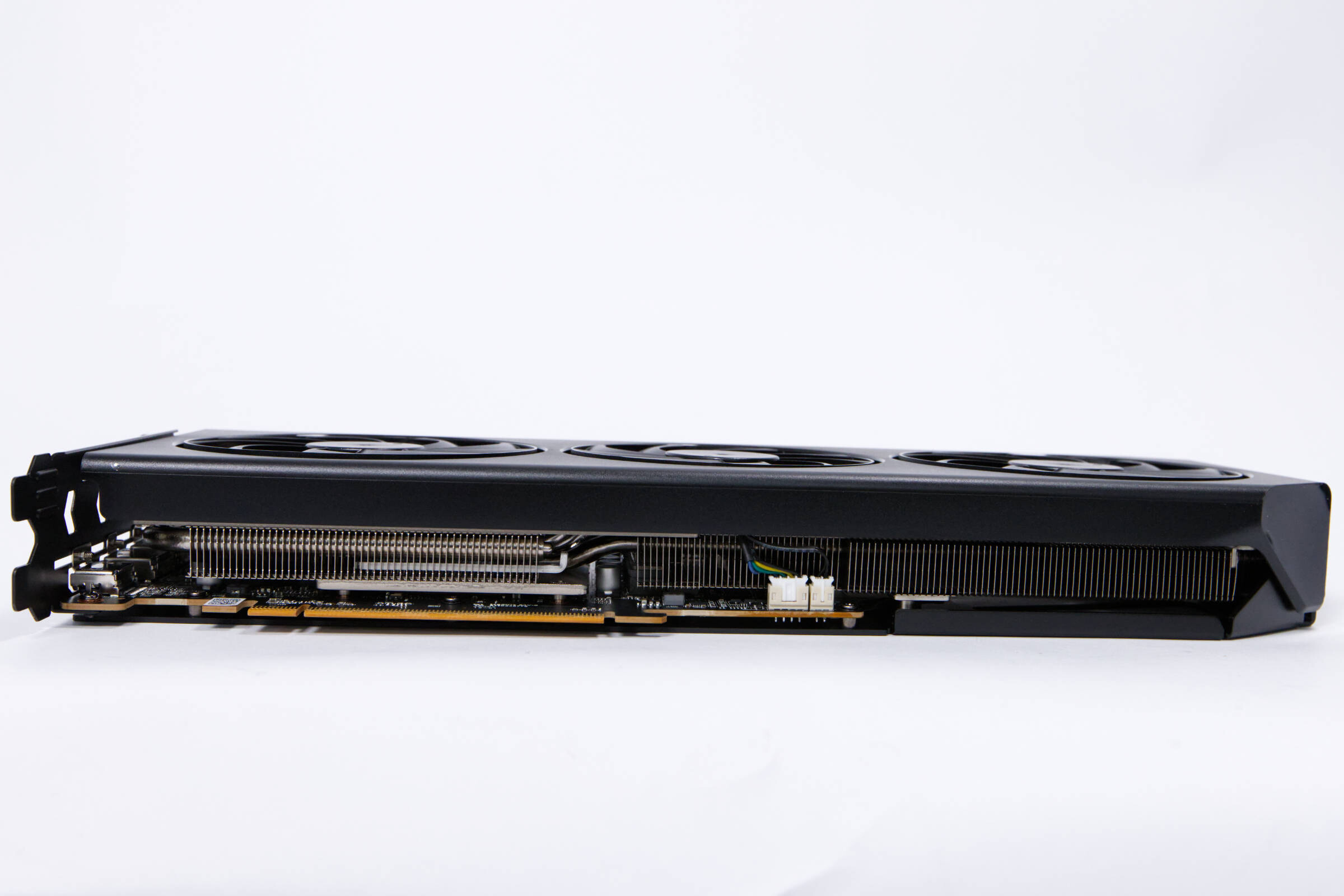
PowerColor has opted for an extremely simple design for the Radeon RX 9070 GRE Hellhound. The front of the graphics card is completely black and matt. The fans on our sample have no stickers - but the retail version will have them. The "Radeon" lettering is printed on the side in gray and nothing else.
 PowerColor Radeon RX 9070 Hellhound Top (Image © PCMasters.de)
The card has a very slim profile and occupies exactly two slots. Nevertheless, the dimensions are anything but compact: 329 mm long, 145 mm high (with slot bracket) and 40 mm wide. The three axial fans at the front have a diameter of 88 mm and are also completely black without lighting. The blue LED lighting is only slightly visible in the rear segment.
 PowerColor Radeon RX 9070 Hellhound Desig (Image © PCMasters.de)
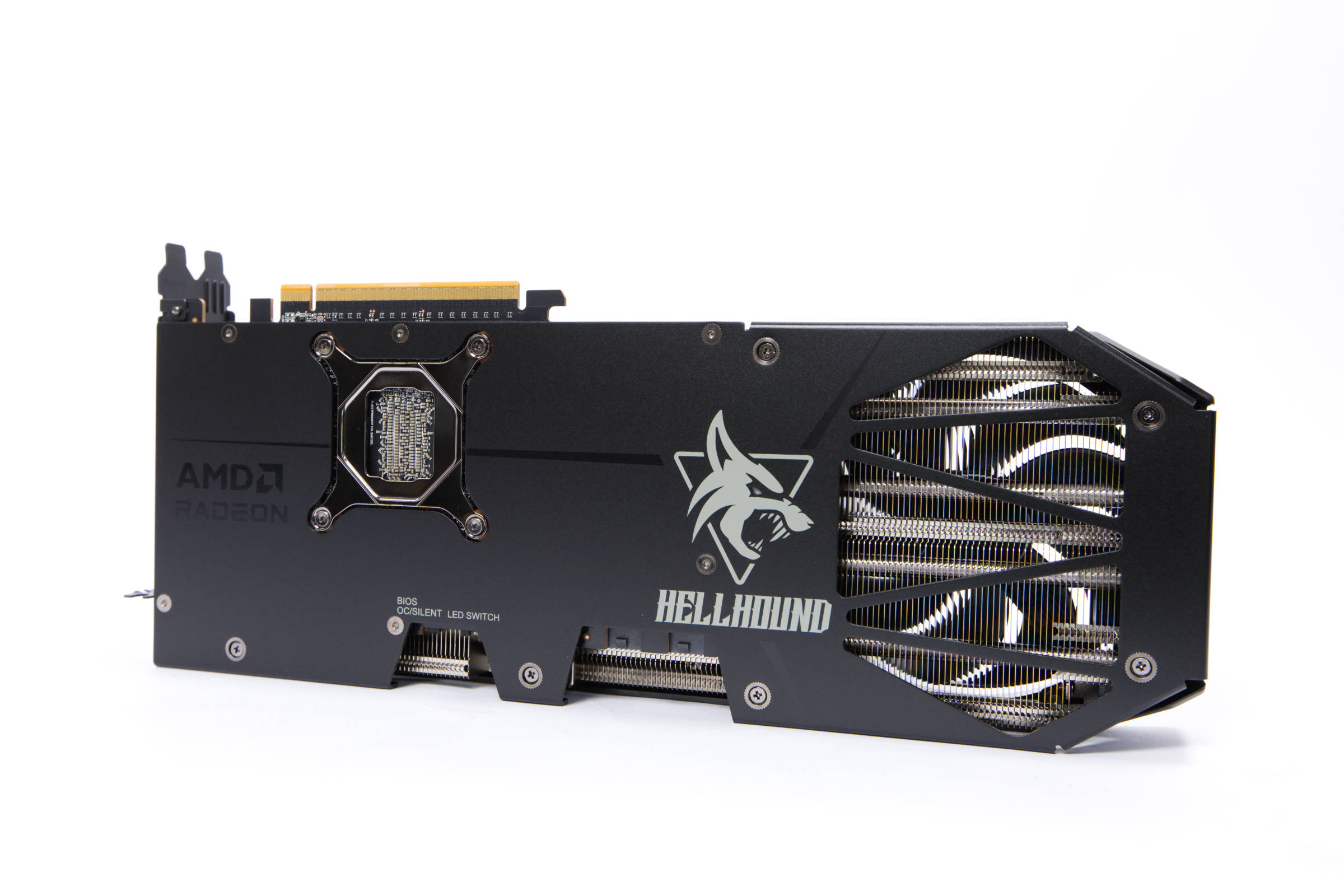
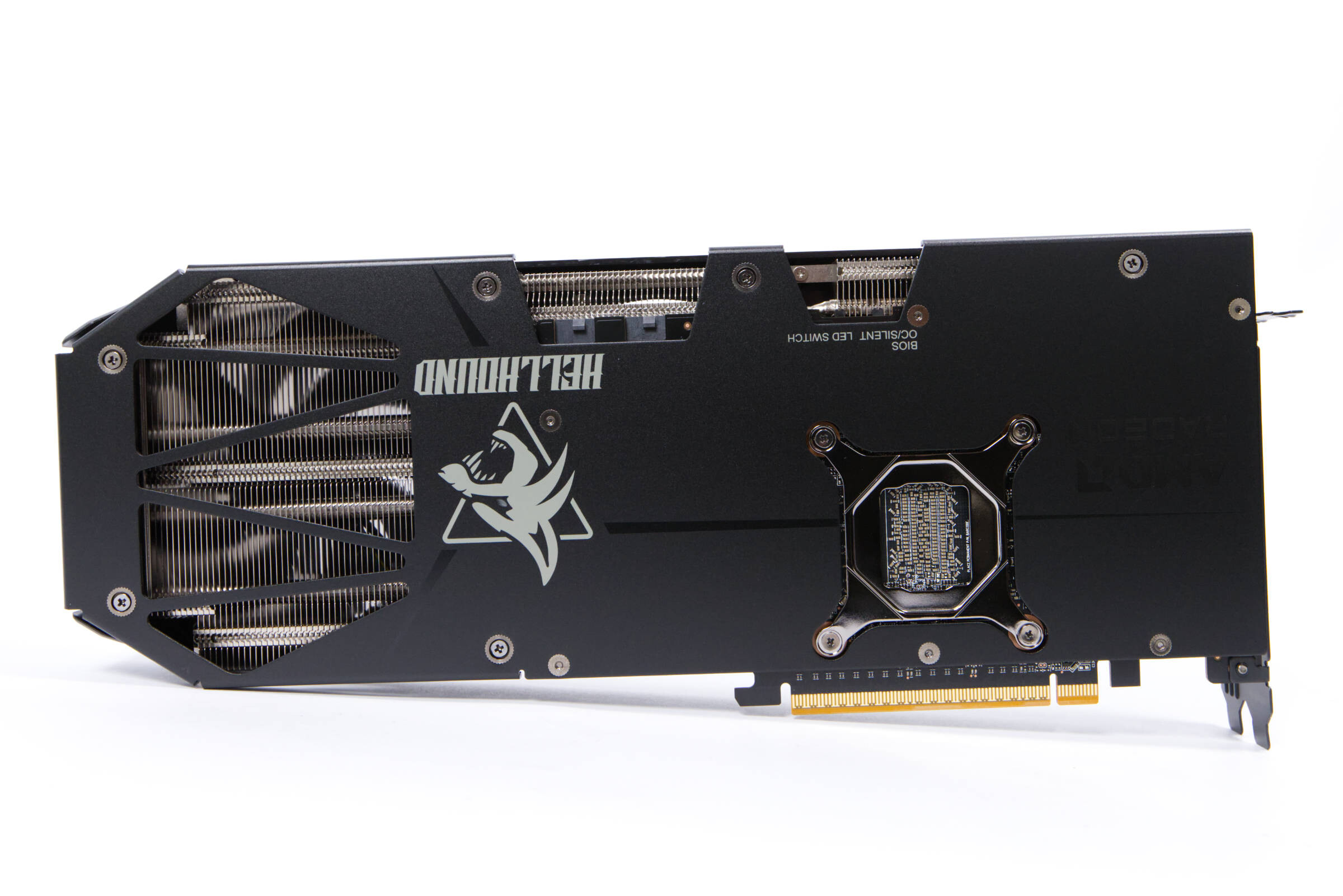
The rear is rather plain by PowerColor standards. We do have a gray HELLHOUND lettering and indications of the switches, but the rest is discreetly black.
 PowerColor Radeon RX 9070 Hellhound Backplate (Image © PCMasters.de)
The backplate is matt, but the "AMD" and "RADEON" lettering is glossy, which makes the lettering stand out in certain lighting conditions. The branding looks good and matches the graphics card well.
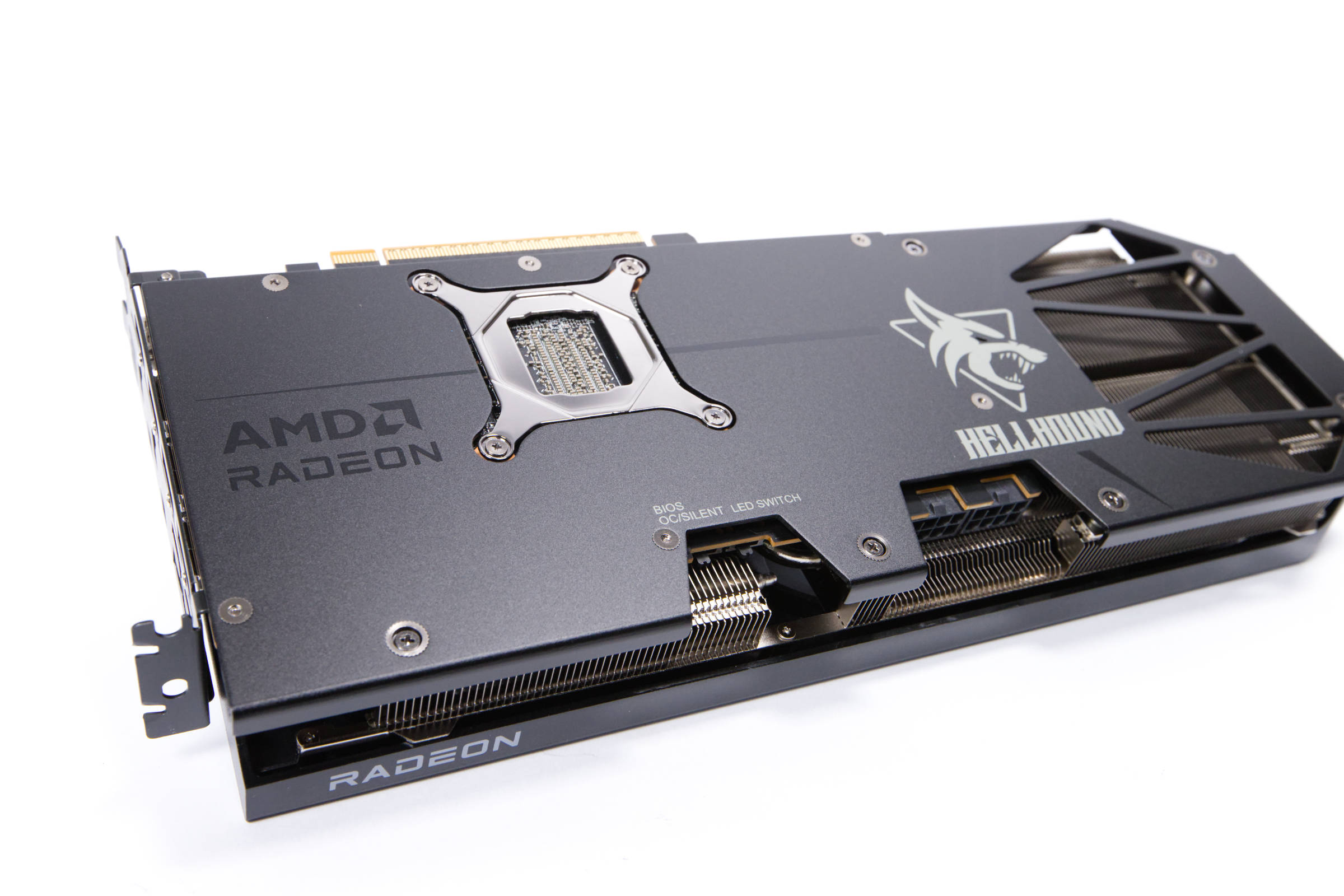 PowerColor Radeon RX 9070 Hellhound AMD Design (Image © PCMasters.de)
The slot bracket is also painted black. It would have been nice if the backplate of the GPU had also been black. The build quality is excellent and there is nothing to complain about here.
PowerColor Radeon RX 9070 GRE Hellhound photos
Test setup
We use a new test system with an open test setup for the tests. The games we use for the test runs have also been adapted. The system now uses the Ryzen 7 7800X3D as the CPU on an ASUS ROG CROSSHAIR X870E HERO board.
The beta driver comes from AMD and has the number 26.5.2 BETA.
The test system
- CPU**: AMD Ryzen 7 7800X3D
- Mainboard: ASUS ROG CROSSHAIR X870E HERO
- m.2 SSD: Corsair MP600 Elite, WD_Blue SN580 1 TB
- RAM**: G.SKILL Trident Z5 48 GB DDR5-6800 (34-46-46-108-1.35v)
- CPU cooler**: DeepCool LS720
- Power supply: NZXT C1500 Platinum
- Fan: 0
- Case**: CoolerMaster Benchtable (open)
Radeon RX 9070 GRE raytracing synthetic benchmarks
We only use 3DMark Port Royal for the synthetic benchmarks with ray tracing support. The remaining tests are based on games that implement the technology in one way or another.
3DMark PORT ROYAL 1.2
Radeon RX 9070 GRE Synthetic Benchmarks
The synthetic benchmarks are quite nice for an initial comparison of performance, but do not reflect the gaming performance of the cards, as they include other factors that are not directly visible.
3DMark Benchmark
Geekbench 6 OpenCL Benchmark
Unigine Superposition Benchmark
8k Benchmarks
We use the Unigine Superposition run with 8k option as the first 8k test in the benchmark course. This can also be run on non-8k monitors.
Radeon RX 9070 GRE ray tracing games benchmarks
With new game titles and the conversion of the test station, more ray tracing titles have been added. The segment now provides a decent data basis. The results are not commented on individually. Our comments are summarized in the rankings below.
Cyberpunk 2077 with ray tracing with/without DLSS/FSR
Fortnite with ray tracing
Black Myth Wukong Benchmark with Ray Tracing
Metro Exodus Ehanced Edition Benchmarks
Radeon RX 9070 GRE Gaming Benchmarks
The benchmark results shown here are without ray tracing and DLSS. We have moved away from 1080p to 4k tests in games.
Final Fantasy XV Benchmarks
## Cyberpunk 2077
## Black Myth Wukong Benchmark
## Monster Hunter Wilds Benchmarks
Shadow of The Tomb Raider
 PowerColor Radeon RX 9070 Hellhound Lüfter (Image © PCMasters.de)
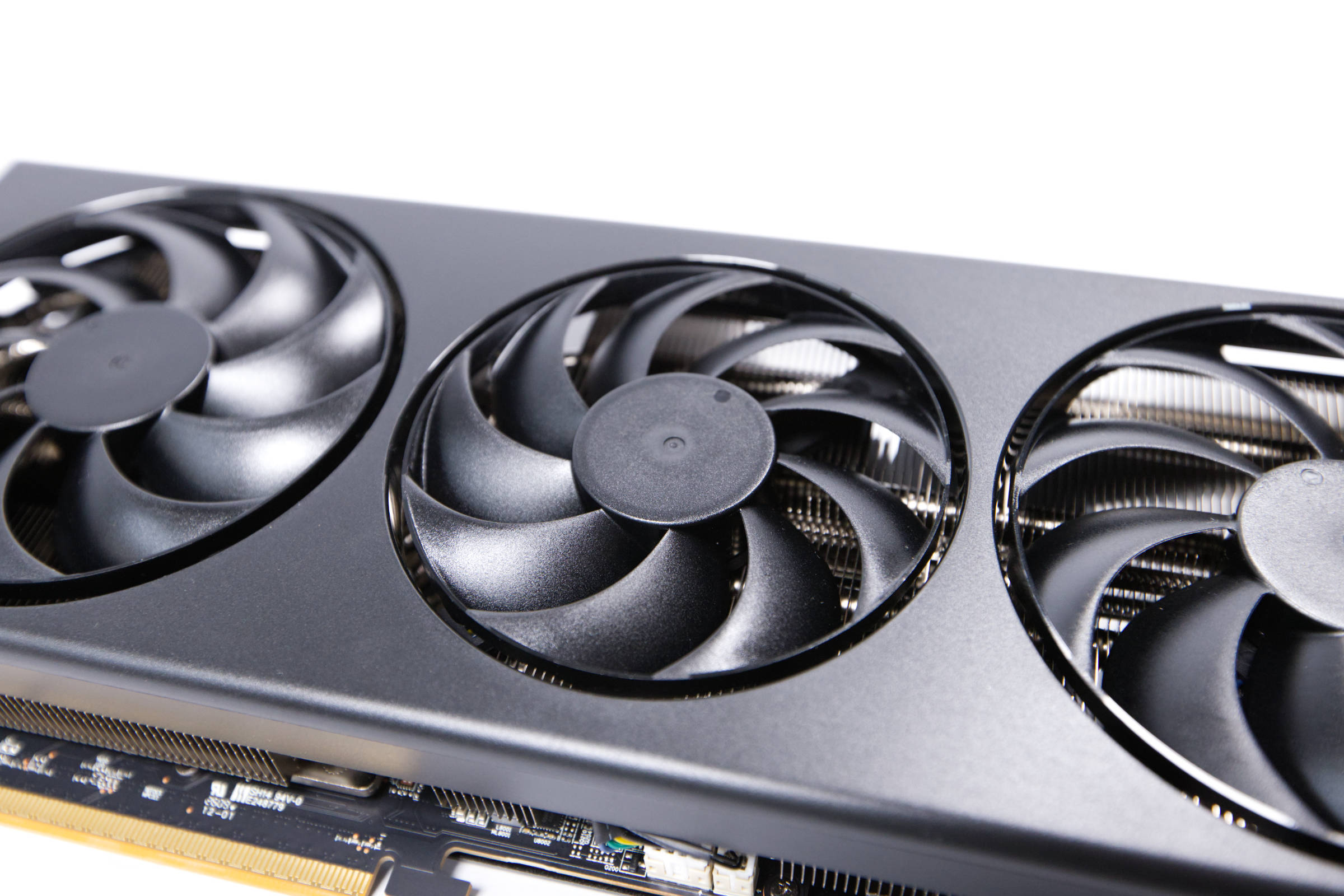
Massive cooler body with three quiet fans
You might think that PowerColor has gone a little overboard here, because the heat sink is huge for the caliber of the Radeon RX 9070 GRE. However, this has a decisive effect: the graphics card is incredibly quiet under full load. The three fans rotate at a maximum of 900 rpm and are whisper-quiet, and that's not even the silent mode.
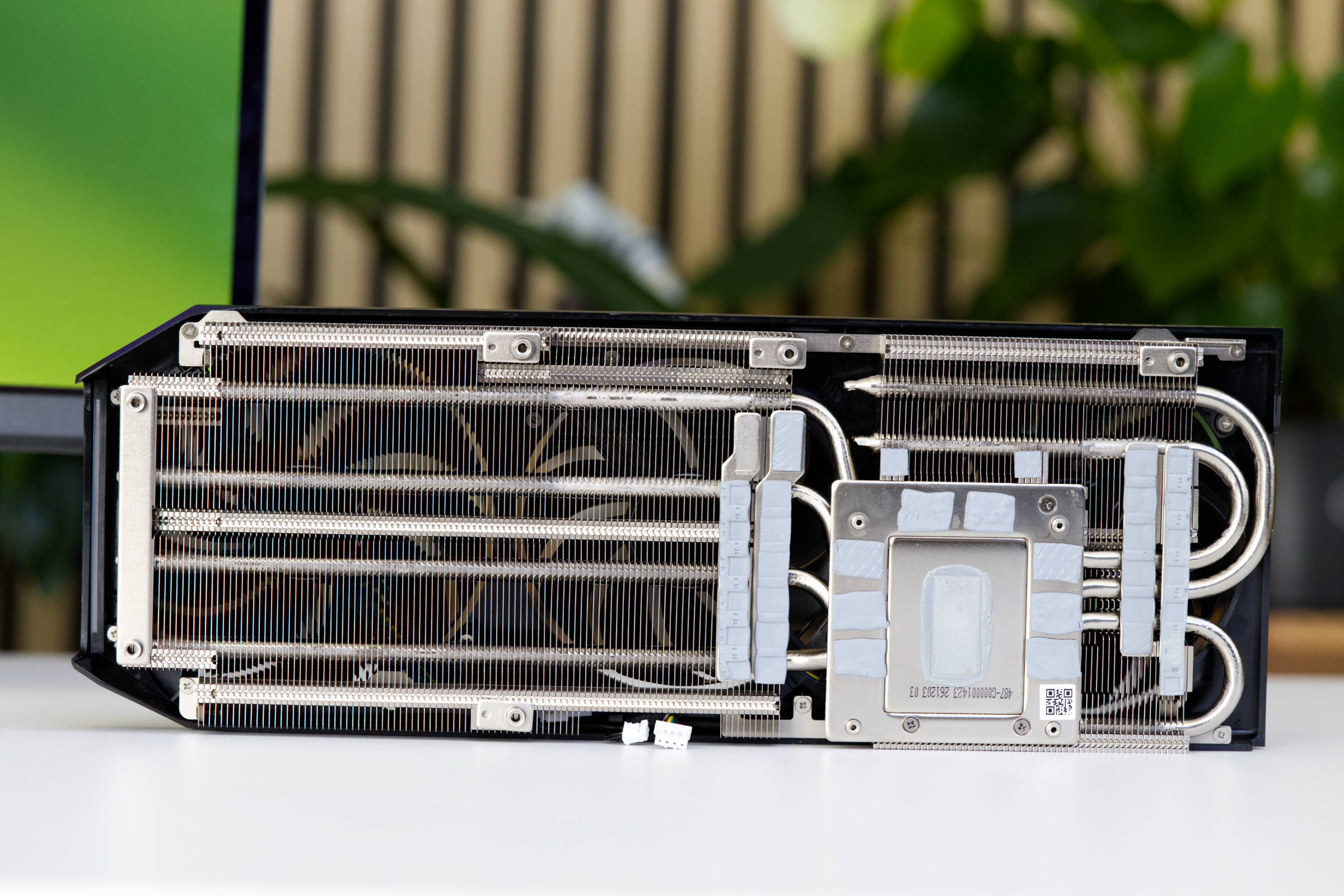
Once the cooler has been removed, you can see the actual construction. The base plate is nickel-plated and should be made of copper. It doesn't look like a vapor chamber, but that's not a bad thing. The memory chips are covered by thermal pads and there are even thermal pads in place of the missing memory chips. There are also corresponding thermal pads for the voltage converters and individual chips, as the components apparently need to be cooled.
 PowerColor Radeon RX 9070 Hellhound Kühler mit WLP (Image © PCMasters.de)
The heat sink is connected from one side with four copper heatpipes and from the other side with three curved heatpipes. The heatpipes are nickel-plated and the cooler has a very high-quality finish. The cooler is even screwed to the backplate in several places, which makes the card significantly stiffer and stabilizes it.
 PowerColor Radeon RX 9070 Hellhound Kühler (Image © PCMasters.de)
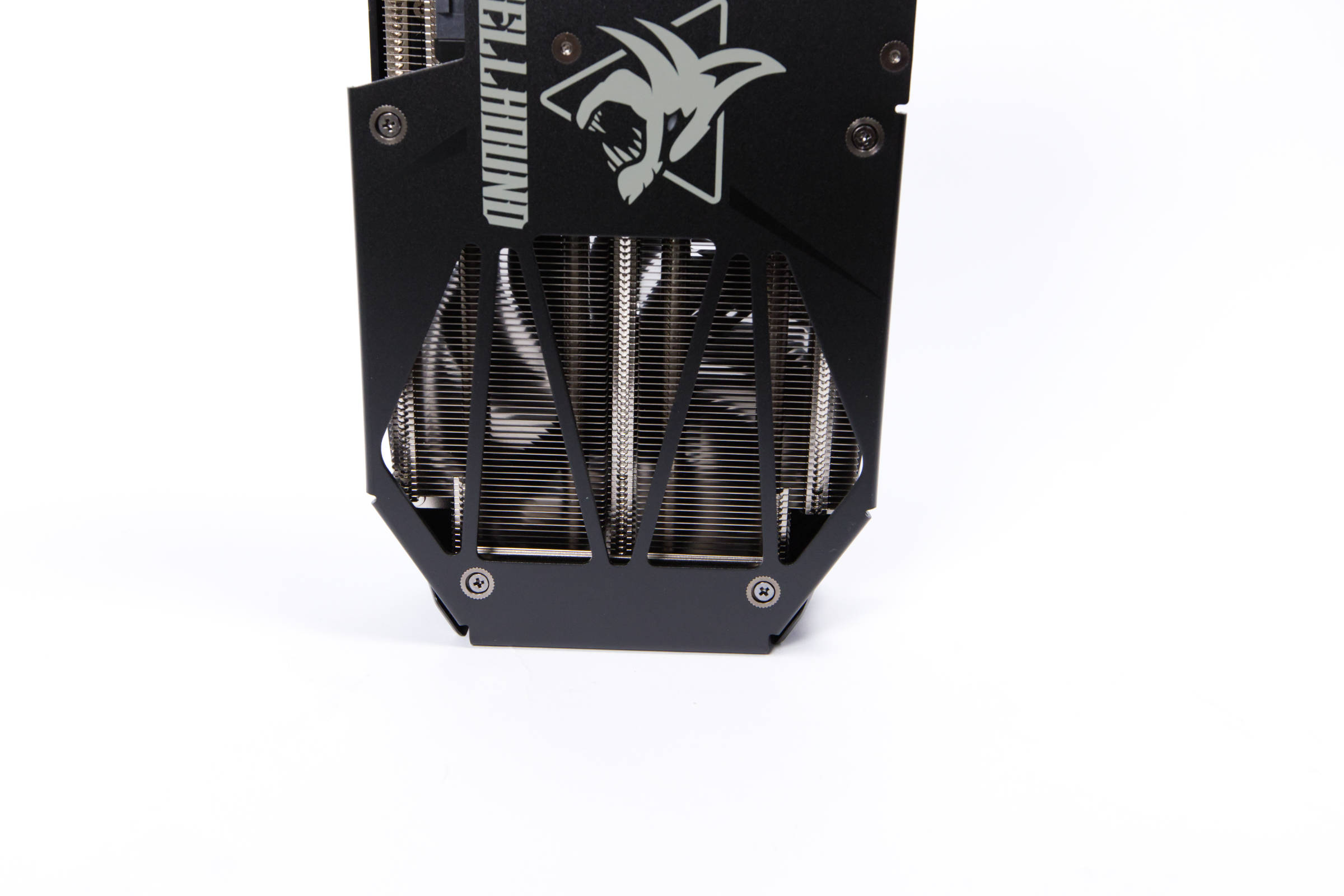
The outer part of the cooler is not covered by the PCB and the last fan can push the waste heat directly through the fins. This is a proven concept.
Temperatures
The cooler does its job well and the chip is not brought to the lowest temperatures, but to a safe level. At idle, the temperatures are slightly higher because the fans are not spinning and the card is therefore not audible.
The measured values are delta values from which the room temperature has been excluded.
Volume of the PowerColor Radeon RX 9070 GRE Hellhound
We rely on the proven volume measurement and also measure the noise level of the Radeon RX 9070 Hellhound. The open design is suitable for such an evaluation and we measure at a distance of 20 cm. The PCE-332A measuring device is set to a measuring range of 30-80 dB(A).
The graphics card is one of the quietest in the comparison. At 30.5 dB(A), the card is only around 1 dB(A) louder than the best placed. After 10 minutes of Furmark, the fans rotated at only 818 rpm.
Power consumption
The Radeon RX 9070 GRE Hellhound from PowerColor also performs very well in terms of power consumption, as it proves to be an economical card. Although the Radeon RX 9070 is slightly more economical, it has the same TBP/TDP.
The consumption measured at the socket is also similar and almost matches that of the Radeon RX 9070. 318.9 watts are economical when compared to the previous generation. The RTX 5060 TI is still more economical, but also costs more.
Graphics card ranking 2026
After we have retested all graphics cards and included them in the comparison, we look at the performance of the model from this test in relation to the rest and the previous generations.
PowerColor Radeon RX 9070 GRE gaming benchmarks at 1920x1080 (1080p)
In 1080p benchmarks, the PowerColor Radeon RX 9070 GRE is ahead of the Radeon RX 7900 XT and Radeon RX 7900 GRE of the previous generation. The RX 9070 is clearly ahead of it and the GeForce RTX 5060 Ti leaves it far behind.
PowerColor Radeon RX 9070 GRE gaming benchmarks at 4k or 3840x2160 without ray tracing
If we increase the resolution to 4K/UHD, the result of the PowerColor Radeon RX 9070 GRE Hellhound looks very similar, even if the Radeon RX 7900 XT clearly outperforms it in this comparison. However, the GeForce RTX 5060 Ti is still far behind it. However, it is a long way behind the RTX 5070.
PowerColor Radeon RX 9070 GRE gaming benchmarks at 4k or 3840x2160 with ray tracing
With ray tracing enabled, the PowerColor Radeon RX 9070 GRE Hellhound performs better again and is just behind the Radeon RX 7900 XT. It is still behind the GeForce RTX 5070, but can leave the GeForce RTX 5060 Ti behind by a similar margin.
PowerColor Radeon RX 9070 GRE gaming benchmarks at 8k
In the 8K benchmark, the picture looks similar and the PowerColor Radeon RX 9070 GRE Hellhound is also closer to the GeForce RTX 5070.
PowerColor Radeon RX 9070 GRE Synthetic benchmarks
A more balanced performance comparison is often visible in synthetic benchmarks. However, things look worse for the PowerColor Radeon RX 9070 GRE Hellhound here, as it lags far behind. The Radeon RX 7900 XT is far ahead of it here and the RTX 5060 Ti is also ahead of it for the first time.
 PowerColor Radeon RX 9070 Hellhound Fazit (Image © PCMasters.de)
PowerColor Radeon RX 9070 GRE Hellhound Conclusion
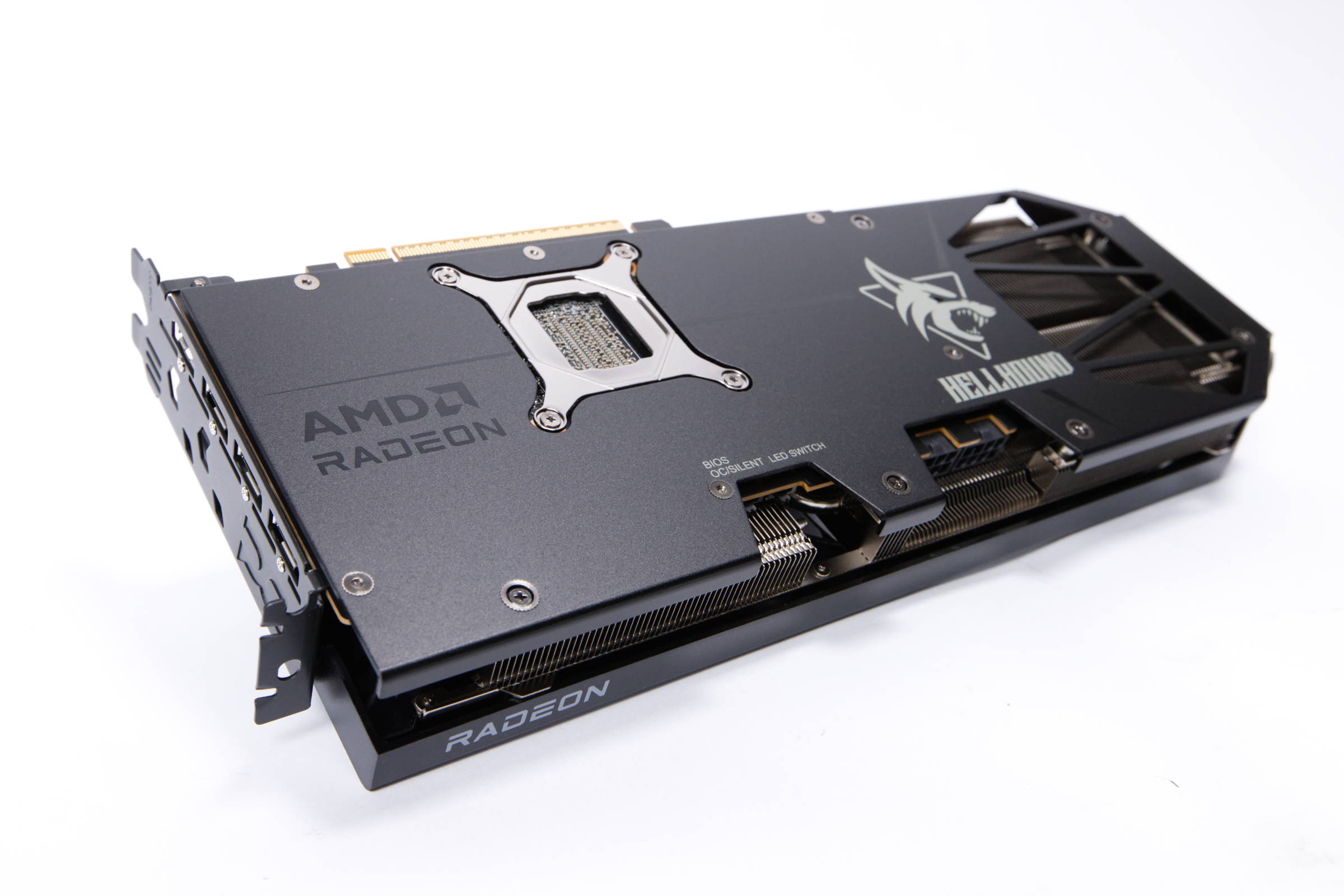
With the Radeon RX 9070 GRE, AMD shows that the manufacturer has not yet given up on the gaming market. The graphics card is a binned Radeon RX 9070 with 12 GB of GDDR6 memory instead of 16 GB. With the same total board power, you get decent performance. In games, it beats both the GeForce RTX 5060 Ti (16 GB) and the previous generation AMD Radeon RX 7900 XT. The PowerColor Radeon RX 9070 GRE Hellound is equipped with a large cooler as an AIB card, which enables remarkably quiet operation under load. The card also has a slightly higher boost clock, is very simple in terms of design and offers simple LED lighting. PowerColor has squeezed the card into a dual-slot design, but the cooler is quite long at 329 mm.
AMD has introduced the Radeon RX 9070 GRE for 559 € for EU and $549 for North America, but at the time of testing we do not know PowerColor's price. The PowerColor Reaper Radeon RX 9070 with a similar cooler costs 550 to 590 € in Germany (Affiliate). The price drop seen over last months of the card is positive, which is why we hope that the Radeon RX 9070 GRE Hellhound will also drop to 500 € and below $500. The GeForce RTX 5060 Ti with 16 GB GDDR7 VRAM currently costs just as much, but is less powerful in games. On the other hand, the GeForce RTX 5070 with its 12 GB GDDR7 VRAM is also available in the price range from €560 to €600, using the example of the MSI GeForce RTX 5070 12G Ventus 2X OC for €569 (Affiliate) in the German market as reference and it is more powerful than the Radeon RX 9070 GRE. At this point, we can praise AMD's ambitions and hope that prices will continue to fall.
Pro
- Good performance in games and benchmarks
- Very efficient
- Works very quietly
- Compact and simple design
- Dual BIOS and switch for LED lighting
- Minimalist LED lighting
- Two 8-pin PCIe power connectors for power supply
Contra
- Scope of delivery