
 Computer Forum
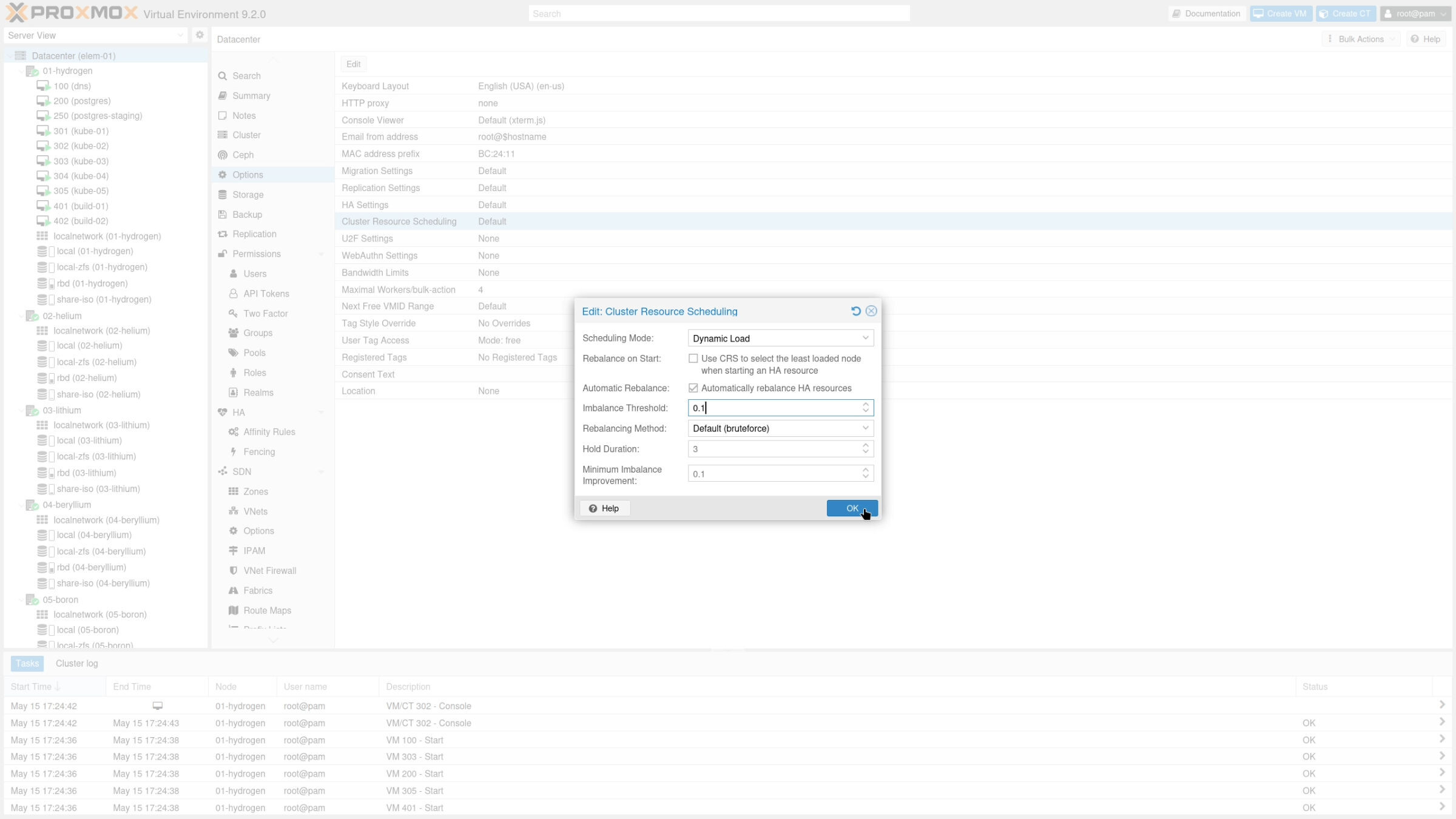 Proxmox VE 9 2 Dynamic Load Balancer (Image © Proxmox)
Intelligent resource distribution
A major new feature in version 9.2 is the Dynamic Load Balancer. This system uses a revised Cluster Resource Scheduler (CRS) that works in dynamic mode. In contrast to static placement, the CRS now analyzes resource utilization in real time across nodes and guests to determine the most efficient placement for instances.
In environments using the High Availability (HA) stack, the load balancer can automatically migrate instances to compensate for imbalances between nodes. This process is controlled by configurable sensitivity parameters, ensuring that administrators retain control over migration triggers while maintaining HA rules.
Advanced networking features
The Software-Defined Networking (SDN) stack has been updated to support more complex network architectures. WireGuard and BGP are now directly integrated into the SDN framework. To enable finer control over route redistribution, the update includes support for prefix lists and route maps within BGP/EVPN filtering.
In addition, the release introduces IPv6 underlay support for EVPN and expands configuration options for EVPN controllers. Users managing OSPF fabrics also benefit from new route redistribution features.
Hardware customization and maintenance
To meet specific workload requirements, Proxmox VE 9.2 provides a management interface for custom CPU models. This tool is located on the “Datacenter” tab of the web interface and allows administrators to define and modify CPU profiles. A new CPU flag selector provides a real-time view of supported flags across the cluster, allowing teams to identify and resolve compatibility issues before deploying virtual machines.
A new HA activation/deactivation feature has been implemented for system maintenance. This allows the HA Manager to be temporarily disabled cluster-wide, preventing the system from triggering node fencing during scheduled hardware or software updates. Once the maintenance window is closed and the system is reactivated, the resources automatically return to their original nodes and previous state.
Updated software stack and availability
The underlying architecture of Proxmox VE 9.2 is based on Debian 13.5 Trixie and the Linux kernel 7.0. The version also integrates QEMU 11.0, LXC 7.0 and ZFS 2.4. In addition to Ceph Squid 19.2, Ceph Tentacle 20.2 is now also available as a stable storage option. Proxmox Virtual Environment 9.2 is available as open source software. It can be deployed via a standard ISO image for bare-metal systems or installed on existing Debian installations. Existing users can upgrade via the APT package management system. Professional support contracts for enterprise stability and security updates are available from EUR 120 per CPU per year.