
 Computer Forum
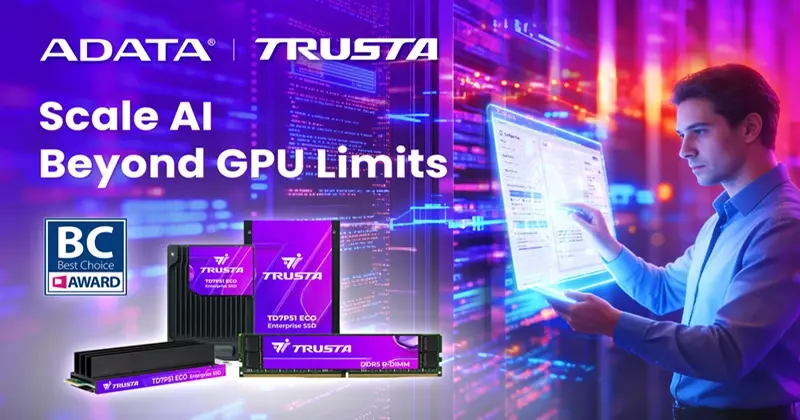 ADATA TRUSTA AI Scaler Extended Memory Solution (Image © ADATA)
Current AI infrastructures often require expensive high-end GPUs as large language models have huge memory requirements. This dependency creates significant adoption hurdles for organizations moving to on-premises and edge AI. The TRUSTA AI Scaler solves this problem by providing a more scalable memory configuration.
By distributing model data across GPU memory, DRAM and SSDs, the toolkit enables more efficient resource utilization. In practice, this allows model inference tasks that would normally require a multi-GPU cluster to be performed on a single GPU. For model fine-tuning, the system dynamically allocates compute resources, which TRUSTA says reduces overall deployment costs by more than 50%.
Open source integration and model support
The AI Scaler Toolkit is provided as a free open source platform. This design ensures that companies and research organizations can configure their AI resources without being tied to specific hardware vendors.
The platform is compatible with several popular model families, including Llama, Mistral, DeepSeek and Gemma. In addition, the toolkit is integrated with Agentic AI workflows and supports applications such as Hermes Agentic and NemoClaw. This flexibility is designed to accelerate the integration of AI agents into enterprise environments.
Synergy between enterprise storage and hardware
In addition to the software toolkit, TRUSTA is introducing the TD7P51 ECO PCIe Gen5 Enterprise SSD. To meet the high data requirements of the AI Scaler, these SSDs offer capacities of up to 15.36 TB and are available in U.2, E1.S and E3.S form factors. A key technical feature of the TD7P51 ECO is the implementation of Flexible Data Placement (FDP), which improves drive reliability and stability through intelligent data management. These drives have been tested on numerous global server platforms to ensure compatibility in data center and cloud environments.