 Computer Forum
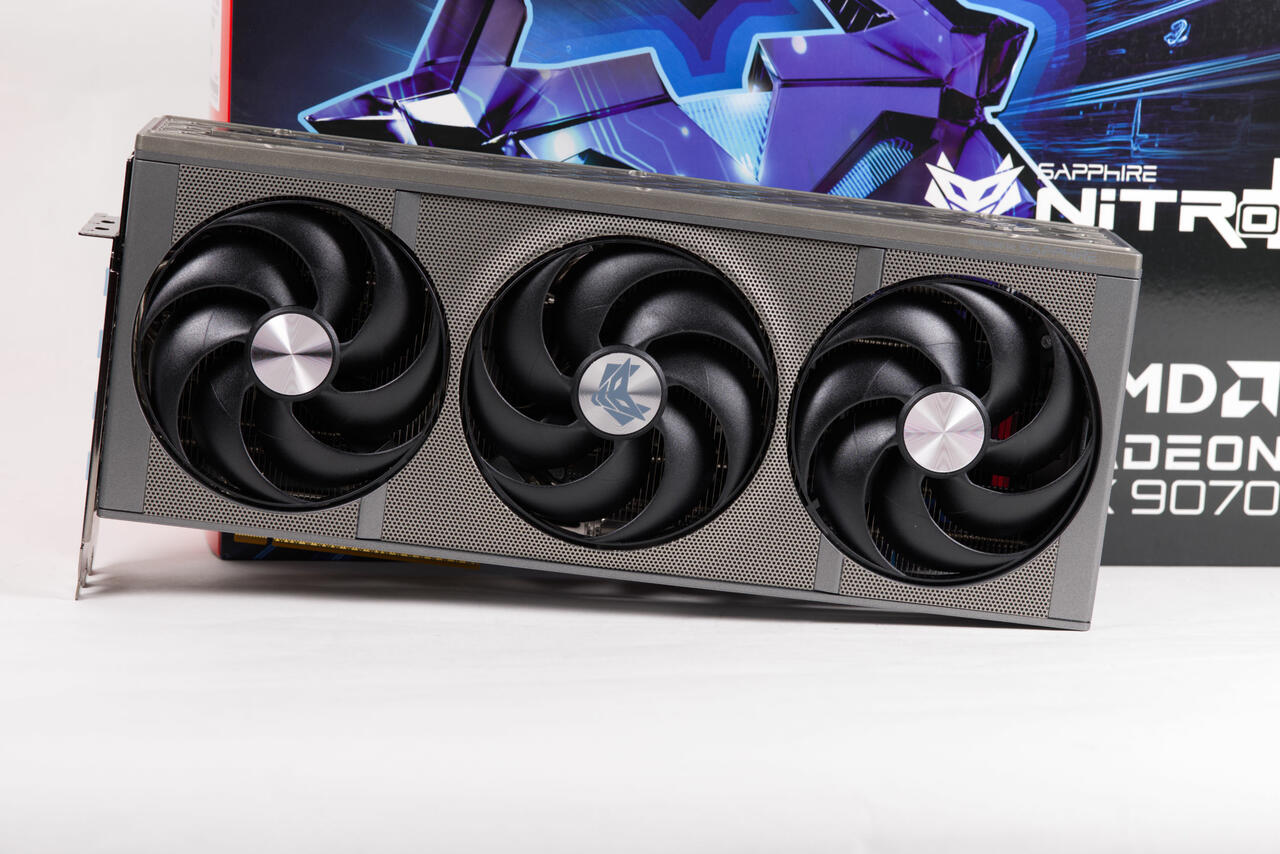 Sapphire Radeon RX 9070 XT Nitro+ Test Review (Image © PCMasters.de)
Radeon RX 9070 XT Nitro+ in Detail
The new Radeon RX 9070 XT graphics cards, part of AMD’s recently unveiled Radeon RX 9000 series, are now available in stores. As part of the series, we’re also testing the **Nitro+ variant of the Radeon RX 9070 XT ** from Sapphire. AMD will not be offering its own MBA models this time, even though photos and renders of such models have been shown.
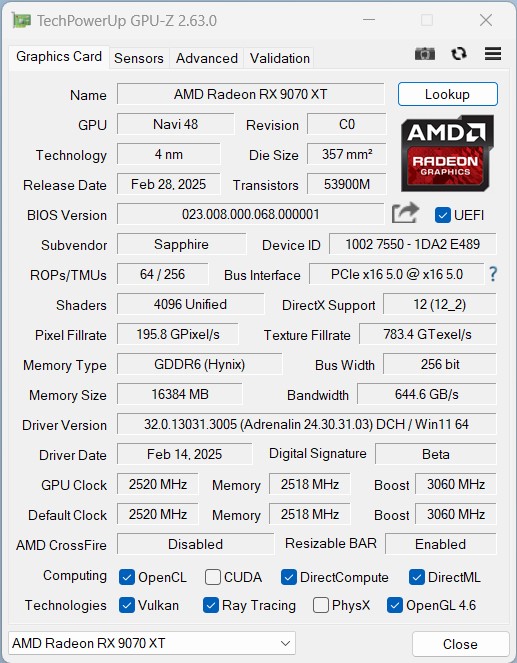 Sapphire Radeon RX 9070 XT GPUz (Image © PCMasters.de)
A closer look at the specifications reveals significant differences from AMD’s previous high-end models. The new Radeon RX 9070 XT, which is more comparable to the more affordable [Radeon RX 7900 GRE (Review)][2] than to the top-tier ** [Radeon RX 7900 XTX (Review)][3]**, features 64 ROPs and 4,096 ALUs (stream processors), which is significantly fewer than in the previous-generation models. The Radeon RX 7900 GRE was equipped with 5,120 ALUs and delivered significantly lower performance in direct benchmark comparisons.
This configuration highlights the differences in AMD’s RDNA4 architecture and demonstrates the improvements the Radeon RX 9000 series is expected to deliver overall. Among other things, this increases efficiency—even with a similar memory configuration. At the same time, however, performance also increases significantly despite a lower number of ALUs. This aligns with the strategy we saw with the Ryzen 9000 processors.
Further details on these RDNA4 improvements will be covered in a [separate article][4].
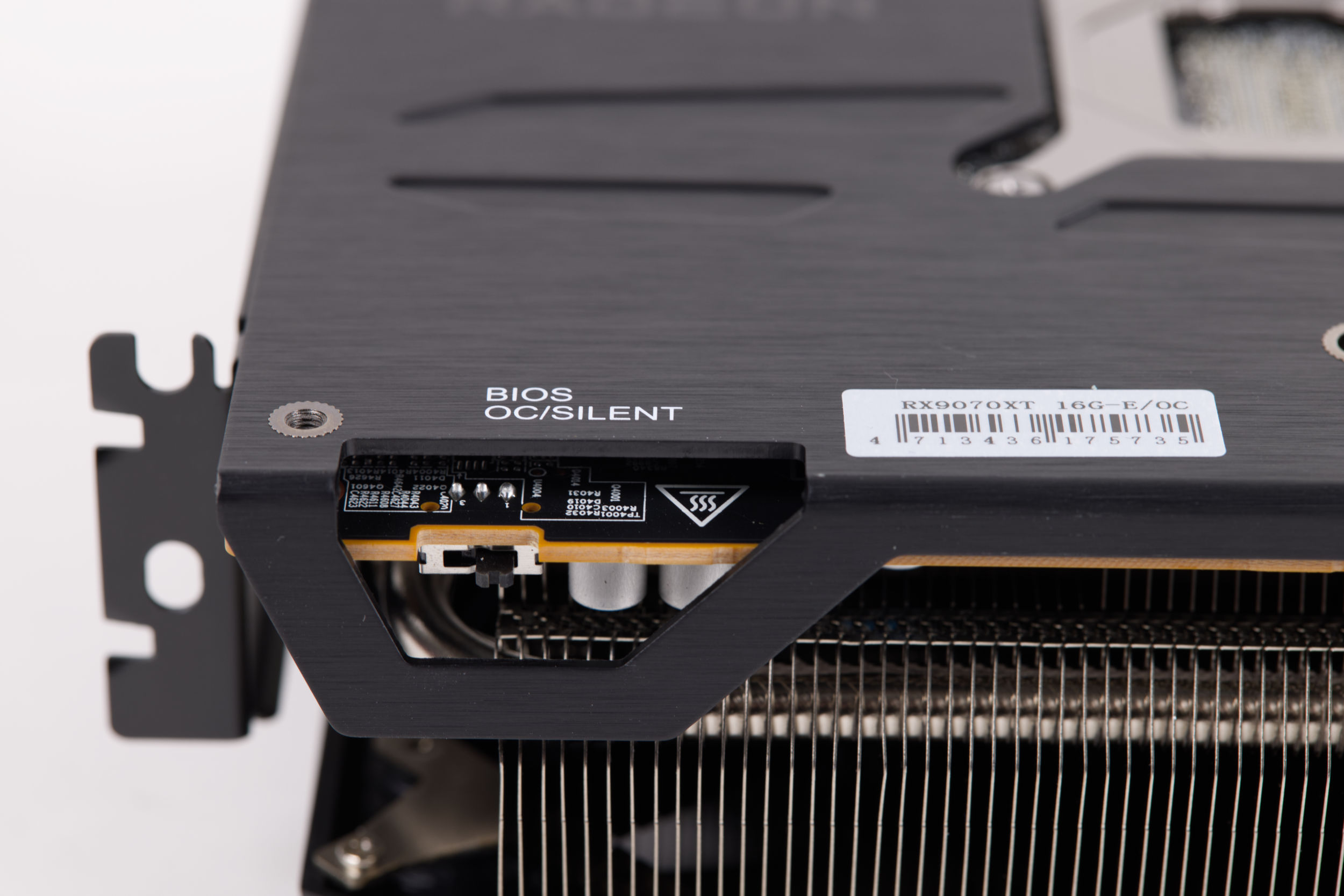 PowerColor Radeon RX 9070 XT Red Devil Dual BIOS Switch (Image © PCMasters.de)
16 GB GDDR6 Graphics Memory
All Radeon RX 9070 XT models feature a memory configuration similar to that of the Radeon RX 7900 GRE, as AMD has opted for 16 GB of GDDR6 graphics memory. While previous top-of-the-line models from the last generation offered 20 GB or even 24 GB of graphics memory, the 16-GB configuration used here is currently considered the sweet spot for gaming scenarios—a threshold you wouldn’t want to fall below. The memory is rated at 20 Gbit/s and uses a 256-bit bus, as is also typical for AMD’s mid-range models. Furthermore, the RX 9070 XT features 64 MB of third-generation AMD Infinity Cache, which further enhances its performance profile.
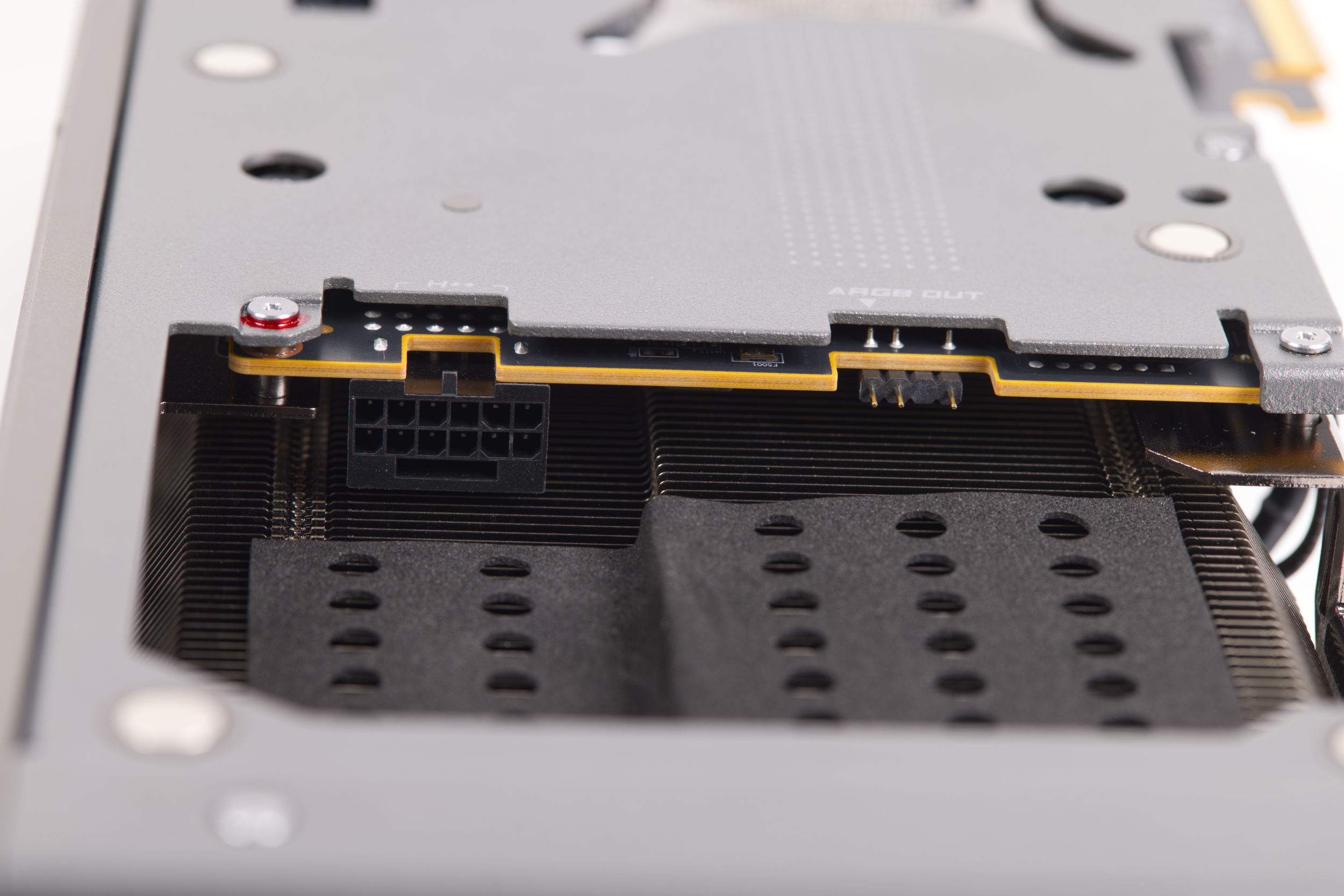 Sapphire Radeon RX 9070 XT Nitro+12V 2x6 Stromanschluss (Image © PCMasters.de)
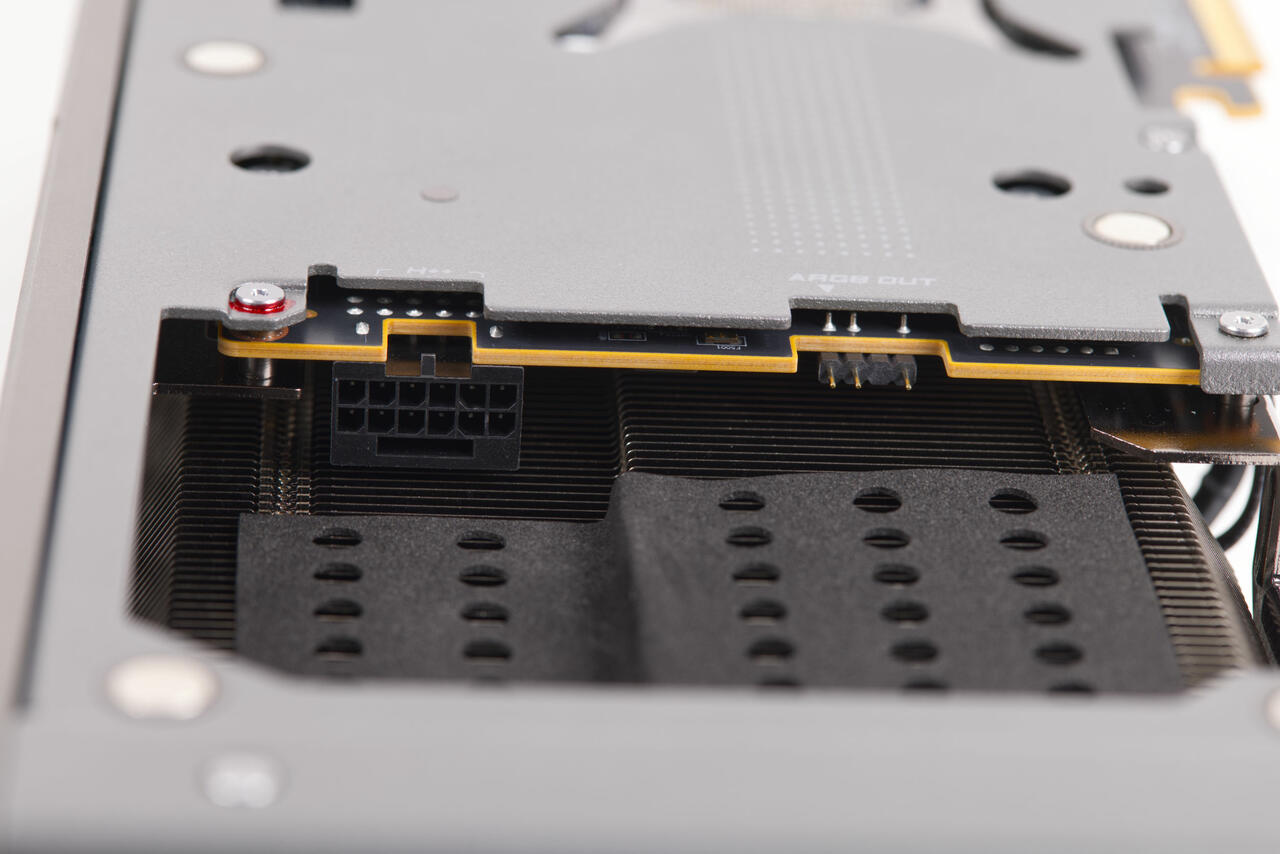
Modern 2x6-pin 12V power connector
When it comes to power supply, Sapphire takes a completely different approach than other AMD board partners and uses the new 2x6 -pin 12V power connector. This is specified in the ATX 3.1 standard and is labeled "H++" on Sapphire’s graphics card. In case the power supply lacks a native 2x6-pin 12V connector, Sapphire includes an adapter with the card that converts to three conventional 8-pin PCIe power connectors.
The 2x6-pin 12V power connector is rated for a constant output of 600 watts at full capacity (on the power supply), even though this card doesn’t require that much. The Total Board Power here is 330 watts, part of which is supplied via the PCIe slot. This makes the connector more than sufficient. The advantage here is clear: The significantly thinner, modern 2x6-pin 12V cable is easier to route and hide, which is made even simpler with the help of the magnetic backplate.
Radeon RX 9070 XT Technical Specifications
To better illustrate the differences between the two generations, we’ve listed the specifications in a table:
| Sapphire Radeon RX 9070 XT Nitro+ | Radeon RX 9070 XT | Radeon RX 9070 | Radeon RX 7900 XTX | Radeon RX 7900 GRE | |
|---|---|---|---|---|---|
| Architecture | RDNA4 | RDNA4 | RDNA4 | RDNA3 | RDNA3 |
| Process | 4nm | 4nm | 4nm | 5nm | 5nm |
| Transistors | 53.9 billion | 53.9 billion | 53.9 billion | 57.7 billion | 57.7 billion |
| Size | 357 mm² | 357 mm² | 357 mm² | 529 mm² | 529 mm² |
| Compute Units (CU) | 64 | 64 | 56 | 96 | 80 |
| ALUs | 4,096 | 4,096 | 3,584 | 6,144 | 5,120 |
| Ray Tracing Accelerators | 64 | 64 | 56 | 96 | 80 |
| AI Accelerators | 128 | 128 | 112 | 192 | 160 |
| ROPs | 64 | 64 | 64 | 192 | 192 |
| Boost Clock | Up to 3,060 MHz (game clock 2,520 MHz) | 2,400 MHz | 2,070 MHz | 2,500 MHz | 2,245 MHz |
| Infinity Cache | 64 MB | 64 MB | 63 MB | 96 MB | 96 MB |
| Graphics Memory | 16 Gb GDDR6 | 16 Gb GDDR6 | 16 Gb GDDR6 | 16 Gb GDDR6 | 16 Gb GDDR6 |
| Memory Bandwidth | 256-bit | 256-bit | 256-bit | 384-bit | 256-bit |
| Memory | 20 Gbit/s | 20 Gbit/s | 20 Gbit/s | 20 Gbit/s | 18 Gbit/s |
| Total Board Power | 304 W | 304 W | 220 W | 355 W | 260 W |
Four Monitors with DisplayPort 2.1 and HDMI 2.1
The Sapphire Radeon RX 9070 XT Nitro+ offers the usual four display ports, but in a different configuration for multi-monitor setups. The card is equipped with two DisplayPort 2.1a outputs and two HDMI outputs, though it is unclear whether the HDMI ports support the 2.1 standard. The maximum resolution for HDMI is 7680 × 4320px, and for the DisplayPort 2.1a ports, it is also 7680 × 4320px.
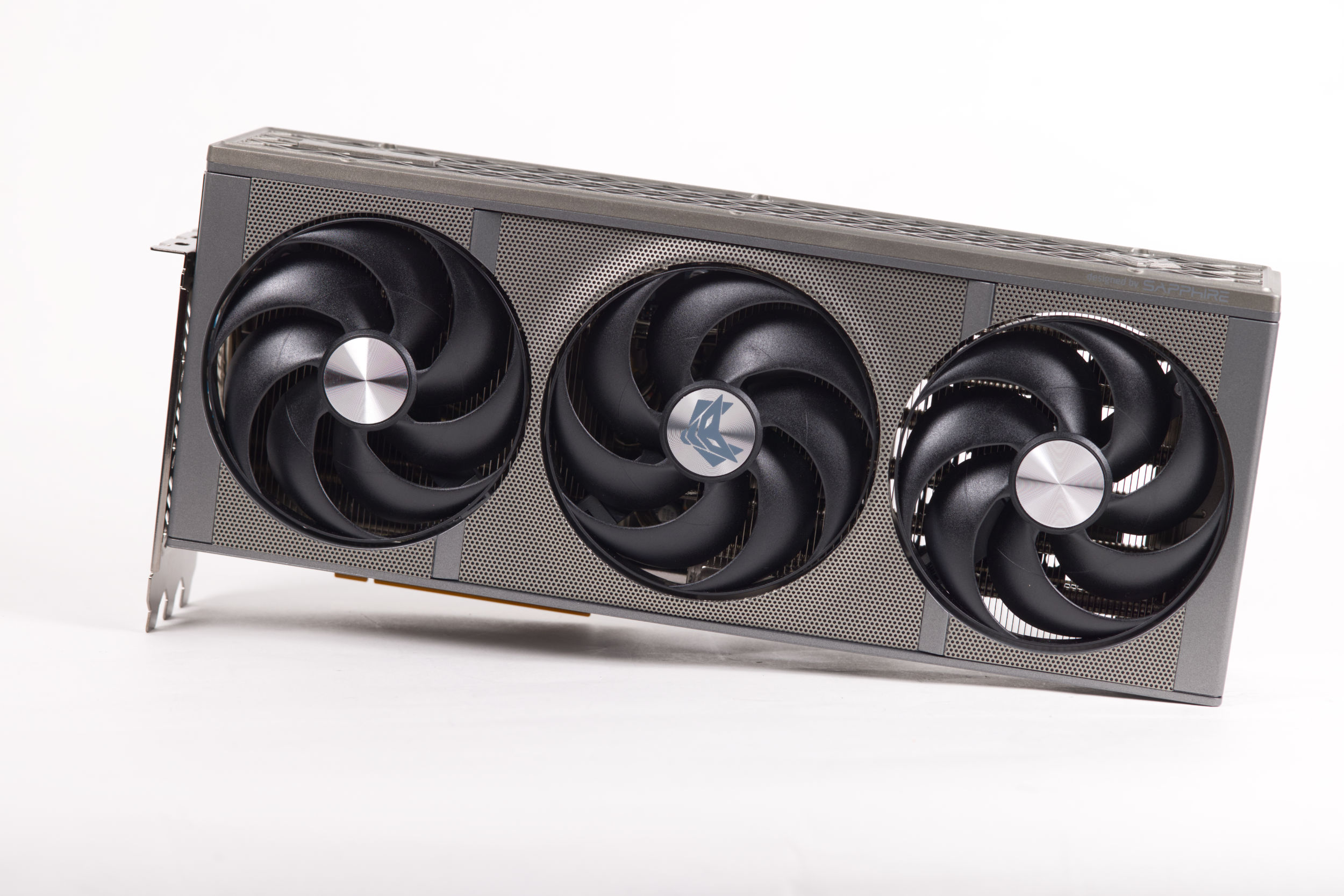 Sapphire Radeon RX 9070 XT Nitro+ Grafikkarte (Image © PCMasters.de)
Special Features of the Radeon RX 9070 XT NITRO+
SAPPHIRE has improved the thermal management of the new NITRO+ Radeon RX 9070 XT and also revamped its design. The new card offers a maximum boost clock of 3,060 MHz and a game clock of up to 2,520 MHz. This is intended to set the card apart from the AMD reference model and the competition.
[image -25612]
Special Backplate Cover
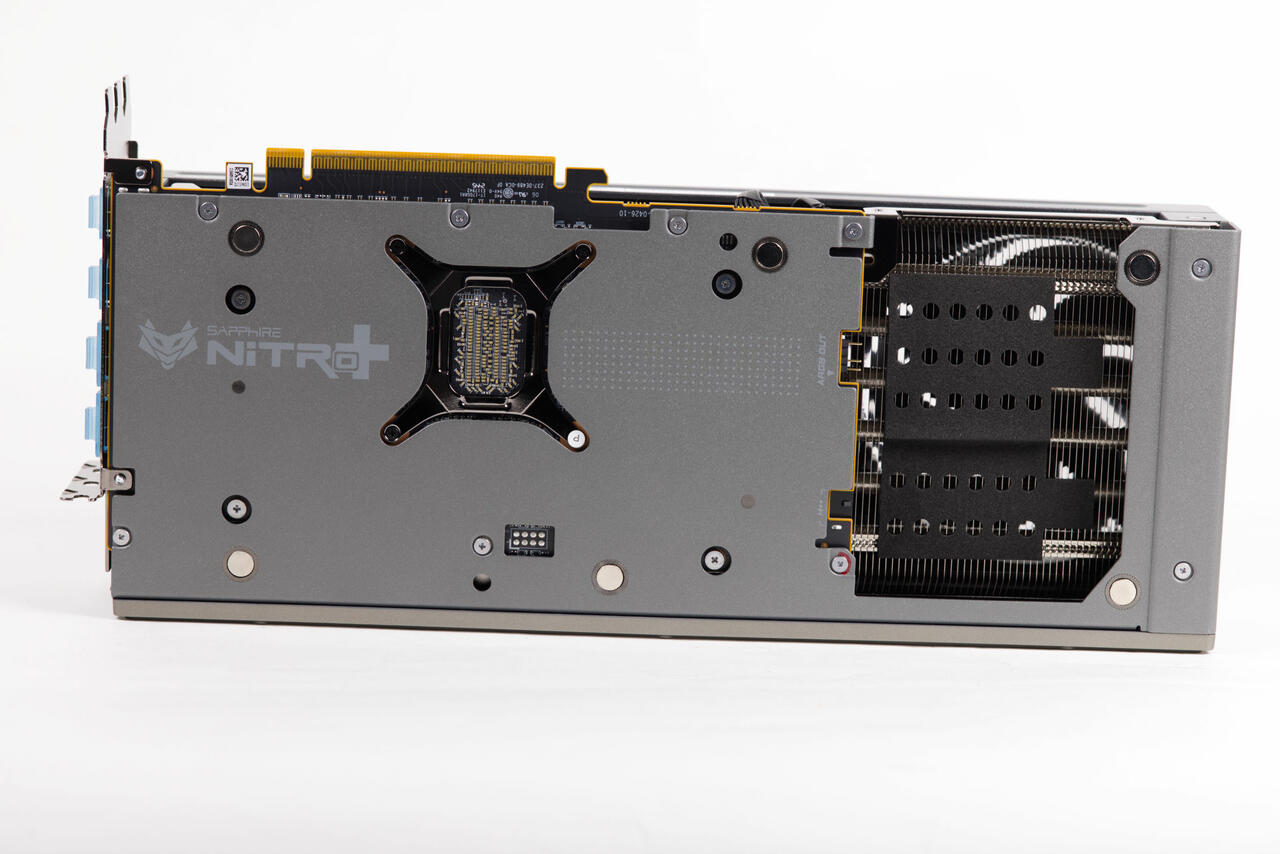
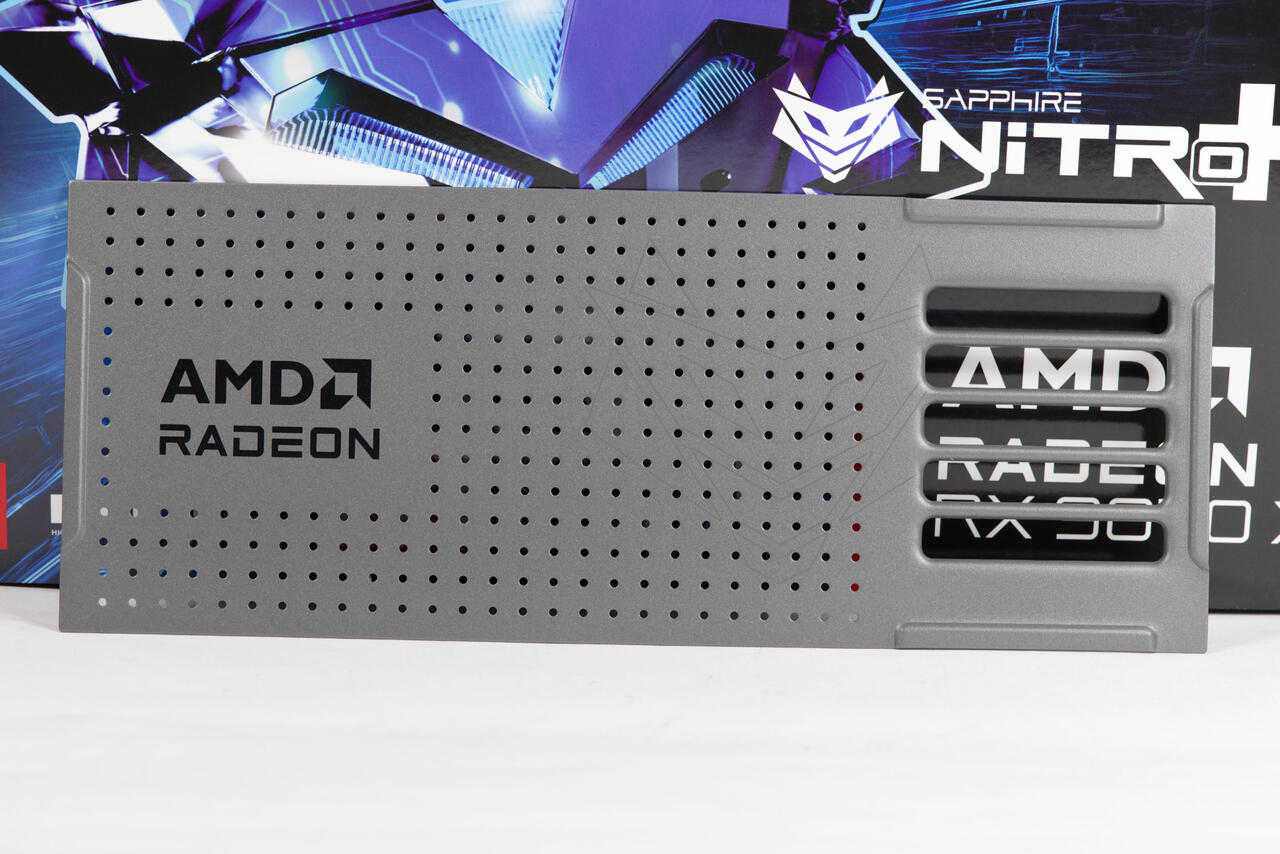
A striking design element is the two-layer all-metal backplate, which is attached to the back of the card via Quick Connect MagniPlate. This magnetic backplate not only improves heat dissipation but also simplifies installation. At the same time, the integrated, hidden STEALTH power cables help keep the system looking clean.
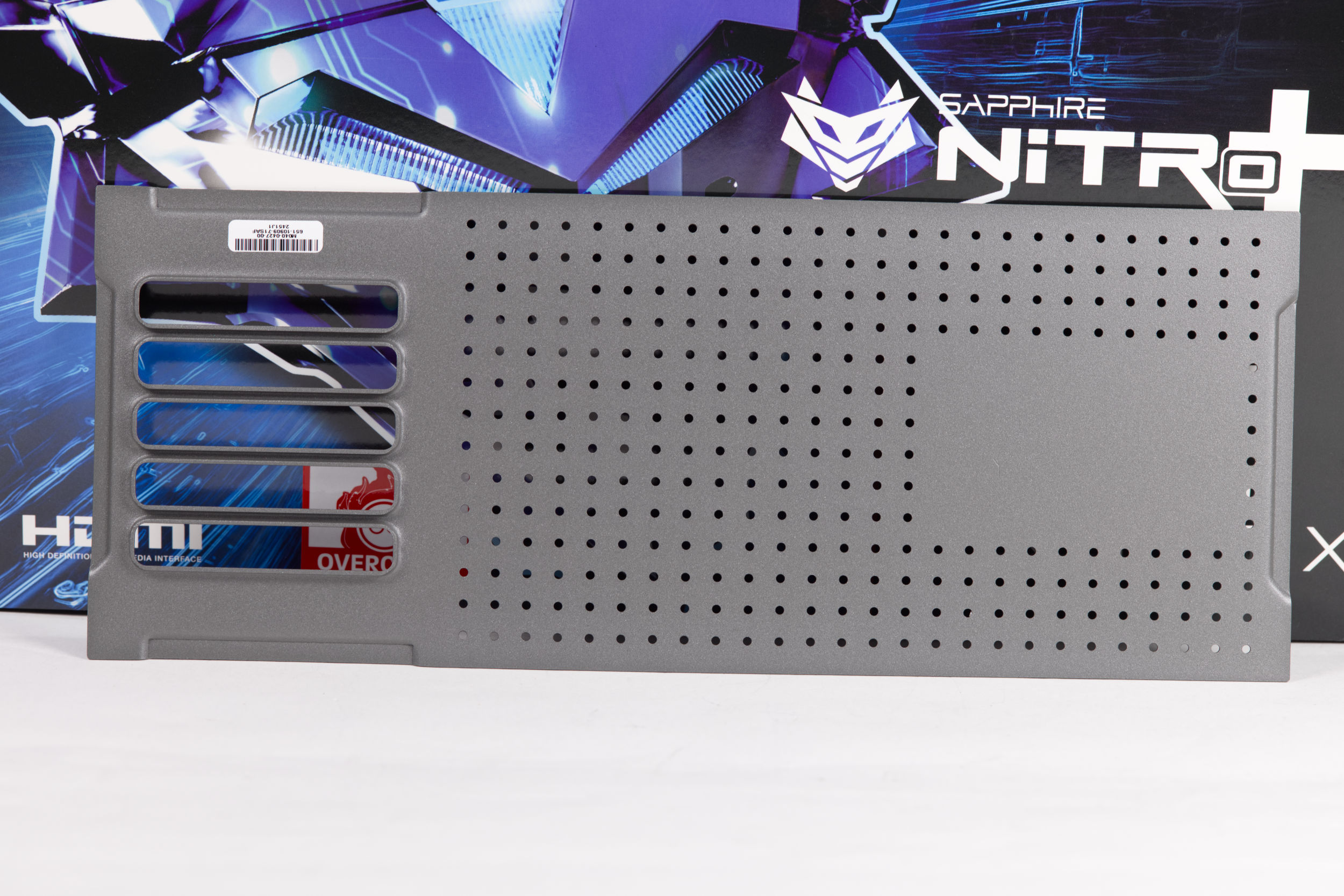 Sapphire Radeon RX 9070 XT Nitro+ Backplatabdeckung Seite 2 (Image © PCMasters.de)
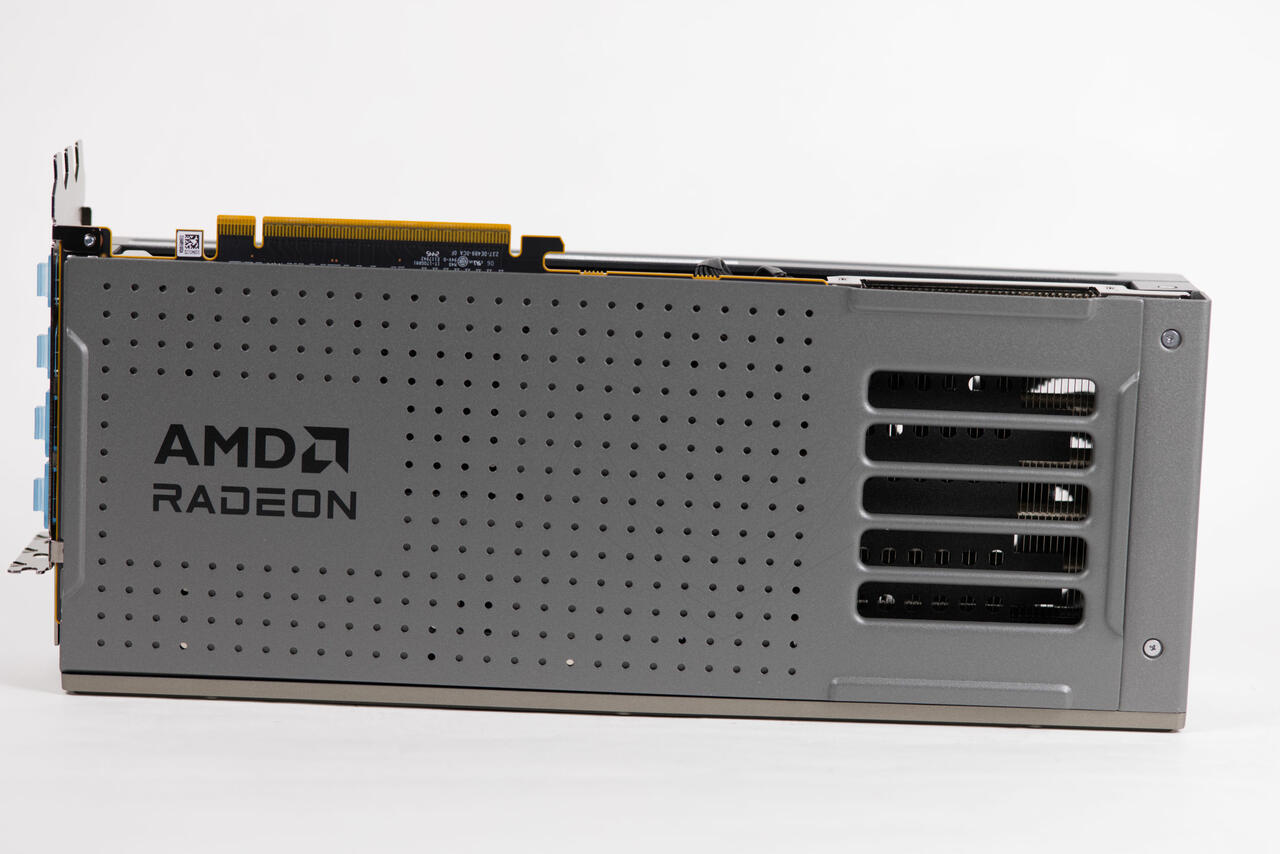
The perforated backplate features cutouts for airflow, and you can also see large AMD Radeon lettering here. The cables are routed toward the rear, toward the PCIe slot, so they should no longer be visible from above. This should also look good with vertical mounting, since the cables don’t stick out.
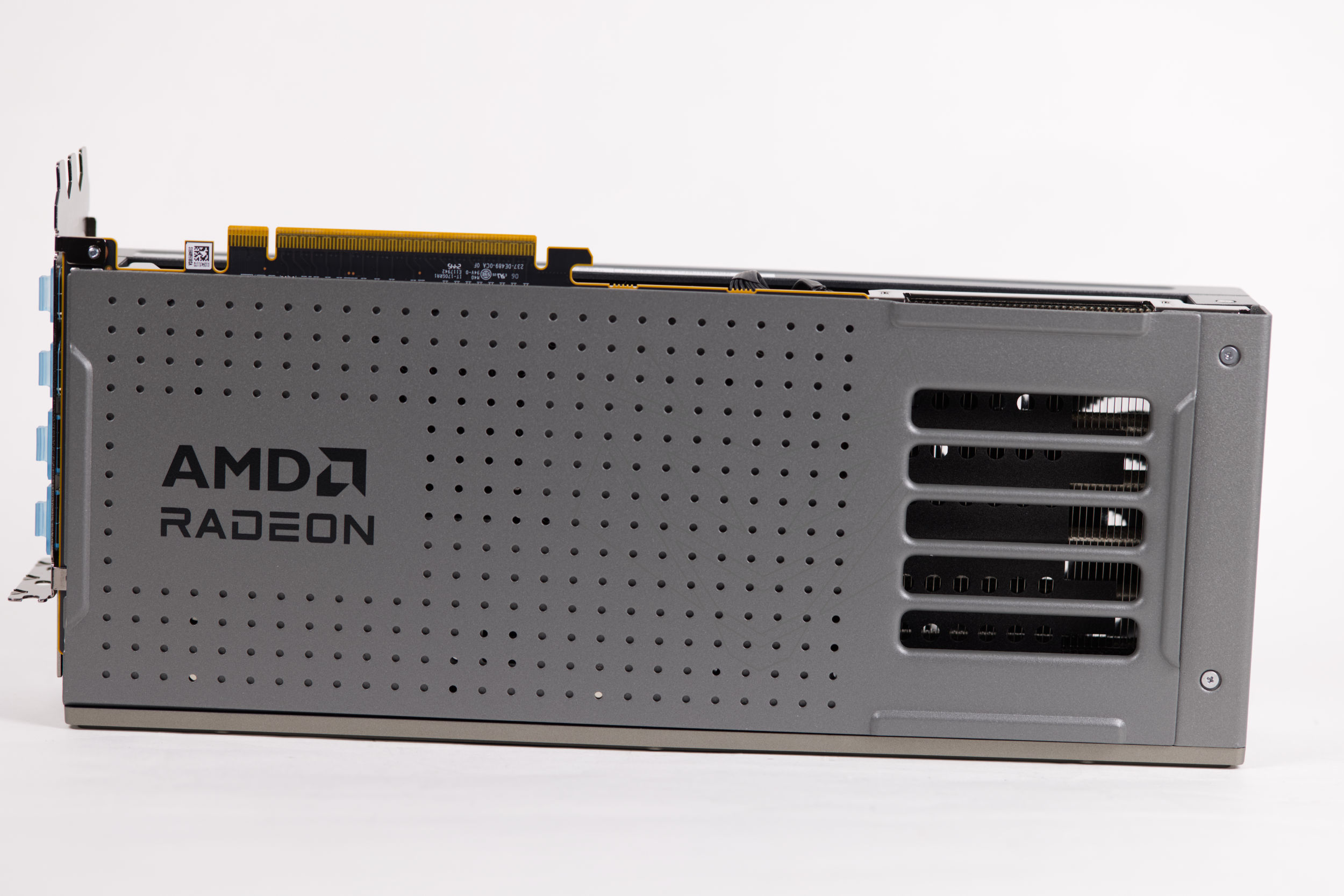 Sapphire Radeon RX 9070 XT Nitro+ Rückseite (Image © PCMasters.de)
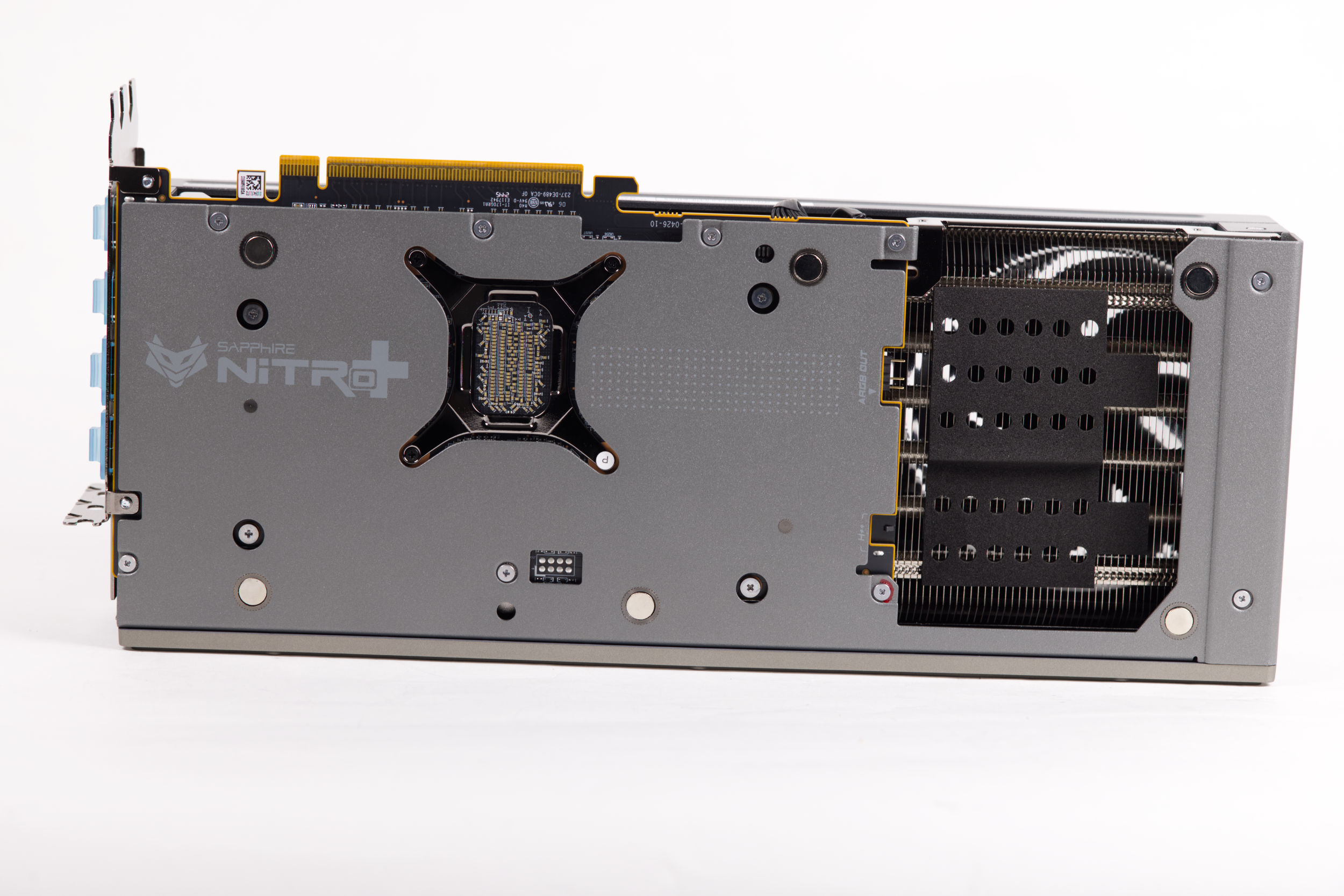 Sapphire Radeon RX 9070 XT Nitro+ Rückseitenansicht (Image © PCMasters.de)
The card’s structure consists of a sturdy metal frame that provides enhanced rigidity and protection for the internal components. A special GPU bracket minimizes flex.
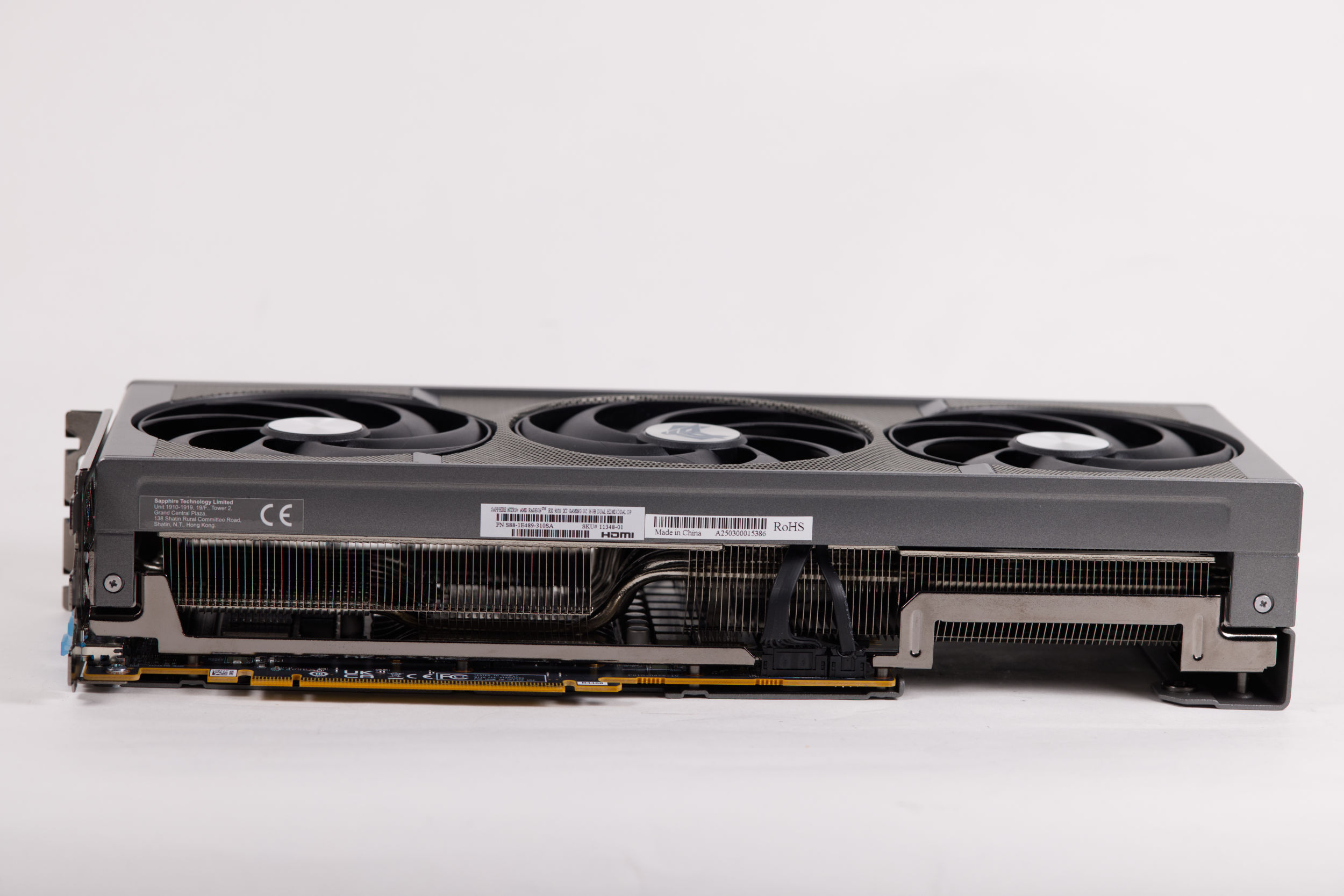 Sapphire Radeon RX 9070 XT Nitro+ Seitenansicht 2 (Image © PCMasters.de)
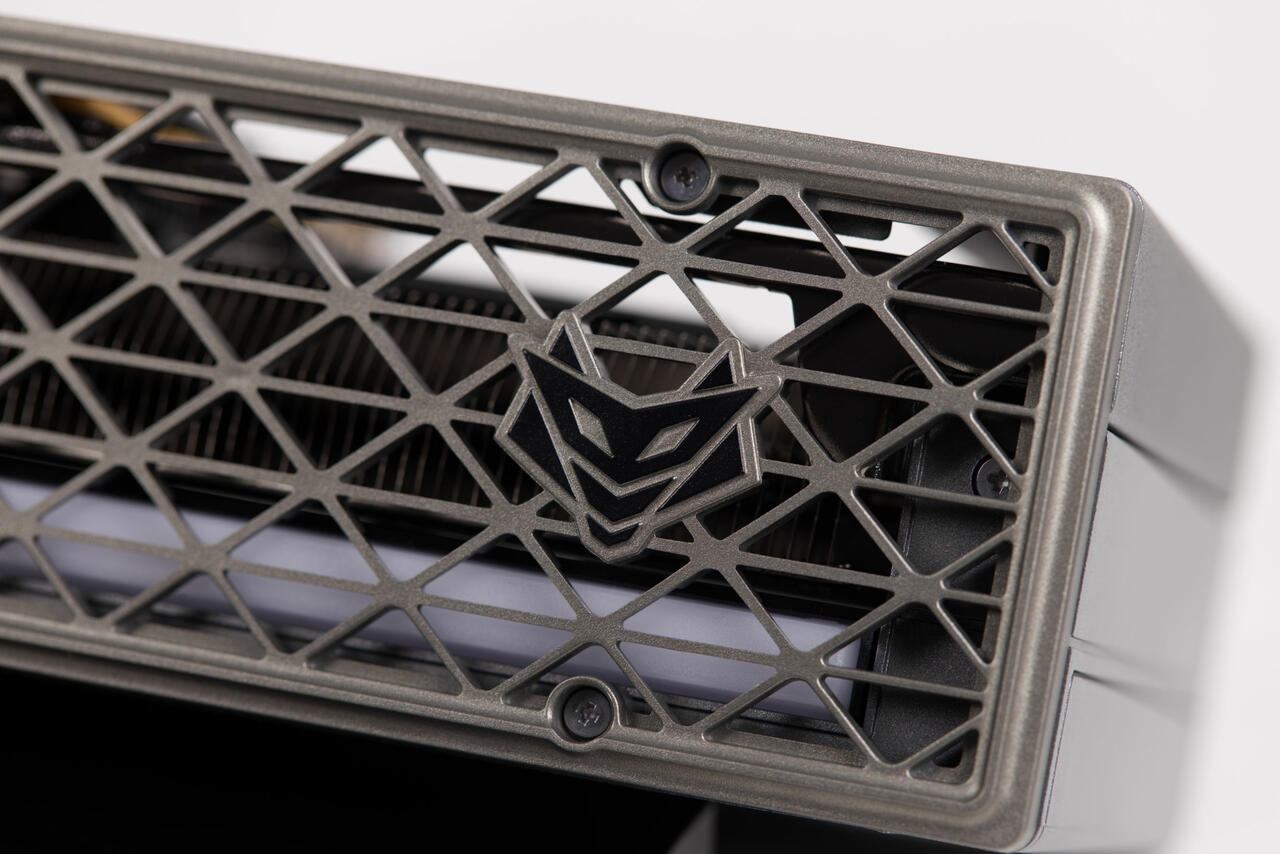
Overall, the design is very appealing and eye-catching, as the gray finish and the mesh design on the front look truly unique and clean. Sapphire has gone to great lengths to cover the card completely.
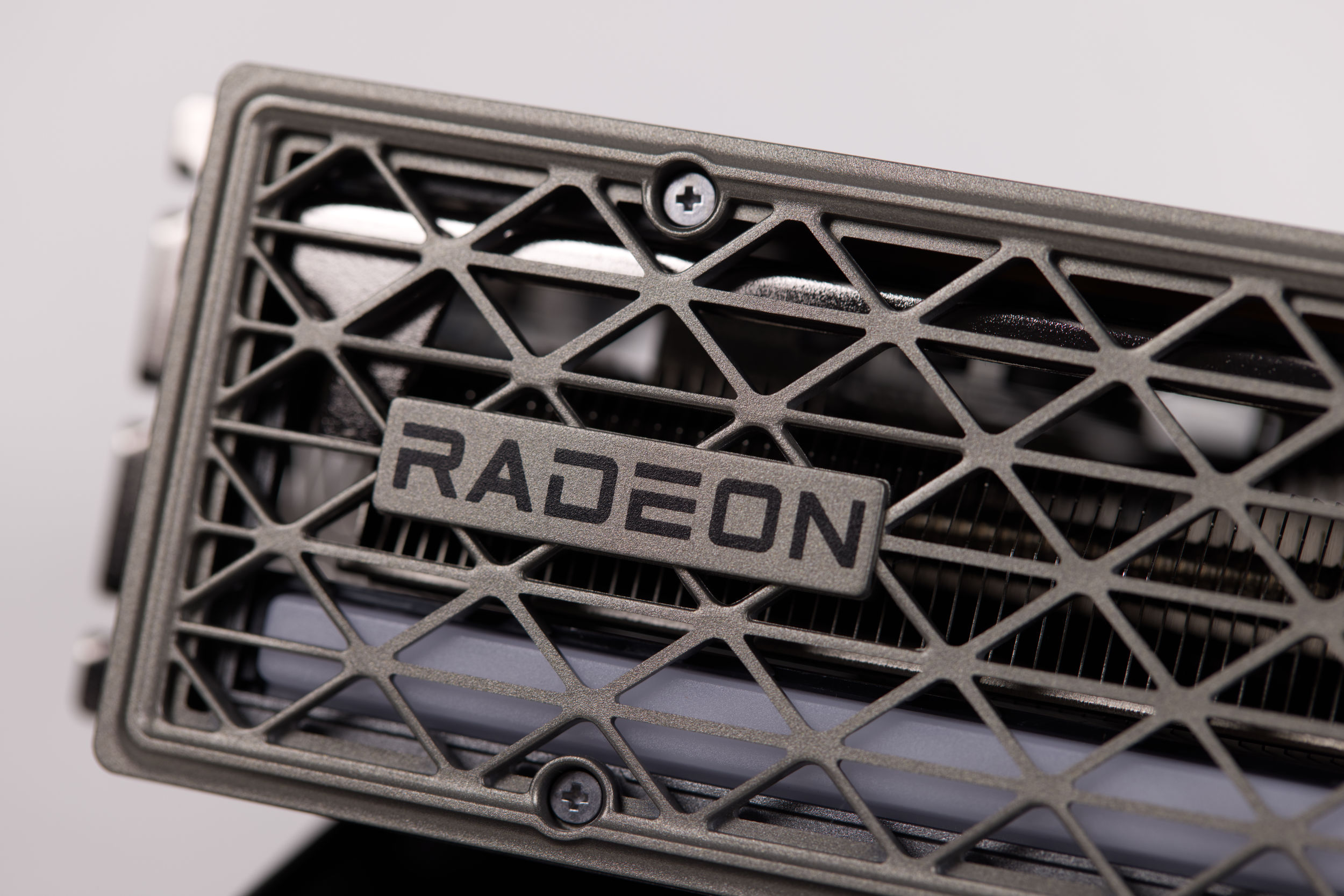 Sapphire Radeon RX 9070 XT Nitro+ Design Radeon Logo (Image © PCMasters.de)
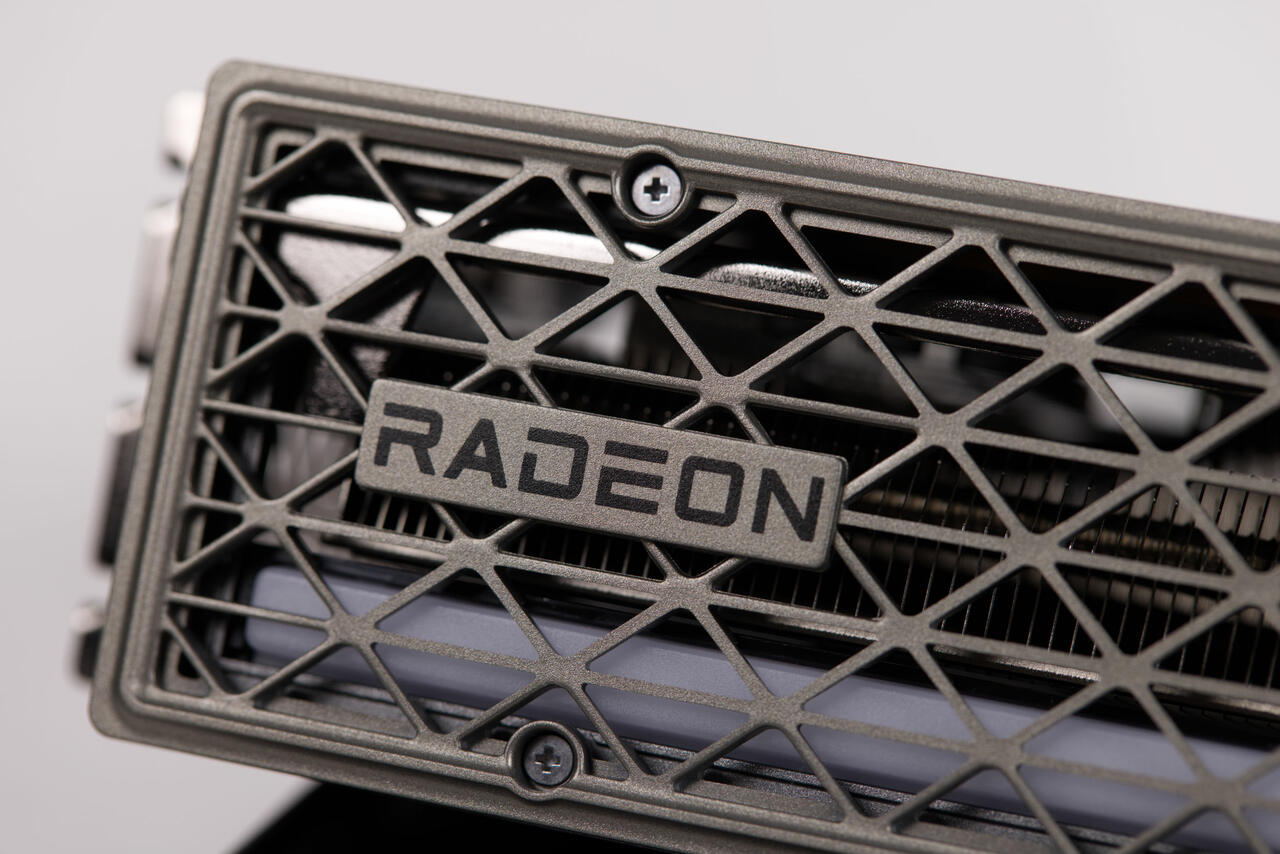
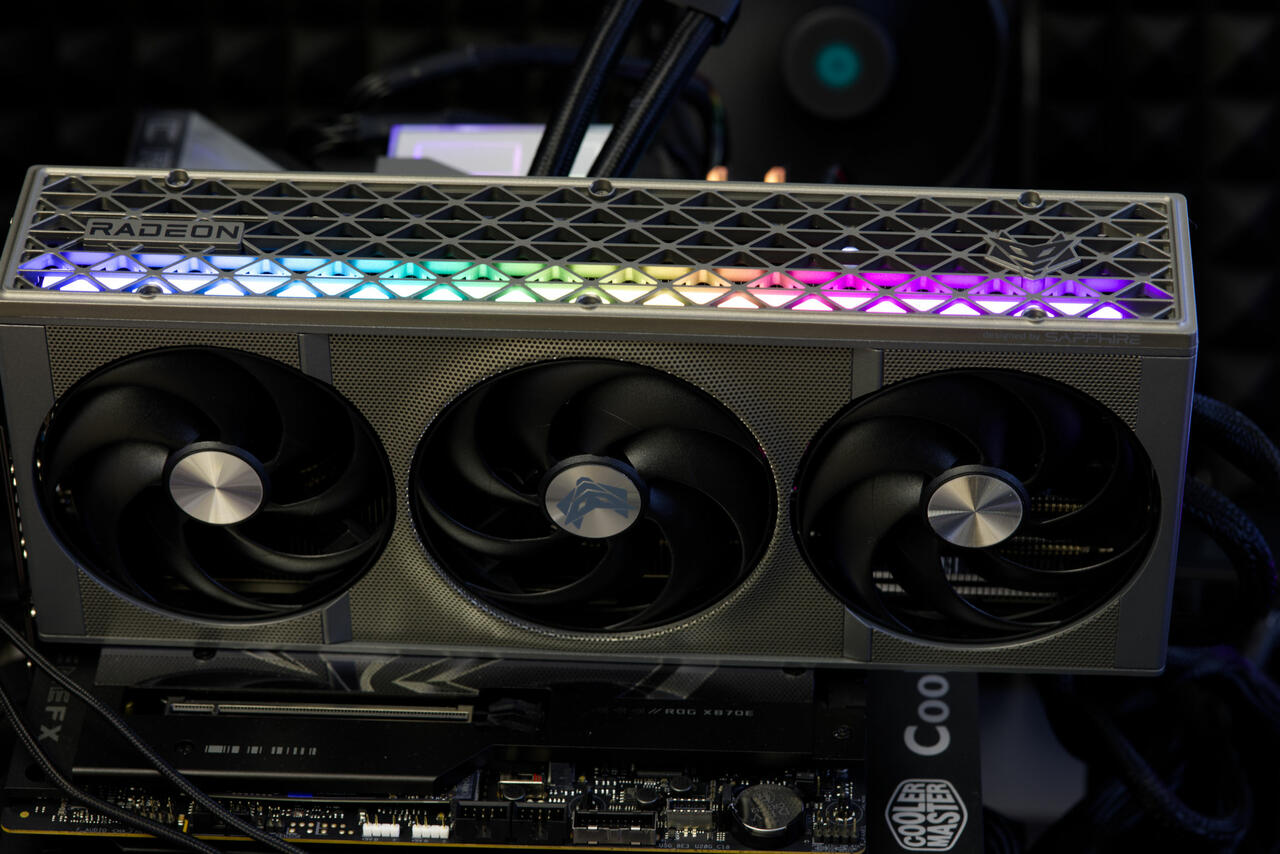
A triangular pattern has been used on the visible side, which doesn’t obstruct airflow and also allows the ARGB lighting to shine through. On one side, you can see "Radeon" lettering, and on the other side, the Nitro+ logo.
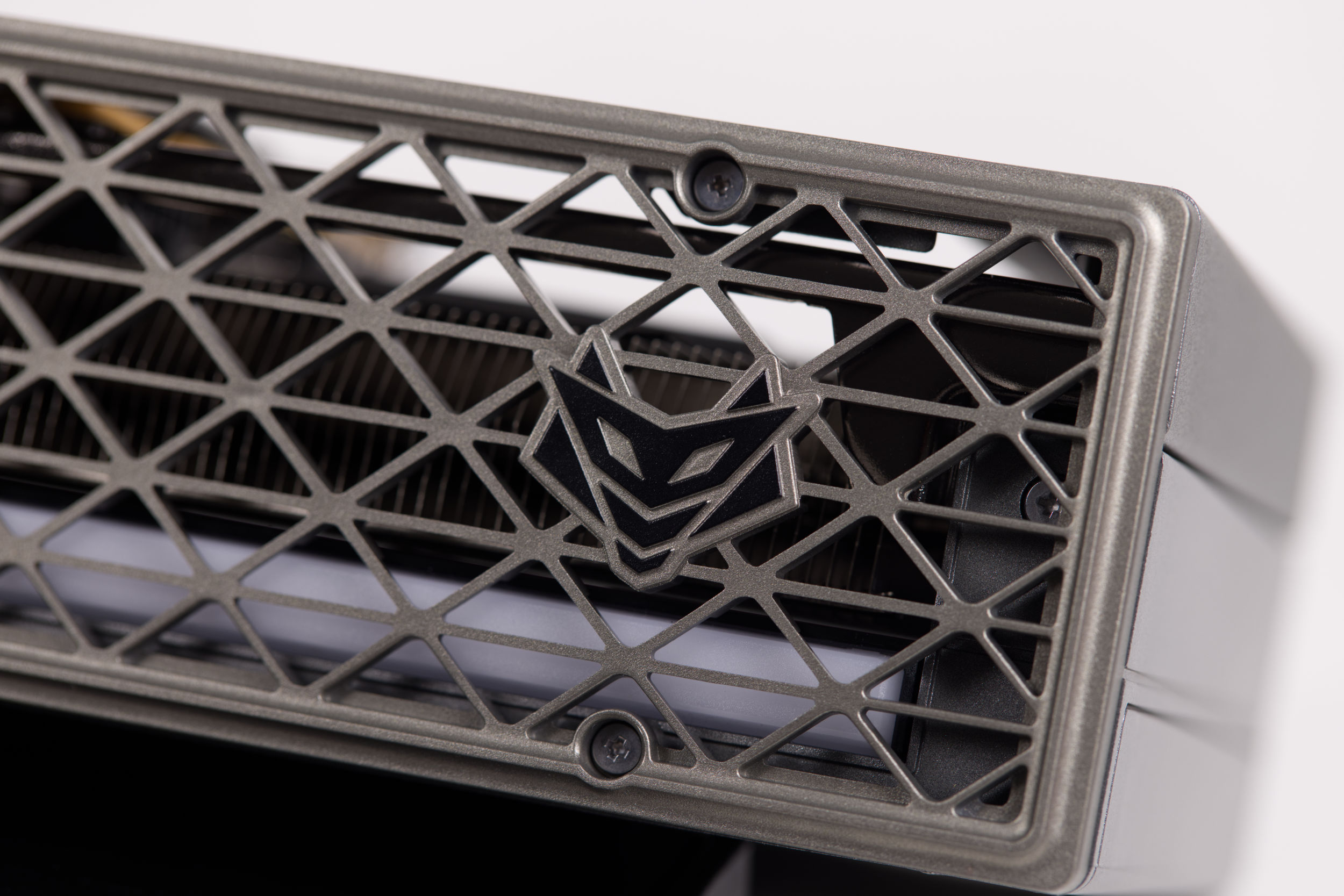 Sapphire Radeon RX 9070 XT Nitro+ Design (Image © PCMasters.de)
Overall, everything comes together very harmoniously, and the build quality is top-notch.
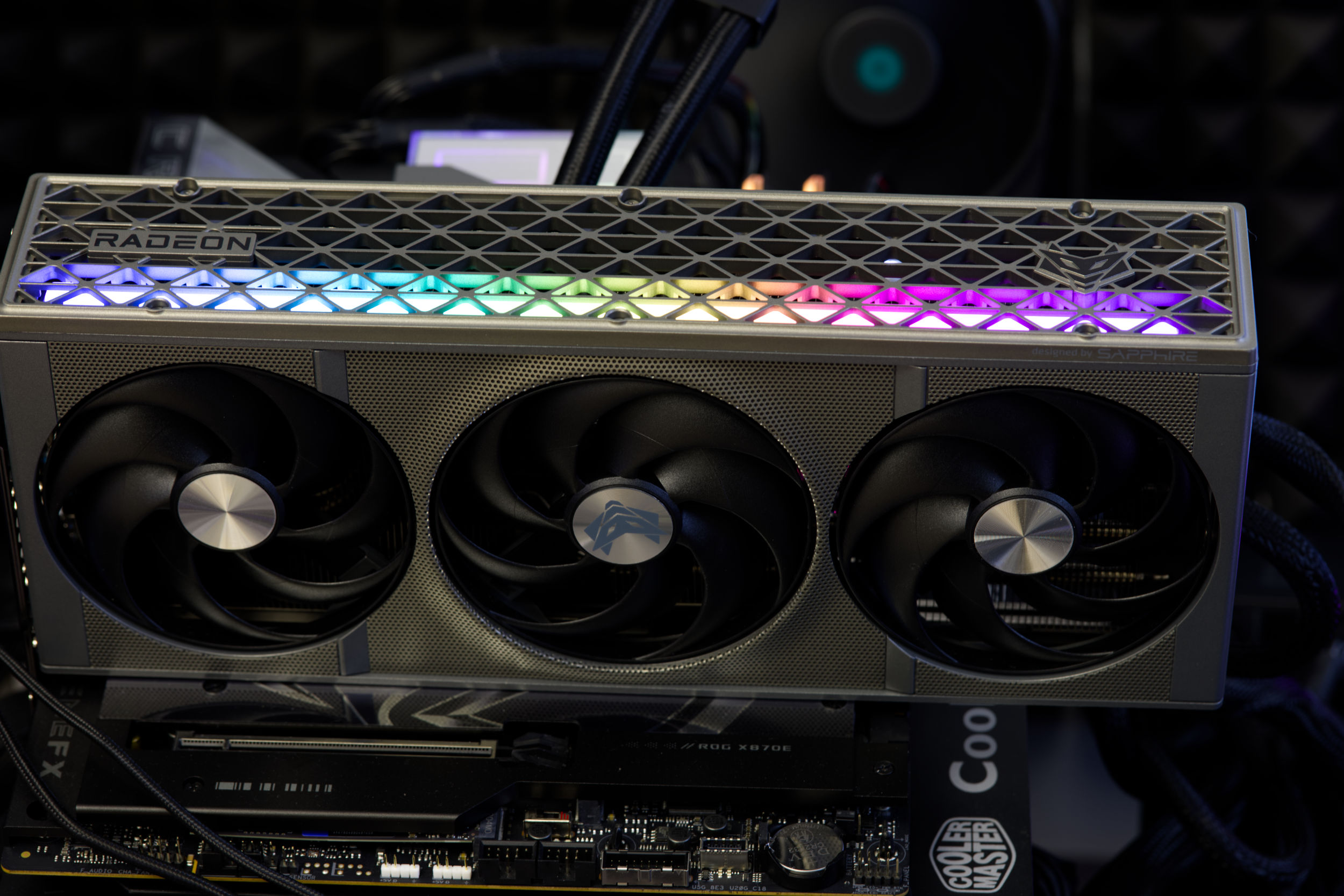 Sapphire Radeon RX 9070 XT Nitro+ ARGB aktiviert (Image © PCMasters.de)
Subtly Integrated ARGB Lighting
Sapphire has kept the ARGB lighting understated, as it isn’t particularly eye-catching. When turned on, the strip creates a very stylish effect, but it’s by no means over-the-top. The ARGB sync connector on the back allows the lighting to be synchronized with other components or controllers. It makes sense to connect the card to the motherboard to achieve smooth gradient effects throughout the entire system.
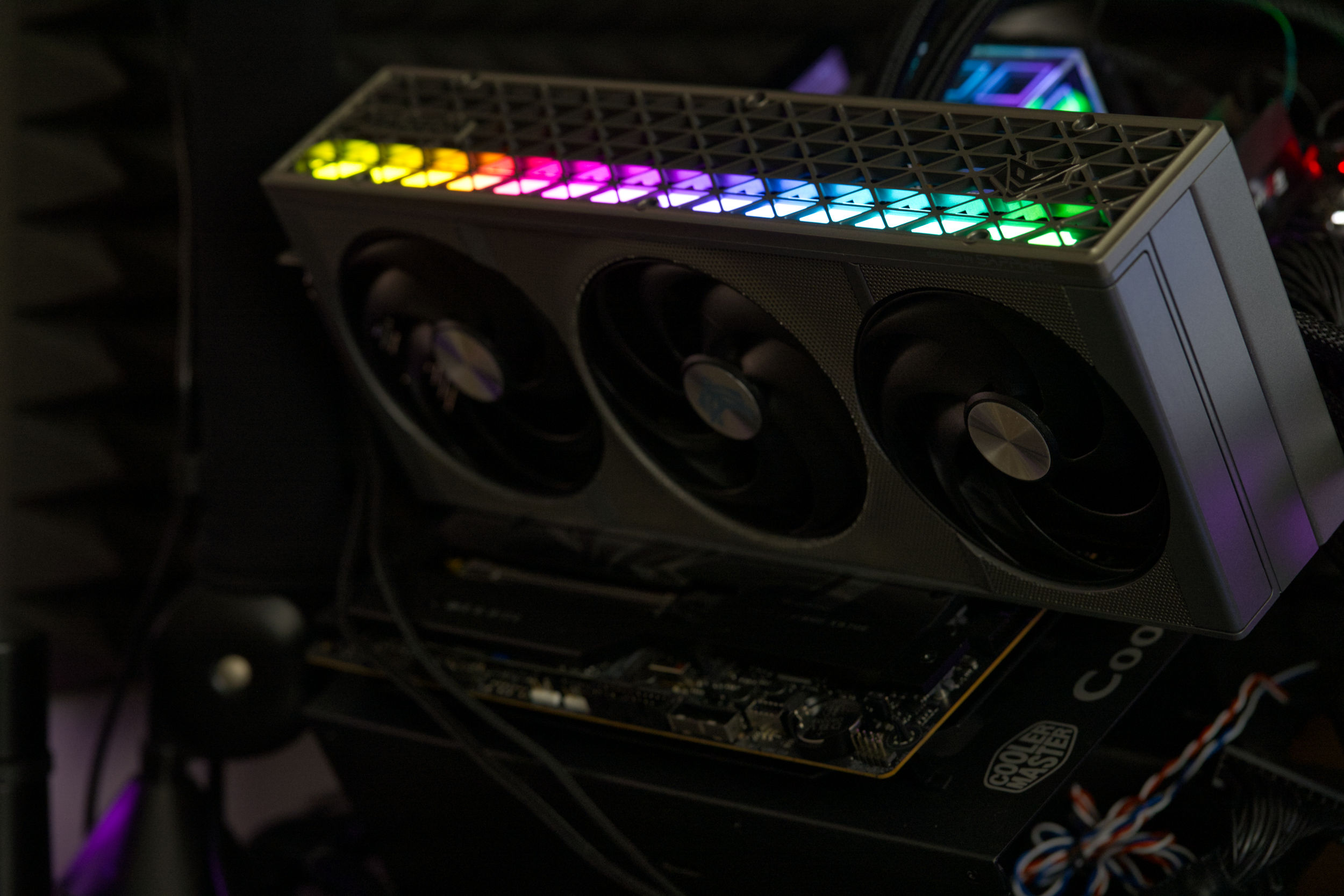 Sapphire Radeon RX 9070 XT Nitro+ ARGB (Image © PCMasters.de)
Control can also be managed via Sapphire’s software, though we did not explore this further here.
Sapphire Radeon RX 9070 XT Photos
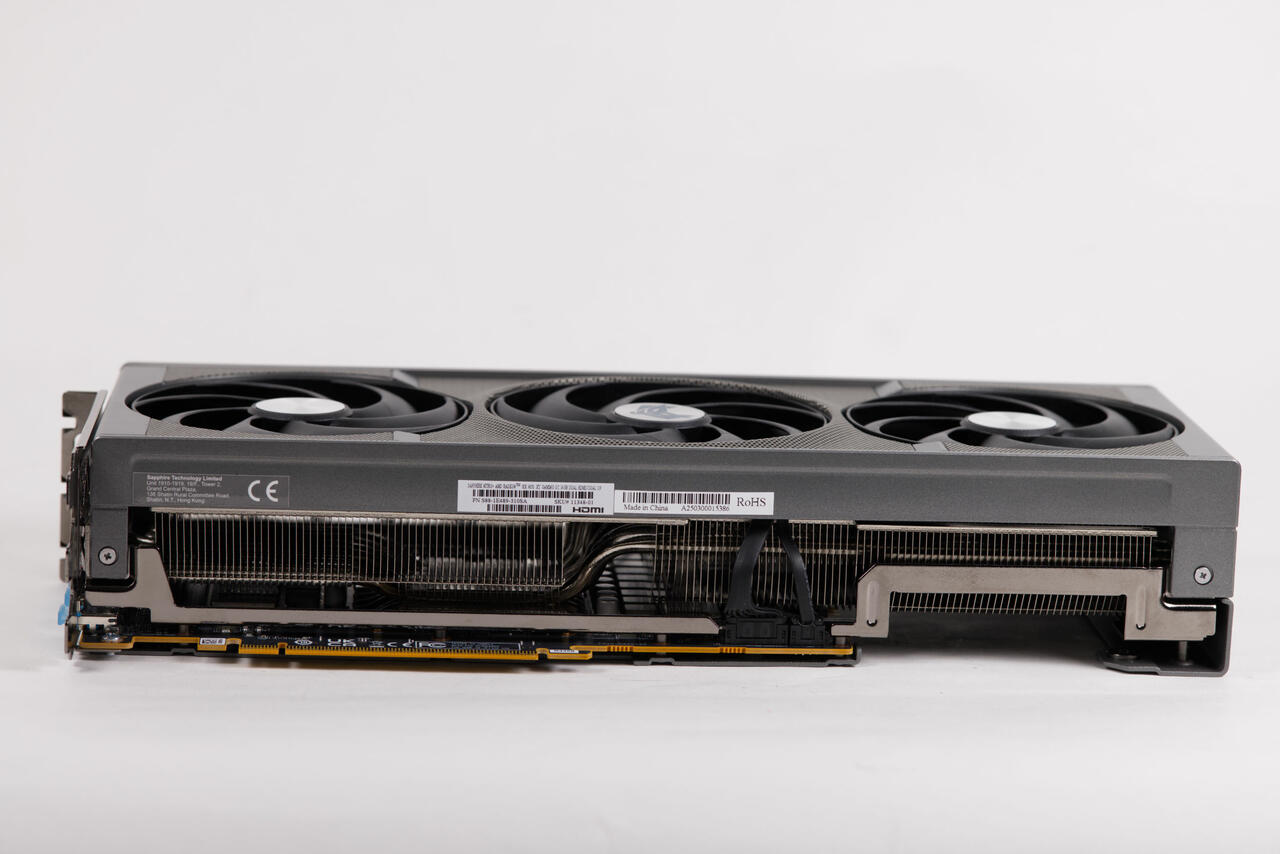
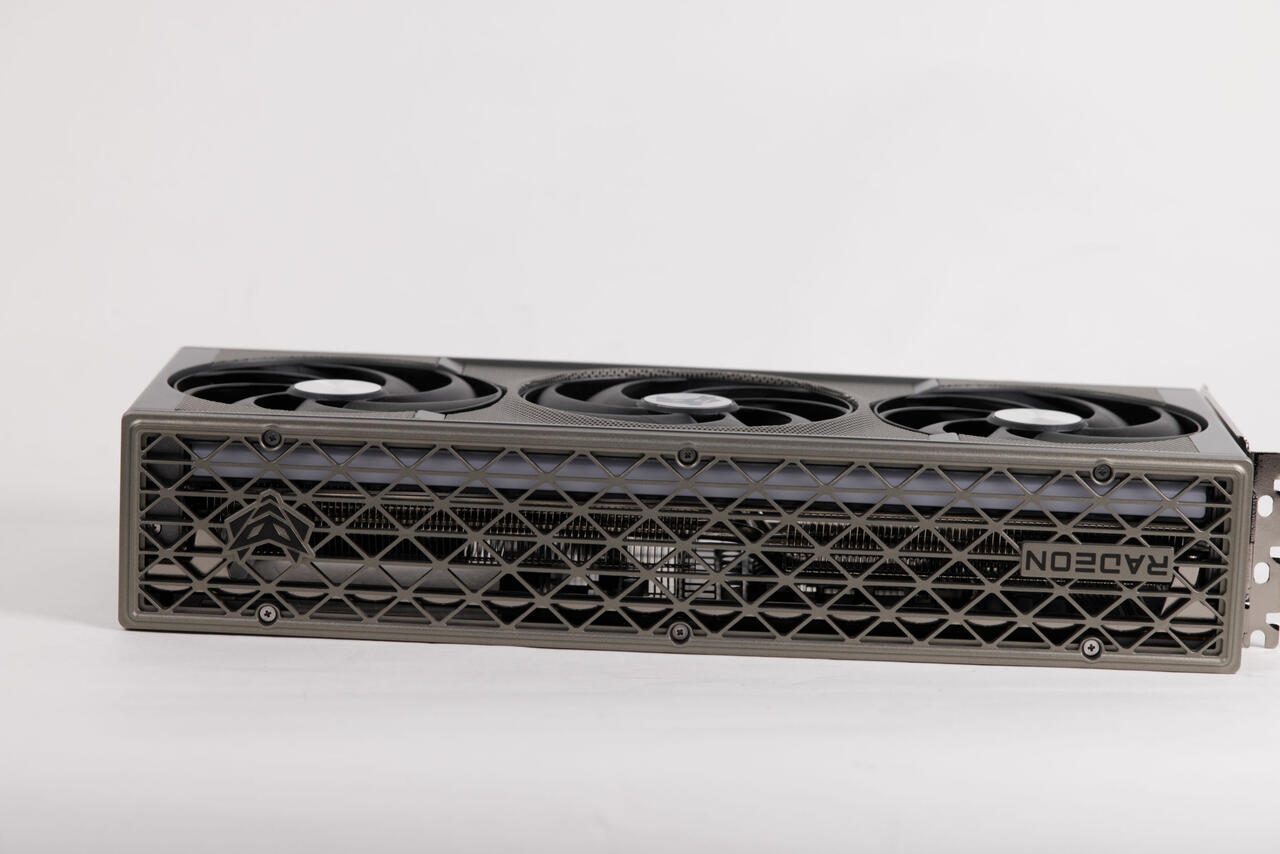
 Sapphire Radeon RX 9070 XT Nitro+Verpackung (Image © PCMasters.de)
Package Contents
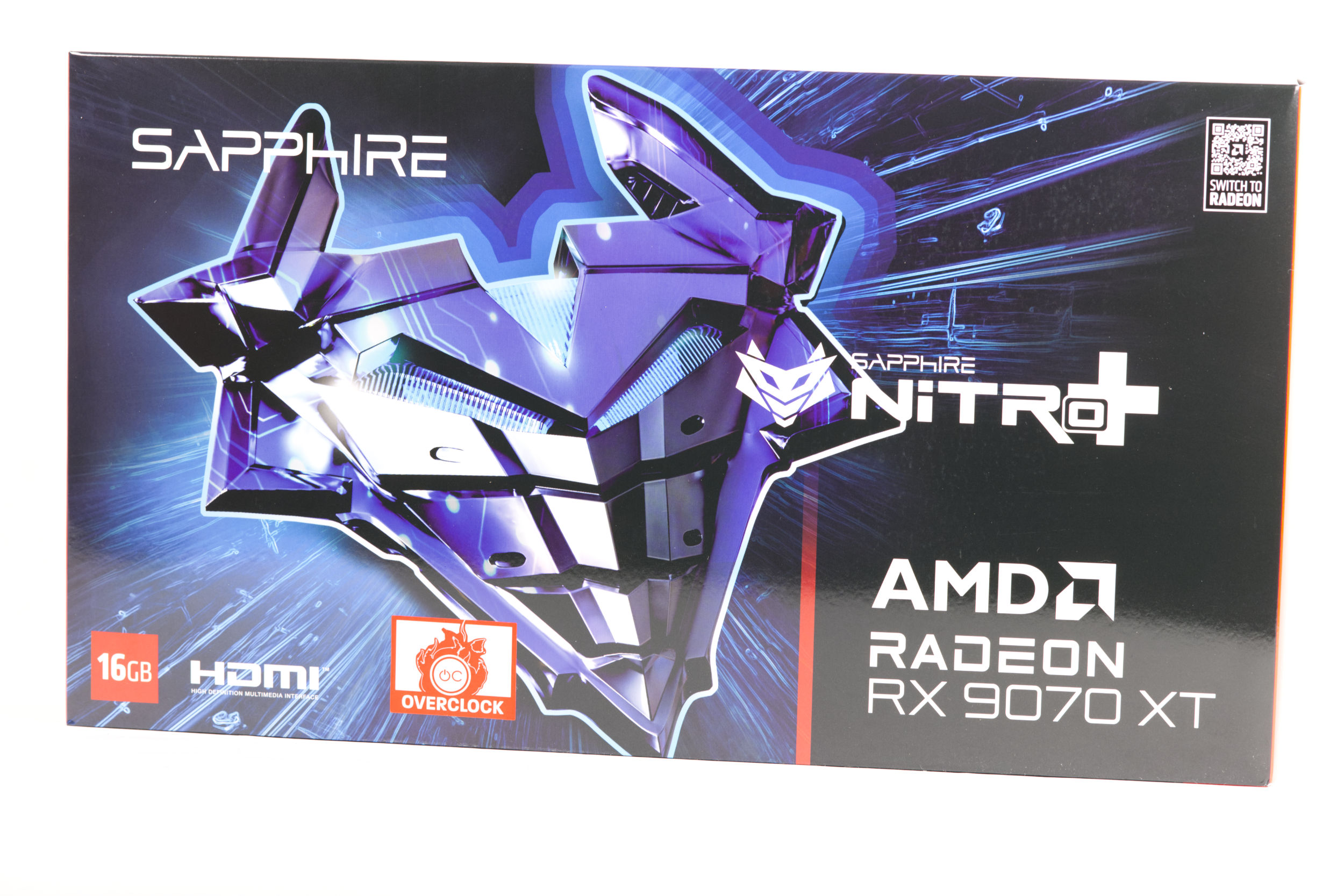
The Radeon RX 9070 XT Nitro+ comes in a very eye-catching printed box. Sapphire promotes the series with an "Overclocked" logo and otherwise uses the standard AMD promotional text on the front. The outer packaging is sturdy and contains a black cardboard box.
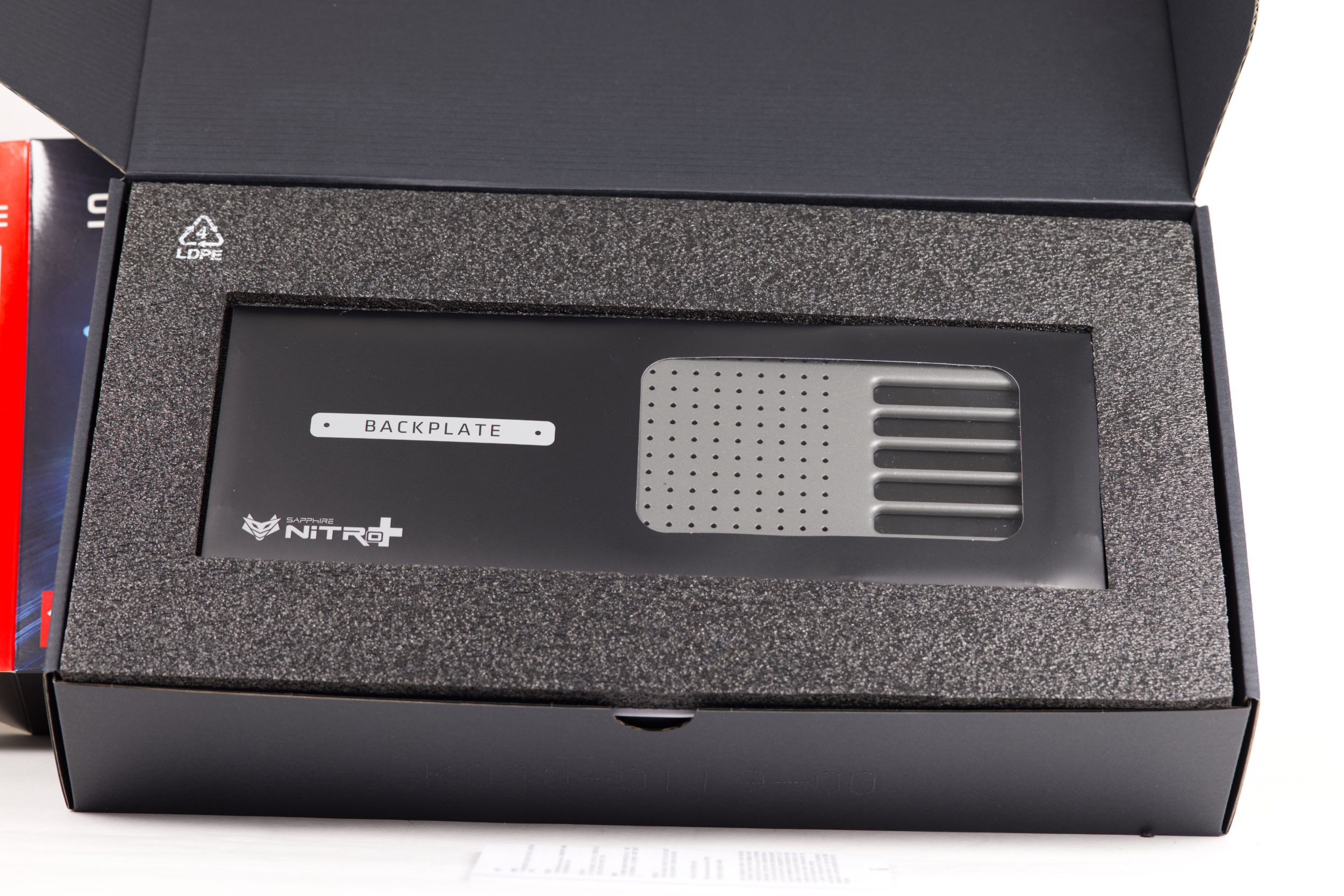 Sapphire Radeon RX 9070 XT Nitro+Verpackung offen (Image © PCMasters.de)
When you open it, the backplate—which is also individually packaged—is the first thing you see. This gives a high-quality impression and really highlights the backplate, encouraging customers to take a closer look at it before beginning the installation. Inside, both the graphics card and the accessories are protected by Styrofoam.
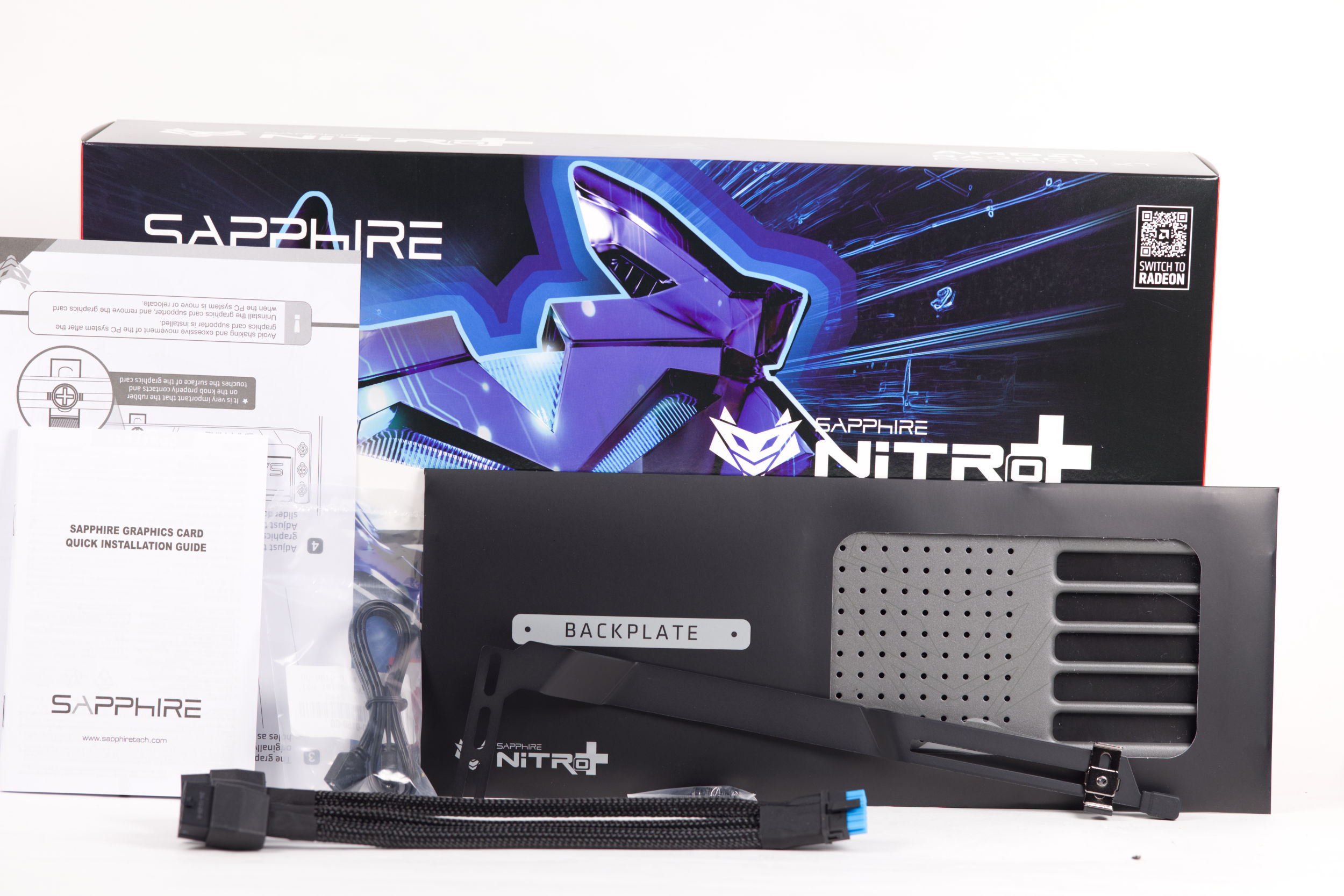 Sapphire Radeon RX 9070 XT Nitro+ Lieferumfang (Image © PCMasters.de)
The package includes the following accessories:
- L-shaped bracket
- 3-pin 5V ARGB cable
- Magnetic backplate
- Power adapter from 2×6-pin 12 V (H++) to PCI Express 3×8-pin
System Requirements
The following system requirements are listed on the manufacturer’s website:
- PCI Express-compatible motherboard with an x16 graphics slot
-
Blocks 3 slots
- Native 2×6-pin 12V power connector (H++) or 3× PCIe 8-pin power connectors
- Power supply with at least 750 W or more
Test Setup
For our tests, we’re using a new test system with an open test setup. The games we’re using for the test suite have also been updated. The system now features the Ryzen 7 7800X3D as the CPU on an ASUS ROG CROSSHAIR X870E HERO motherboard.
The beta driver is from AMD and was version 24.30.31.03.
The Test System
- CPU: AMD Ryzen 7 7800X3D
- Motherboard: ASUS ROG CROSSHAIR X870E HERO
-
M.2 SSD: Corsair MP600 Elite, WD_Blue SN580 1 TB
- RAM: G.SKILL Trident Z5 48 GB DDR5-6800 (34-46-46-108-1.35V)
- CPU Cooler: DeepCool LS720
- Power Supply: NZXT C1500 Platinum
- Fans: 0
- Case: CoolerMaster Benchtable (open)
Radeon RX 9070 XT Ray Tracing Synthetic Benchmarks
For synthetic benchmarks with ray tracing support, we use only 3DMark Port Royal. The remaining tests are based on games that implement the technology in one way or another.
3DMark PORT ROYAL 1.2
Synthetic Benchmarks
Synthetic benchmarks are useful for an initial comparison of performance, but they do not reflect the cards’ in-game performance, as other factors come into play that are not immediately apparent.
3DMark Benchmark
Geekbench 6 OpenCL Benchmark
Unigine Superposition Benchmark
8k Benchmarks
For our first 8k test in the benchmark suite, we use the Unigine Superposition run with the 8k option. This test can also be run on non-8k monitors.
Radeon RX 9070 XT Ray Tracing Game Benchmarks
With new game titles and the overhaul of the test station, additional ray-tracing titles have been added. This segment now provides a solid data foundation. The results are not commented on individually. Our comments are summarized in the rankings below.
Cyberpunk 2077 with Ray Tracing with/without DLSS/FSR
Fortnite with Ray Tracing
Black Myth Wukong Benchmark with Ray Tracing
Metro Exodus Enhanced Edition Benchmarks
Game Benchmarks
The benchmark results shown here do not include ray tracing or DLSS. We have transitioned from 1080p to 4K testing in games.
Final Fantasy XV Benchmarks
Cyberpunk 2077
Black Myth Wukong Benchmark
Monster Hunter Wilds Benchmarks
Shadow of the Tomb Raider
Sapphire Radeon RX 9070 XT Nitro+ Grafikkarte (Image © PCMasters.de)
Efficient Cooler with Three Axial Fans
The Radeon RX 9070 XT Nitro+ features a triple-fan cooler design with three 100 -mm Axial-Tech fans that generate a steady, high-pressure airflow through an optimized fin arrangement. The Free Flow cooling design minimizes turbulence and efficiently directs air over the aluminum heatsink, which is equipped with Honeywell PTM7950 thermal pads and seven 6-mm heat pipes. This configuration is supported by a phase-change GPU thermal pad that liquefies when heated and fills microscopic gaps between the GPU and the cooling module to ensure excellent thermal conductivity and a long service life.
When idle, the fans do not spin, so the card remains silent.
Temperatures
The massive cooler does its job well, keeping the card relatively cool. At idle, temperatures are slightly higher because the fan doesn’t need to spin at all, so you can’t hear the card.
The measured values are delta values, with room temperature factored out.
Noise Level of the Sapphire Radeon RX 9070 XT
We rely on our proven noise measurement method to measure the noise level of the Radeon RX 9070 XT Nitro+. The open-air design is well-suited for this type of evaluation, and we measure at a distance of 20 cm. The PCE-332A measuring device is set to a measurement range of 30–80 dB (A).
At 32 dB(A), this card is the quietest of all the cards tested. After 10 minutes of Furmark, the card reaches 1,262 RPM but remains surprisingly quiet.
Power Consumption
In terms of power consumption, the Radeon RX 9070 XT Nitro+ from Sapphire is also on the more efficient side. AMD specifies a Total Board Power of 330 watts, and GPUz measures this as well. This is 30 watts higher than the competing GeForce RTX 5070 Ti.
Power consumption measured at the outlet looks slightly different. The Radeon RX 9070 XT Nitro+ with the entire system consumes 454.8 watts, while the GeForce RTX 5070 Ti consumes 416 W, which speaks in favor of the NVIDIA competitor. This means power consumption is also higher than that of the PowerColor card, even though the TBP is identical.
Graphics Card Rankings 2025
After retesting all graphics cards and including them in the comparison, we’ll examine the performance of the model from this test relative to the rest of the field and previous generations.
Sapphire Radeon RX 9070 XT Gaming Benchmarks at 1920x1080 (1080p)
In 1080p benchmarks, the Sapphire Radeon RX 9070 XT ranks almost on par with the GeForce RTX 4080 Super, which seems surprising at first glance. It also outperforms the Radeon RX 7900 XTX.
Sapphire Radeon RX 9070 XT Gaming Benchmarks at 4K (3840x2160) Without Ray Tracing
When we increase the resolution to 4K/UHD, the Sapphire Radeon RX 9070 XT Nitro+ trails the GeForce RTX 4080 Super by a narrow margin and outperforms the Radeon RX 9070 XT from PowerColor. On average, it lags behind the GeForce RTX 5070 Ti by 2.5% or 2 fps.
Sapphire Radeon RX 9070 XT Gaming Benchmarks at 4K (3840x2160) with Ray Tracing
With ray tracing enabled, the Sapphire Radeon RX 9070 XT Nitro+ is also nearly on par with the GeForce RTX 4080 Super, trailing by an average of 2 fps—a gap that could potentially be closed through overclocking. It even outperforms the Radeon RX 7900 XTX by an average of 7% (5 fps), which points to improvements in ray tracing.
Sapphire Radeon RX 9070 XT Gaming Benchmarks at 8K
In the 8K benchmark, the Sapphire Radeon RX 9070 XT Nitro+ cannot keep up with the GeForce RTX 5070 Ti and GeForce RTX 4080 Super. The gap widens here.
Sapphire Radeon RX 9070 XT Synthetic Benchmarks
Synthetic benchmarks often reveal a more balanced performance comparison. The Sapphire Radeon RX 9070 XT Nitro+ ranks in the middle of the pack. It trails the GeForce RTX 4080 SUPER by approximately 42% and the GeForce RTX 5070 Ti by 51%. In this scenario, the Radeon RX 7900 XTX also outperforms the Sapphire Radeon RX 9070 XT Nitro+ by a considerable 46%. The Radeon RX 7900 GRE is 15% faster.
Sapphire Radeon RX 9070 XT Nitro+ ARGB aktiviert (Image © PCMasters.de)
Sapphire Radeon RX 9070 XT Nitro+ Conclusion
As a long-standing AMD partner, Sapphire offers a very stylish version of the Radeon RX 9070 XT. The Nitro+ series graphics card we tested stands out in several areas.
From a technical standpoint, the new generation is exciting because AMD delivers better performance—especially in games—despite having fewer ALUs. The Radeon RX 9070 XT outperforms the Radeon RX 7900 GRE by a significant margin and often matches the performance of the much more expensive flagship Radeon RX 7900 XTX, which was very unexpected. It’s also interesting to note that it comes close to the GeForce RTX 4080 Super in games and, in some scenarios, even to the GeForce RTX 5070 Ti. The graphics cards in question are significantly more expensive than the Radeon RX 9070 XT. Ray tracing also performs better on this new generation than before. In synthetic benchmarks, however, the gap is large, and the beta driver appears to be optimized for games. When it comes to gaming performance, the Radeon RX 9070 XT is a surprisingly good graphics card.
Sapphire has clearly put a lot of effort into the design of the Radeon RX 9070 XT Nitro+. The graphics card operated efficiently, didn’t get too hot, and has established itself as the quietest graphics card. On top of that, the card’s design is truly stylish. This is further enhanced by the special, magnetic backplate, which conceals the innovative 2x6-pin 12V power connector. This connector is usually found only on NVIDIA graphics cards,
but Sapphire has recently started using it as well, since it’s part of the ATX 3.1 standard and isn’t exclusive to NVIDIA.
The ARGB lighting is subtly integrated into the cover and looks great when the PC is turned on. Using the included cable, you can also synchronize the lighting with the motherboard, for example, to better control the effects.
The graphics cards are reportedly in stock now and are [slightly more expensive at €819][5] than the €689 recommended by AMD.
Pros
- Good performance in games and benchmarks
- Efficient
- Runs very quietly
- GPU bracket and special backplate
- 2x6-pin 12V power connectors and adapters
- Good value for the price
Cons
- Synthetic benchmarks could be better
[2] : https://www.pcmasters.de/testbericht/133712776-radeon-rx-7900-gre-test-review-Sapphire-hellhound.html [3]: https://www.pcmasters.de/testbericht/133711958-Sapphire-radeon-rx-7900 -xtx-Nitro+-test-review.html [4]: https://www.pcmasters.de/news/133714098-radeon-rx-9070-xt-und-rx-9070-alle-fakten-spezifikationen-und-erwartungen-zu-preisen.html [5] : https://www.awin1.com/cread.php?awinmid=11731&awinaffid=612769& ued=https%3A%2F%2Fwww.alternate.de%2FSAPPHIRE%2FRadeon-RX-9070-XT-Nitroplus-Gaming-OC-Grafikkarte%2Fhtml%2Fproduct%2F100108010