
 Computer Forum
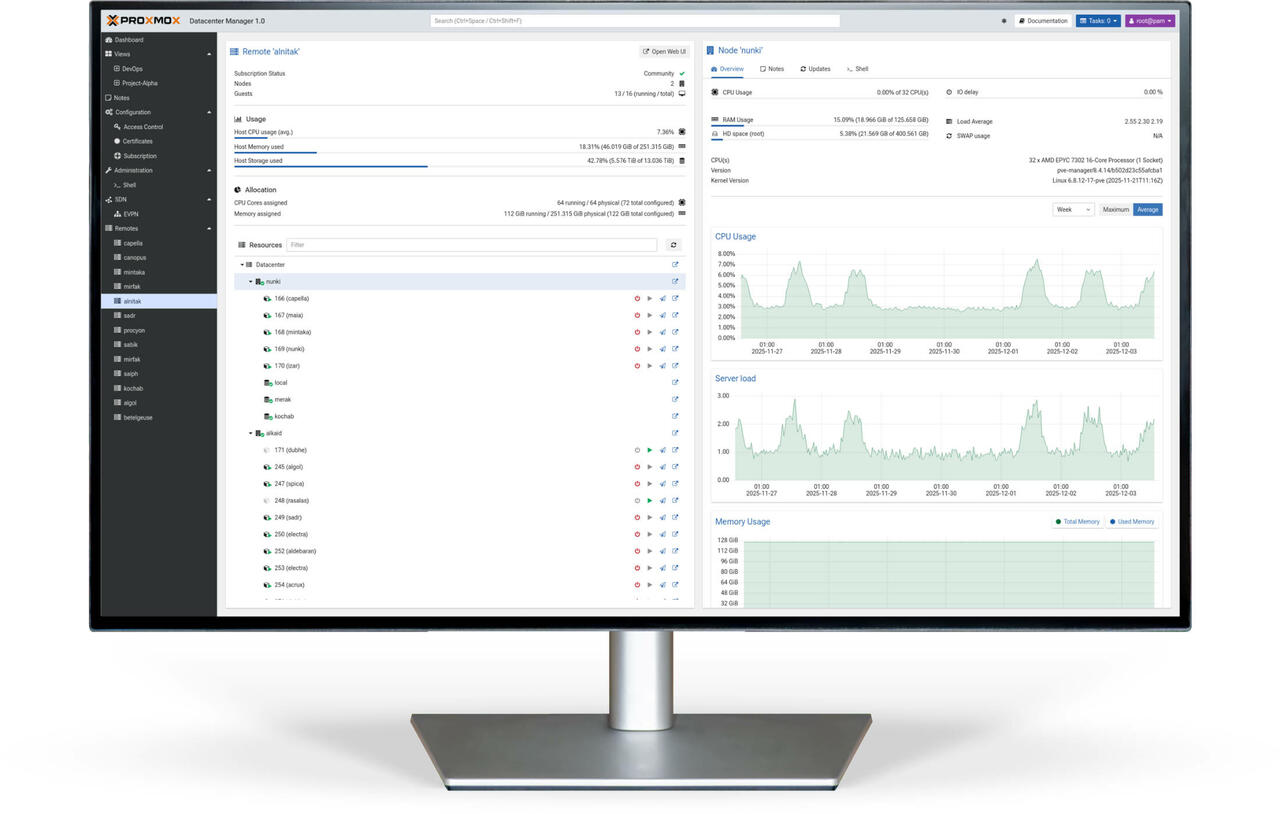 Proxmox Datacenter Manager 1.0 (Image © Proxmox)
Version 1.1 transforms the Datacenter Manager into a central configuration server. This allows administrators to standardize the deployment of hosts in distributed environments using answer files. These files contain predefined parameters that enable unattended installations. To ensure security, a token-based mechanism restricts access to these configurations exclusively to authorized target systems. Installation progress can be monitored in real time via the web interface.
To simplify the management of large environments, a new subscription registry has been added. This registry creates a central pool of subscription keys that can be assigned to specific remote systems. Furthermore, these keys can be integrated directly into answer files, allowing new hosts to automatically register their subscriptions during the installation process.
Improved Monitoring for Ceph and Infrastructure
For organizations using a Proxmox VE-based hyperconverged infrastructure (HCI), version 1.1 introduces native monitoring for Ceph clusters. A consolidated dashboard provides a real-time overview of the cluster’s status, capacity, and performance. This includes detailed data on Object Storage Daemons (OSDs), monitors, metadata servers, and specific cluster flags.
The user interface has also been updated with new visualization widgets. A geographic map now displays the physical locations of connected remote sites defined via Proxmox VE or the Proxmox Backup Server. Additionally, new gauges provide instant insights into CPU, RAM, and storage utilization. The manager host itself now reports its own resource consumption via integrated Round-Robin Database (RRD) charts.
Centralized Guest and Snapshot Orchestration
Version 1.1 introduces a unified view for managing QEMU VMs and LXC containers across multiple remote sites. Administrators can organize these guests using sortable tables or tree structures and utilize text filters for quick identification.
This interface also includes centralized snapshot management. Users can now create, restore, delete, or edit snapshots via a hierarchical parent-child view. Additionally, a “Resume” command has been added to the existing power settings, allowing administrators to reactivate paused or suspended QEMU VMs.
The Foundation of the New Release
The updated platform is based on a modern open-source stack and uses Debian 13.5 Trixie, the Linux kernel 7.0, and ZFS 2.4. This combination is designed to provide a stable foundation for long-term infrastructure lifecycle management.
Proxmox Datacenter Manager 1.1 is available as open-source software. It can be deployed on bare-metal systems using the provided ISO installation image or installed on existing Debian systems. For existing installations, upgrades can be performed via the standard APT package management system. Enterprise support contracts remain available for organizations that require verified stability and direct access to technical experts.